



Carbon Streaming’s Price Action Nears Critical Thresholds
Carbon Streaming Corp (OTCQB: OFSTF) continues its distinctive position within voluntary carbon markets (“VCM”) as a financing and streaming platform instead of a project operator (akin to Uranium Royalty Corporation previously covered by TradersQue. Rather than operating carbon projects directly, the company provides financing to project developers in exchange for future carbon-credit deliveries, royalties, or revenue participation.
OFSTF – Carbon Streaming Corporation | OTC Markets
This model gives investors exposure to multiple carbon-credit categories without requiring Carbon Streaming to manage the projects itself. However, the business still depends on successful project execution, reliable counterparties, credit verification, registry approvals, legal enforceability, and stable regulatory conditions in each project jurisdiction.
Carbon credits are a key tool in the global effort to mitigate climate change, representing one metric ton of carbon dioxide equivalent (tCO₂e) either removed from or avoided being released into the atmosphere.
To review, carbon credits are categorized by project type and quality:
- Nature-Based Removals: High potential, but dependent on permanence and verification. Reforestation, Soil Carbon Capture.
- Avoidance Projects: Typically lower-priced and more controversial emissions prevention. Clean Cookstoves, Forest Preservation.
- Engineered Removals: Premium-tier credits with high cost but robust permanence. Biochar, Direct Air Capture, BECCS.
Portfolio Exposure
| Project | Methodology | Geography | Strategic Exposure |
|---|---|---|---|
| Sheep Creek | Reforestation / ARR | Montana | Nature-based removals |
| Feather River | Reforestation / ARR | California | Nature-based removals |
| Community Carbon | Cookstoves & Water | Sub-Saharan Africa | Community avoidance credits |
| Enfield & Waverly | Biochar | United States | Engineered removals |
| Cerrado Biome | REDD+ Forestry | Brazil | Forest conservation |
| Nalgonda Rice | Methane Reduction | India | Agricultural methane avoidance |
Institutional buyers increasingly favor carbon credits supported by clear evidence of impact, conservative reporting practices, and carbon storage that can be independently verified. Markets are evermore prioritizing full traceability centering on permanence, additionality, monitoring quality, and scientific defensibility.
Uranium Royalty Corp: A Different Uranium Bet ‣ TradersQue
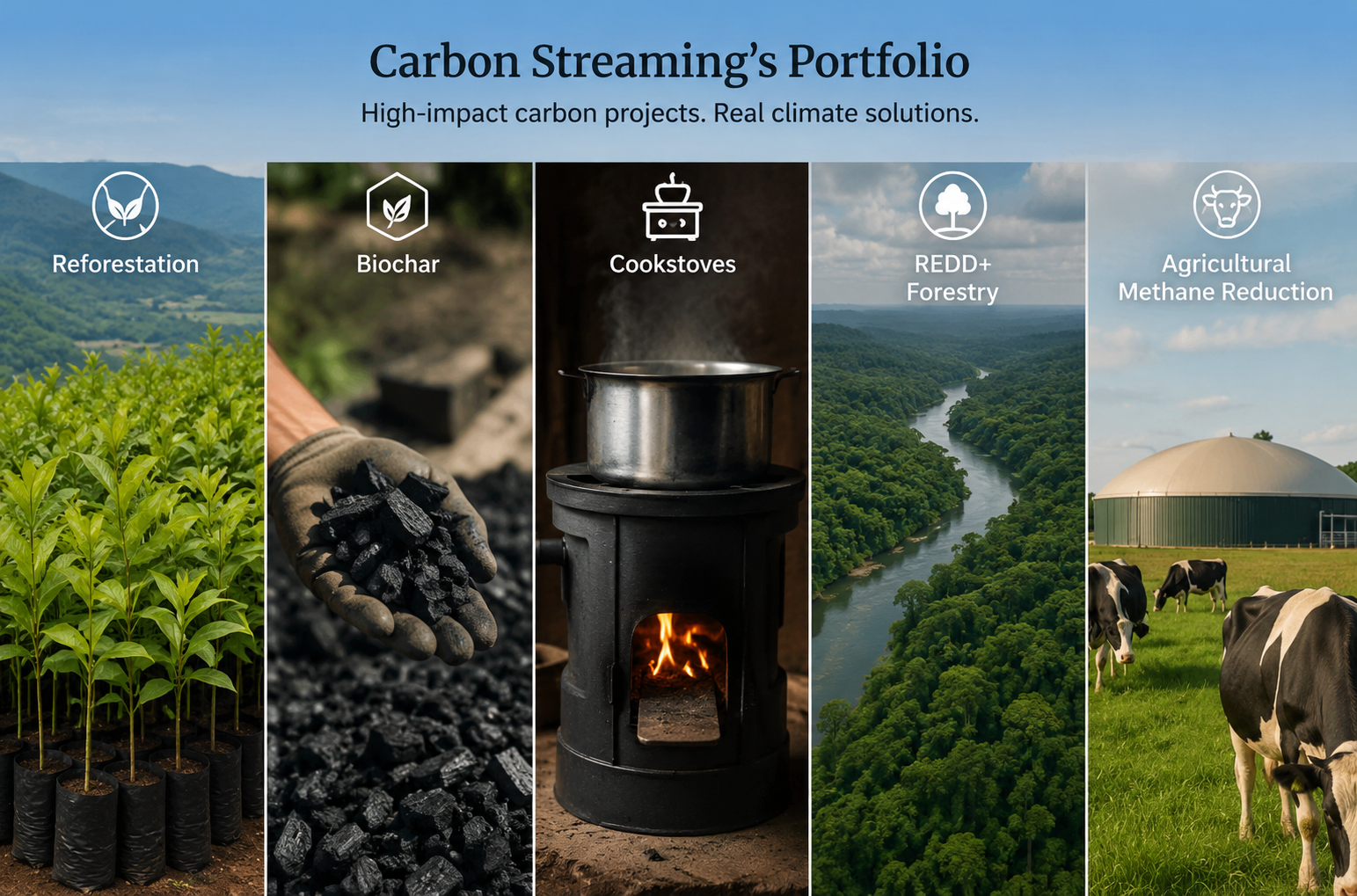
Carbon Streaming’s portfolio spans several credit types, including reforestation, biochar, cookstoves, REDD+ forestry, and agricultural methane reduction. This creates diversified exposure but also introduces different risk profiles. Biochar and other engineered removals are generally viewed as higher-integrity and more durable, while forestry, cookstove, and avoidance credits can face greater scrutiny around additionality, permanence, monitoring, and verification. The broader voluntary carbon market is increasingly rewarding credits with stronger evidence, traceability, and durability, while lower-quality or less transparent credits face pricing pressure.
For new investors, the key point is that not all carbon credits are equal. A reforestation credit, a biochar removal credit, a cookstove credit, and a REDD+ forestry credit can trade at very different prices because buyers evaluate permanence, scientific credibility, monitoring quality, and reputational risk differently. As a result, projected credit issuance does not automatically translate into realized revenue.
Carbon Category Positions
| Credit Category | Market Positioning | Pricing |
|---|---|---|
| Biochar / Engineered Removal | High-integrity durable removal | Premium pricing environment |
| ARR / Reforestation | Premium nature-based removal with biological risk | Mid-to-high pricing dispersion |
| REDD+ Forestry | Increasingly selective buyer scrutiny | Wide quality-based dispersion |
| Cookstoves | Lower-priced avoidance market | Sensitive to integrity perception |
| Rice Methane Reduction | Mid-tier agricultural avoidance | Moderate pricing variability |
Carbon Streaming’s recent investment case has shifted from growth-at-any-cost to restructuring, cash preservation, and portfolio monetization. The company reported $39.1 million in cash and no corporate debt at year-end 2025, reduced full-time salaried headcount from 24 at the start of 2024 to three by year-end 2025, and generated positive operating cash flow in Q3 and Q4 2025, largely supported by settlements and cost reductions.
Several corporate actions helped reduce perceived survival and dilution risk. The Rimba Raya/InfiniteEARTH settlement included cash proceeds and cancellation of 4,539,180 shares, while the Community Carbon buyout agreement, announced in March 2026, provided a potential USD $6 million monetization path for that stream and related inventory. The Azuero Reforestation amendment also improved downside protection by removing Carbon Streaming’s mandatory funding obligations while preserving optional participation rights.
These developments appear to have contributed to the stock’s rerating.
Still, the risk profile remains high. Carbon Streaming represents a leveraged bet on the maturation of higher-integrity voluntary carbon markets. Its balance sheet, debt-free position, and restructuring progress improve its survivability, but future upside depends on successful portfolio monetization, credible credit issuance, stronger buyer demand, and continued market preference for durable, verifiable carbon credits.
Passive Exposure to Carbon Markets
For readers looking to participate in carbon markets without directly assuming the project execution risk that Carbon Streaming Corp (and similar equities) face, exchange-traded funds (ETFs) and exchange-traded notes (ETNs) offer a more stable, diversified, and transparent entry point.
Most of these instruments track compliance carbon markets and offer indirect exposure to carbon pricing trends and policy developments, thus serving as a bridge for new or risk-averse investors. These instruments trade on major U.S. exchanges and offer direct pricing exposure to mature, regulated carbon markets. They moreover avoid project-specific execution risks.
However, they do not provide co-benefits or social impact exposure and may lack ESG “depth” compared to credits from nature-based or community projects.
| Ticker | Fund Name | Focus |
|---|---|---|
| KRBN | KraneShares Global Carbon ETF | Global carbon futures (EU, CA, RGGI) |
| KCCA | KraneShares California Carbon ETF | California Cap-and-Trade |
| KUEC | KraneShares European Carbon ETF | EU ETS futures |
| GRN | iPath Series B Carbon ETN | ICE EUA futures |
Regardless of market type, however, these investments lack the impact narrative and upside of early-stage projects, and they guarantee neither ethical nor emissions integrity. Put differently: carbon ETFs and ETNs are financial tools, not environmental solutions, thus demanding ongoing due diligence with a health mix of optimism and skepticism for all investors.
Could a Carbon Tax Reshape Market Risk?
Carbon markets are contrarian, with the present-day underscoring the ironies. Despite current macroeconomic conditions, ideological hostility, and investor malaise, a contrarian perspective emerges claiming that the present represents a prime opportunity to fast-track carbon markets into maturity.
How Would a Carbon Tax Affect the Economy?
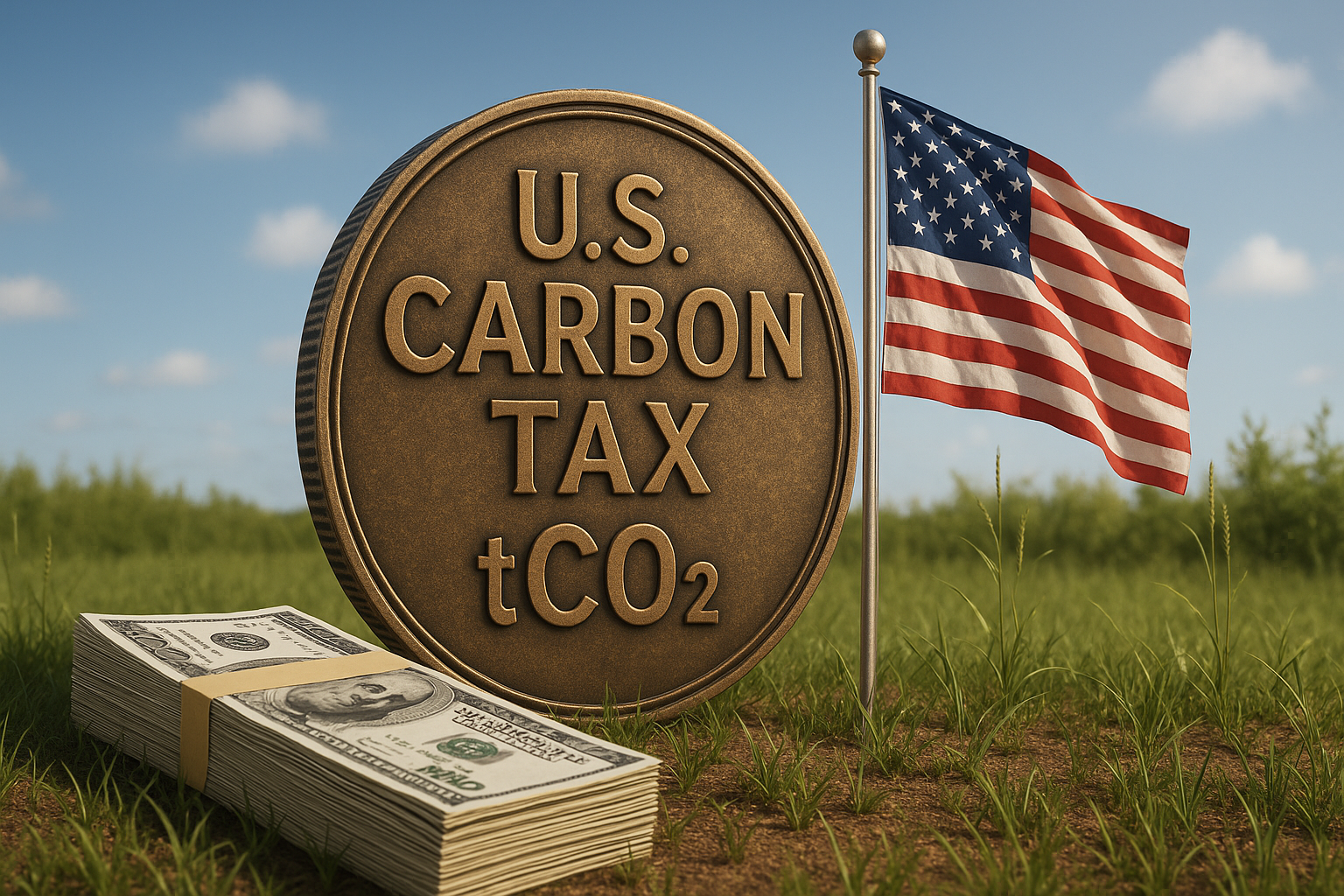
One of the least discussed but potentially most consequential macro catalysts for the carbon market is the growing conversation around a U.S. carbon tax. While largely absent from domestic legislation in recent years, a confluence of federal debt pressure, global competitiveness (and carbon market awareness), and corporate accountability is reopening the debate.
From a macroeconomic lens, a carbon tax could become not only an environmental necessity but also a fiscal one. With U.S. debt-to-GDP exceeding 124% in CY2024, an additional $1.5 trillion in additional debt YTD, and interest payments projected to surpass defense spending ($850 million) within a few years, political pressure is mounting to raise revenue without disrupting essential programs. A carbon tax is increasingly framed as both a climate policy tool and reframed as a revenue-generation mechanism. Injecting clout into the deliberations are representatives of a likewise contrarian sector: oil and gas.
For carbon markets—and especially voluntary market participants like Carbon Streaming Corp—a federal carbon tax could act as a pricing anchor, reducing uncertainty and improving long-term credit demand and rewarding verified carbon projects with real pricing power. It would not erase verification risk or project delays, but it could meaningfully improve buyer appetite, credit liquidity, and market structure.
How Is the US Pricing Carbon? | Harvard Kennedy School
But until such a tax is legislated, the voluntary carbon space remains exposed to wide pricing bands, low enforcement, and buyer skepticism, notably in regard to legitimizing permanence to actual offsets or reductions.
Final Thoughts
Carbon Streaming is not a simple “carbon credit growth stock” but is better understood as a speculative play tied to the future value of high-integrity carbon credits. New investors should focus on cash balance, burn rate, project delivery, monetization events, credit quality, and dilution risk before assigning value to long-term issuance projections.
Our take at TradersQue remains not anti-carbon, but rather pro-diligence.  Carbon Streaming (OTCQB: OFSTF) aims to accelerate a net-zero future. The company pioneered the use of streaming transactions, a proven and flexible funding model, to scale high-integrity carbon credit projects. Its focus is on projects that have a positive impact on the environment, local communities, and biodiversity, in addition to their carbon reduction or removal potential. This approach aligns strategic interests with those of project partners to create long-term relationships built on a shared commitment to sustainability and accountability and positions the company as a trusted source for buyers seeking high-quality carbon credits.
Investors Page – Carbon Streaming
Additional Coverage
Additional coverage can be found on the author’s X account.