



Why BRICS+ Consulting Group Is Right on Fertilizer Risk but Wrong on the Details
The central argument in BRICS+ Consulting Group’s August 2026 article Fertilizer, Not Oil, May Become the Next Strategic Battleground for the Global South is stronger than the evidence used to support it.
Fertilizer security belongs in the economic-security calculations of import-dependent states. Disruptions to production, shipping, or energy supply can raise farm costs and place pressure on food systems. The problem is not that the article identifies a false vulnerability. It is that the analysis treats distinct fertilizer markets as though they face the same risks, groups countries with very different exposures, and overlooks the largest geopolitical shock that had already occurred by publication: the disruption involving the Strait of Hormuz.

Fertilizer Markets Face Different Geopolitical Risks
The first problem is categorical. The article often begins with the economics of nitrogen fertilizer and ends with conclusions about fertilizer as a whole.
That approach is understandable because nitrogen has a direct link to energy markets. The International Energy Agency identifies ammonia as the starting point for mineral nitrogen fertilizers, with about 70% of ammonia used for fertilizer production. Just over 70% of ammonia production relies on steam reforming based on natural gas. Most of the remainder depends on coal gasification.
But this production chain does not describe the entire fertilizer market.
| Nutrient | Production | Main Channels | Strategic Significance |
|---|---|---|---|
| Nitrogen | Ammonia produced mainly from natural gas, with some coal | Gas, LNG, ammonia capacity, shipping | Most directly exposed to energy |
| Phosphate | Phosphate rock combined with sulphur and ammonia | Mining, processing inputs, exports | Gas matters indirectly |
| Potash | Mined potassium salts | Mining and concentrated exports | Far less dependent on gas |
“Fertilizer security” is therefore an umbrella category, not a single price or supply problem. The World Bank’s 2026 assessment reinforces this distinction. Potash markets were less exposed to Middle Eastern disruption than nitrogen and phosphate markets. Phosphate production, by contrast, remained sensitive to sulphur and ammonia supplies.
The distinction matters because the original article implies a fairly direct chain: geopolitical disruption affects gas, gas affects fertilizer, and fertilizer affects agriculture. That chain is persuasive for nitrogen. It is less complete for phosphate and much weaker for potash.
Mosaic (NYSE: MOS): A Fertilizer Cycle Reset in Motion? | TradersQue
The buffers also differ by market. Trade rerouting, inventories, alternative suppliers, new production capacity, and farmer substitution can absorb part of a shock. The World Bank expected fertilizer prices to ease in 2027 as exports recovered and new supply entered the market. It also warned that prolonged disruption to energy and shipping could keep risks elevated.
Strategic vulnerability, in other words, does not imply uniform scarcity.
Import Dependence Defines Fertilizer Security
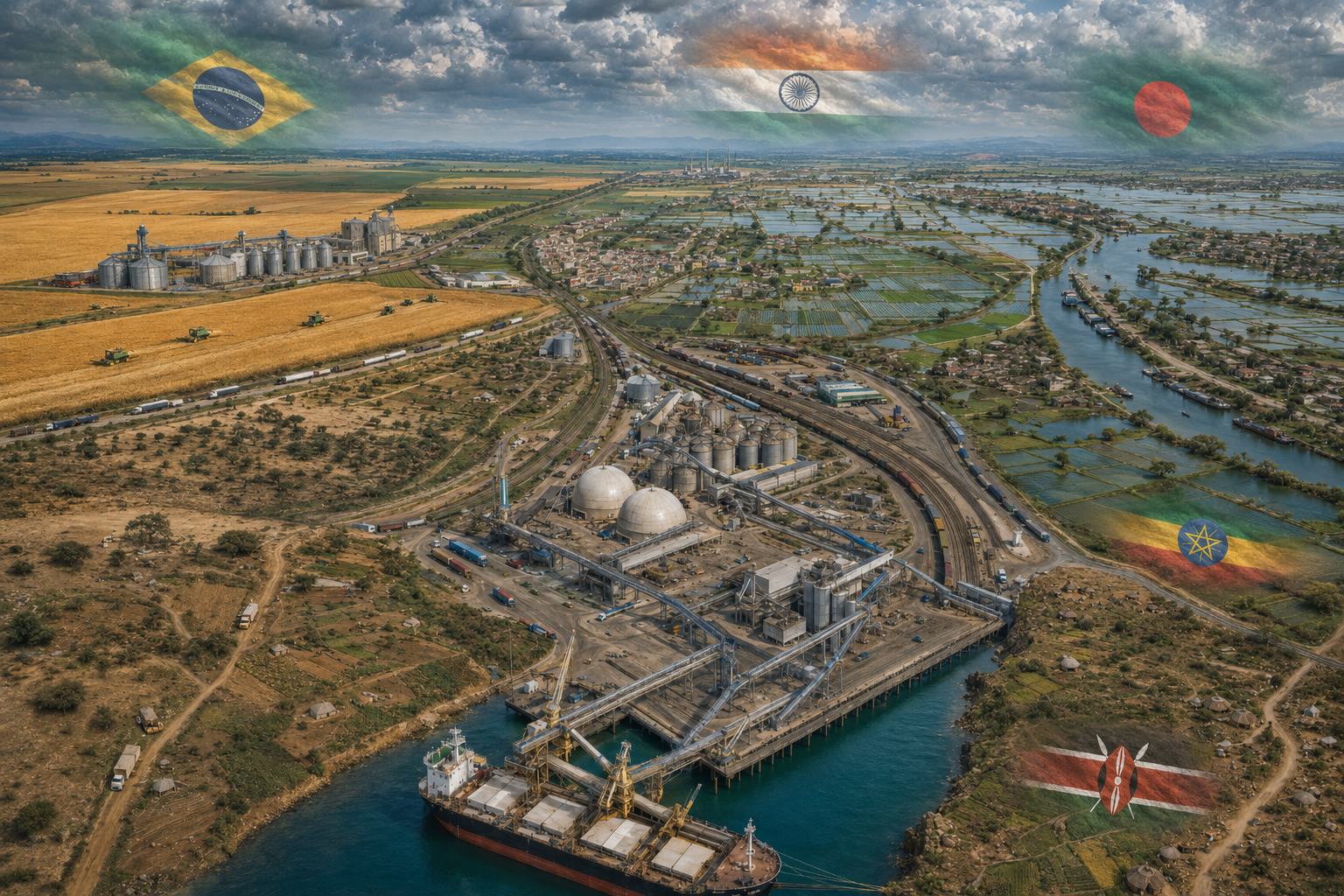
The second problem is geographical. Kenya, Ethiopia, Bangladesh, India, and Brazil may all face fertilizer insecurity, but they do not face it in the same way.
Exposure depends on more than whether a country imports fertilizer. Domestic production, nutrient requirements, supplier concentration, subsidies, transport systems, and local farm economics all shape the outcome. An external shock can become a problem for farmers, public finances, inflation, or all three. The transmission differs by country.
The available material points to sharply different profiles:
| Country/Region | Evidence | Countervailing Factor or Gap | Implication |
| India | Major nitrogen-fertilizer importer | Large domestic urea output and subsidies | Import reliance does not equal full price exposure |
| Brazil | Major agricultural producer with roughly 80–90% fertilizer import dependence | Exposure varies by nutrient and supplier | High dependence, partly moderated by capacity and diversification |
| Kenya and Ethiopia | Import dependence creates external exposure | Nutrient mix and supplier concentration remain unquantified | Country-level data are necessary |
| Bangladesh | External fertilizer and energy exposure | Domestic output, procurement, climate, and water also matter | Risk combines external and domestic constraints |
| Sub-Saharan Africa | Prices and infrastructure constrain fertilizer use | Soils, efficiency, and farming systems vary | More supply alone is insufficient |
Brazil shows why country-level evidence matters. The World Bank reported in March that Brazil imports about 80–90% of the fertilizer used by its agricultural sector. Global supply disruption and price volatility therefore have direct relevance to production costs. Once the scale of exposure is established, the geopolitical argument becomes more precise.
The African case shows the opposite danger: excessive aggregation.
FAO’s 2026 work on sub-Saharan Africa argues against a uniform fertilizer policy. Effective use depends on local soil conditions, farmer economics, credit, infrastructure, and agronomic practice. FAO reported average regional nitrogen use of about 13kg/hectare in 2022, roughly one-fifth of the global average. Yet it also stressed that simply increasing mineral fertilizer supply is not enough. Better soil management, infrastructure, and more efficient application also matter.
Soil Sovereignty: Terreplenish® and EasyFEN™ Empower Africa | TradersQue
That point introduces a countervailing mechanism largely absent from the BRICS+ article. Resilience can come from more domestic production and diversified imports. It can also come from using nutrients more efficiently. Strategic security is partly about tonnage. But it is also about how effectively each tonne translates into agricultural output.
The same discipline should apply to institutional claims. The proposition that the New Development Bank could finance agricultural infrastructure is plausible. But institutional capacity does not prove the existence of a dedicated BRICS fertilizer-security architecture. Potential financing and an established strategic program are different things, and the analysis should keep them separate.
The Strait of Hormuz Turned Risk into Reality
The most consequential omission is glaringly temporal.
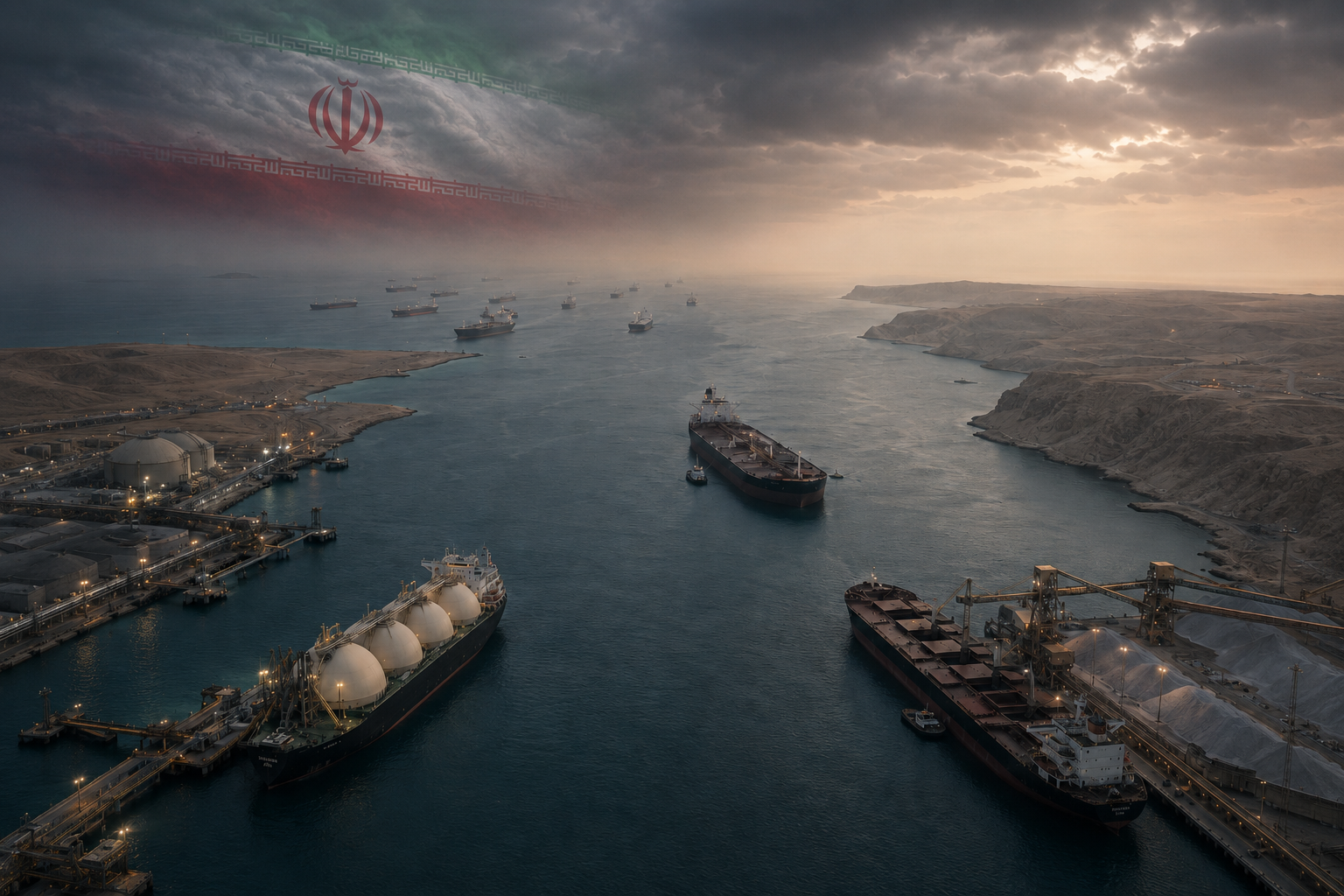
Published on August 3, 2026, the article avoids the very real-world geopolitical test it treats as a hypothetical. The Strait of Hormuz disruption did not merely threaten energy and fertilizer markets in theory. It affected them at the same time. The available evidence makes the chronology unusually clear:
| 2026 Evidence | What Occurred | What It Establishes |
| Fertilizer prices | Index up 12% in Q1; urea above $850/MT in April; about 80% above February | Rapid transmission into nitrogen prices |
| Regional Concentration | Middle East supplies nearly 25% of global urea exports | Hormuz intersects with concentrated supply |
| Maritime Flows | By June: crude -95%, LNG -99%, fertilizer -94% | One chokepoint disrupted energy and farm inputs |
| Fertilizer Cargo | 30% of fertilizer-related seaborne cargo crossed Hormuz before the conflict | Exposure was systemically significant |
| Post-ceasefire Recovery* | Crude partly resumed; LNG and fertilizer flows remained stalled | Recovery differed by commodity |
*Signals recovery upon the initial ceasefire announcement.
The price evidence comes from the World Bank. The shipping evidence comes from WTO vessel-tracking analysis, which also warns that AIS-based data can understate flows when vessels stop transmitting. That methodological limit matters when interpreting the figures.
The significance of Hormuz is not simply that it supports the article’s concern. The episode also makes the argument more precise.
The LAC-Panama Stalemate Continues | TradersQue
First, fertilizer risk can move through both production and shipping. Second, different nutrient markets respond differently to the same geopolitical shock. And third, oil and fertilizer are not strategic substitutes.
That final point weakens the premise implied by the article’s headline. Crude, LNG, and fertilizer-related trade contracted via the same maritime constraint. By June, WTO tracking described all three outbound categories as severely disrupted. Recovery after the June ceasefire agreement also proved uneven.
Fertilizer did not become strategically important because oil allegedly risks diminishing as the primary impacted commodity. It became strategically important because food production depends on the same network of energy supply, industrial inputs, transport routes, and concentrated trade flows. That is the stronger thesis.
Fertilizer security deserves greater weight in economic planning, but greater precision strengthens the case rather than narrowing it. Nitrogen, phosphate, and potash expose states to different production systems. Brazil, India, Bangladesh, Kenya, and Ethiopia occupy different positions within those systems. The 2026 Strait of Hormuz disruption then showed how concentrated commodity flows can transmit geopolitical instability into agricultural input markets.
Final Thoughts
The original article identifies the correct strategic concern, but it misses important features of the system around it.
A more precise conclusion follows. Fertilizer is unlikely to contend with oil as the defining commodity of geopolitical insecurity. Instead, fertilizer has become another critical channel through which energy disruption, trade concentration, and state capacity affect food-system resilience.
The 2026 evidence already supports that case. The original analysis should be equally precise.
Additional Coverage
Additional coverage is available on the author’s X platform, along with previous archives via TradersQue.com.