



Utilities Have Fuel Today, but Falling Contract Coverage After 2030 Could Change Who Holds the Bargaining Power
Uranium’s visible market and its physical market are sending different signals.
URA Stock Price | Global X Uranium ETF | Investing.com
Spot prices remain below earlier cycle highs, and many uranium equities have corrected sharply. Yet most reactor fuel is not bought in the spot market. Utilities secure much of their supply through long-term contracts, hold inventories that allow them to delay purchases, and plan fuel requirements years before delivery.
URNM Stock Price | Sprott Uranium Miners ETF I Investing.com
That structure helps explain the present lull. U.S. reactor operators reported about 360 million pounds U3O8e of maximum requirements for 2026 through 2035. Existing contracts covered about 174 million pounds, leaving roughly 186 million pounds unfilled. Near-term coverage remains strong, but the gap widens rapidly after 2030. The central issue is therefore whether enough commercially acceptable uranium can be financed, produced, processed, and delivered when utilities need it later in the decade and into the 2030s.
UEC’s Expanding Role Changes UROY’s Valuation | TradersQue
For investors, that distinction matters because equity valuations can respond quickly to weak spot prices even when the longer-dated procurement problem has changed little.
Spot Prices Don’t Tell the Whole Uranium Story
Uranium does not trade on a central exchange where most physical supply clears each day. Spot and term markets therefore answer different questions, while utility inventories and forward contract coverage shape how urgently buyers must act.
Four Uranium Signals, Four Different Questions
| Mechanism | What It Measures | What It Misses | Investor Relevance |
|---|---|---|---|
| Spot | Prompt availability and near-term willingness to transact | Long-dated coverage and private contract terms | Drives sentiment quickly but can overstate physical weakness |
| Term | Price and conditions required to commit future supply | Daily liquidity and short-term trading pressure | Better reflects future production economics |
| Utility Inventories | How long buyers can delay procurement | Whether later years are contractually covered | Explains why low urgency can coexist with firm demand |
| Forward Contract Book | Material already secured by delivery year | Whether suppliers will execute without delay | Shows when purchasing flexibility begins to narrow |
The distinction is material. Preliminary data shows U.S. civilian reactor operators bought 46.9 million pounds U3O8e in 2025, and 87 percent of those deliveries came through long-term contracts. Only 13 percent came through spot contracts.
The current price structure also shows the divergence. Cameco’s published industry series placed spot uranium at $86.38 per pound at the end of July 2026, while the long-term price stood at $95.50. Spot had exceeded $100 in January 2024 before falling into the mid-$60s in early 2025, while long-term pricing proved far more stable and later reached a new cycle high.
Why FERC’s Data Center Grid Plan Makes Sense | TradersQue
Spot prices prompt material. Term contracts price the value and risk of committing pounds years before delivery.
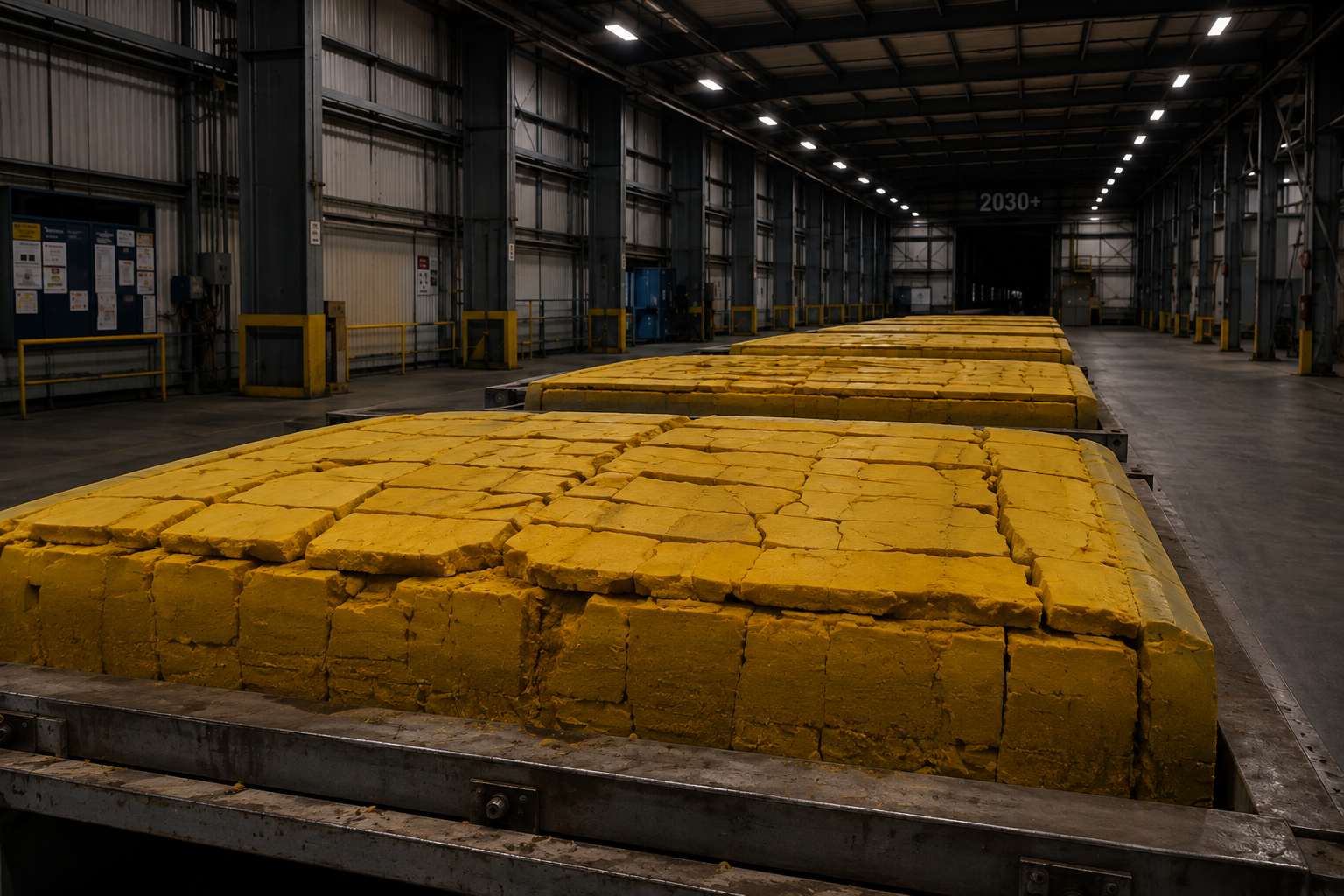
Utilities Can Wait Now, but Coverage Thins After 2030
Utilities can wait because they hold fuel. At the end of 2025, preliminary data shows U.S. reactor operators held about 118 million pounds U3O8e in commercial inventory. Other U.S. market participants held roughly 51 million pounds. Reactor-owner inventories alone were equal to about 2.9 times the 40.9 million pounds loaded into U.S. reactors during 2025.
NLR’s Nuclear Exposure Runs Deep | TradersQue
That stock gives buyers negotiating leverage. It allows utilities to defer discretionary purchases and seek better contract terms when spot prices weaken. But inventory and contract coverage solve different problems. Inventory supports near-term operations. Contracts secure specific future delivery years.
U.S. Contract Coverage Deteriorates post-2030
| Delivery | Max requirement (Mlb U3O8e) | Max contracted (Mlb) | Unfilled share |
| 2027 | 39.8 | 37.4 | 6% |
| 2030 | 30.0 | 17.9 | 40% |
| 2032 | 35.3 | 9.0 | 75% |
| 2034 | 39.5 | 2.2 | 94% |
Unfilled share is calculated from EIA maximum-requirement and maximum-contracted figures; percentages are rounded.
The important change is the speed at which coverage disappears. Near-term procurement remains manageable. After 2030, utilities lose part of their ability to wait as more requirements remain open. One utility can delay and gain bargaining power. Many utilities delaying together can later find themselves competing for the same delivery years.

Term Contracts Put a Price on Future Supply
A long-term uranium contract is more than a quantity multiplied by one fixed price. Contracts can use fixed prices, market-linked formulas, escalation clauses, floors, ceilings, or combinations of these terms. The structure determines how future price risk is divided between buyer and seller.
A producer expecting higher prices may resist committing too much future production at current levels. A utility may accept market exposure but seek a ceiling. The producer may accept that ceiling only with a floor or favorable escalation.
AI Data Centers Face Issues of Power and Policy | TradersQue
The key issue is therefore the value of commitment. Published term indicators do not capture every improvement in contract economics. Producers can secure stronger floors, better escalation, or more market participation even when the headline term price moves slowly.
Term pressure can also reach spot. Utilities may use spot purchases to fill gaps, while producers may buy prompt material when mine output or inventory does not fully cover delivery obligations. Cameco has disclosed future delivery commitments that can exceed attributable mine production in a given year, with inventories, joint-venture material, and market purchases helping bridge the difference. This is one reason a quiet spot market can reprice quickly. The trigger may be a change in how buyers and sellers judge future coverage rather than a sudden physical shortage.

Future Uranium Supply Depends on What Can Be Delivered
The relevant supply question is not how much uranium exists underground. It is how much can reach utilities on time. A deposit must be permitted, financed, built, and operated before it becomes supply. Production must then move through conversion, enrichment, and fabrication. Existing contracts, trade rules, logistics, and state-backed procurement can narrow the available pool further.
Why Headline Supply Can Overstate Deliverable Supply
| Limitation | What Headlines Mislead | Market Consequence | Investor Focus |
| Existing Contracts | Current output may already belong to long-term customers | Fewer uncommitted pounds remain | Uncommitted production, not total output |
| Project Execution | Permitting, financing, construction, and ramp-up can slip | New supply may arrive late | Schedule credibility and capital needs |
| Fuel-cycle Capacity | Uranium must be converted and enriched before use | Bottlenecks can pull procurement forward | Conversion and enrichment availability |
| Geographic Access | Trade rules, logistics, and state-backed buying limit usability | Global output can exceed contestable supply | Jurisdiction and customer access |
World Nuclear Association data place 2024 mine production at 60,213MT uranium, equivalent to about 156.5Mlb U3O8. Its 2025 reactor-requirement estimate was 68,920MT uranium, or about 179.2Mlb U3O8. Those figures refer to different years and should not be treated as a precise annual deficit. Inventories, secondary supply, underfeeding, re-enrichment, and other sources also bridge part of the difference.
The comparison still shows the scale of reactor demand relative to recent primary production. It also underscores why future supply increasingly depends on execution. World Nuclear Association listed 441 operable reactors and 79 under construction in August 2026. New units are only part of the demand picture; life extensions, uprates, and restarts can preserve or increase consumption at existing plants.
India’s Energy Push Continues Going Nuclear | TradersQue
Higher prices can improve project economics, but they cannot erase permitting delays, financing constraints, construction risk, or poor ramp-up performance. Time is the binding variable.

The Lull Creates Opportunity
The current cycle has already shown that spot can correct sharply without a comparable collapse in term pricing. Cameco’s industry series placed spot uranium at $100.25 per pound in January 2024, $64.23 in March 2025, and $86.38 in July 2026. Over the same broad period, the long-term price rose from $72 in January 2024 to $95.50 by June and July 2026. That does not make every correction a buying opportunity. It does show why spot weakness alone is a poor test of whether the larger cycle has ended.
The stronger test is whether the future procurement problem has become easier to solve. So far, public data do not show a broad improvement. U.S. contract coverage falls sharply after 2030, the long-term price remains above spot, and the global reactor fleet continues to expand. This creates a timing mismatch. Equities trade every day. Utility procurement runs across years. Mine development can take longer still. When spot weakens, investors can mark down producers and developers quickly even though their contract exposure, asset quality, and future supply value differ widely.
That can create mispricing, but not uniformly across the sector:
- For producers, the important traits include reliable operations, manageable costs, balance-sheet strength, and enough uncommitted future output to benefit from better contracts.
- For developers, the focus shifts to resource quality, permitting progress, capital intensity, infrastructure, financing options, jurisdiction, and the probability that production begins during the years when utility coverage is thinnest.
U.S. Miners Gain from Asia’s Nuclear Pivot | TradersQue
The bullish case can weaken. Major producers may add more uncommitted supply. Restarted mines may perform better than expected. New projects may enter production on time and at competitive costs. Utilities may keep drawing inventories rather than rebuilding them, while reactor requirements may grow more slowly than expected. The emphasis is therefore not on that supply cannot grow. It is that supply growth may not match the timing of future utility needs. If equity valuations decline before that forward imbalance improves, selective buying opportunities can emerge.
Final Thoughts
The uranium market cannot be understood through spot alone. Spot shows the value of prompt material. Term contracts show the price and conditions required to commit future supply. Inventories show how long utilities can wait. The forward book shows when that waiting becomes harder.
Near-term supply remains cushioned by inventories and existing contracts. Farther out, about 186 million pounds of maximum U.S. requirements for 2026 through 2035 remained unfilled at the end of 2025, with published coverage falling rapidly after 2030. At the same time, the long-term uranium price remains above spot, new mines still require years of execution, and the reactor fleet continues to expand.
Rare Earth & Critical Minerals Stocks in Focus | TradersQue
None of this proves that uranium equities have reached a bottom. It supports a narrower conclusion: weak spot sentiment can coexist with a firm long-term fuel problem, and that divergence can create selective investment opportunities.
Additional Coverage
Additional coverage can be found on the author’s X platform in addition to previous archives via TradersQue.com.