



Serve Robotics (NASDAQ: SERV): Physical AI Platform or Overvalued Delivery Robot Company?
Serve Robotics has rapidly evolved from a niche autonomous delivery startup into one of the most closely watched Physical AI companies in public markets. Operating across 44 cities in 14 states, the company has expanded beyond simple sidewalk food delivery and is increasingly positioning itself as a broader autonomous systems platform with ambitions spanning logistics, healthcare robotics, and other real-world service applications.
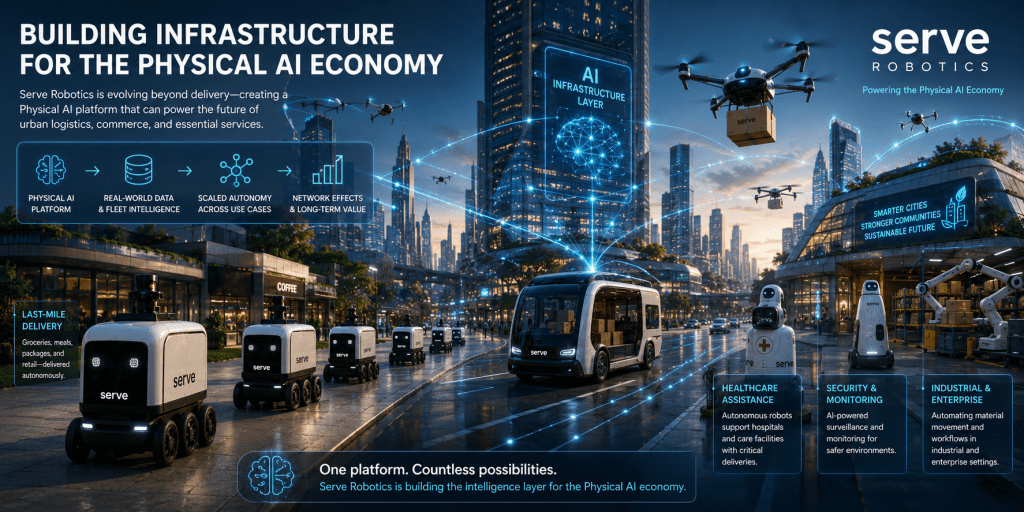
While skeptics focus on limited revenue, ongoing operating losses, and a valuation that appears disconnected from traditional financial metrics, supporters argue that the company is building something far larger than a delivery business. The bull thesis increasingly revolves around autonomous infrastructure, fleet intelligence, machine learning, and the accumulation of real-world operational data. As deployment activity accelerates and strategic partnerships deepen, investors are beginning to evaluate Serve not as a delivery company, but as a potential platform for the emerging Physical AI economy.
Serve Robotics Inc Stock Price Today | NASDAQ: SERV Live – Investing.com
 From Postmates Experiment to Public Robotics Company
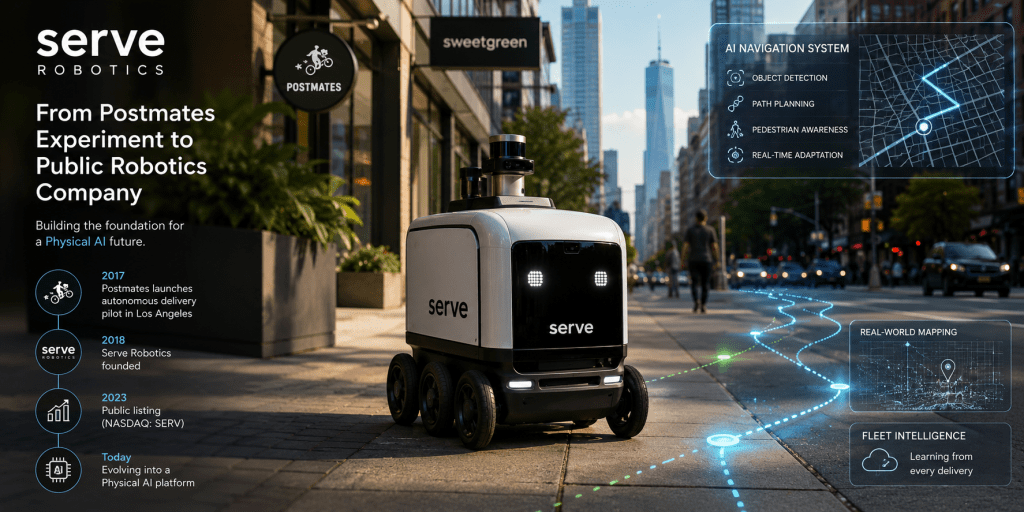
Most investors first encountered Serve Robotics as a delivery robot company, but the firm’s origins tell a much larger story. The technology was initially developed inside Postmates, where management sought ways to reduce the high costs associated with traditional last-mile delivery. Autonomous sidewalk robots represented an opportunity to lower delivery expenses while improving efficiency in dense urban environments.
Following Uber’s acquisition of Postmates in 2020, the robotics division eventually emerged as an independent company focused entirely on autonomous mobility and delivery solutions. Since becoming a publicly traded company, Serve has steadily expanded its vision beyond food delivery. Today, management increasingly discusses autonomous systems, AI-driven logistics, fleet intelligence, and robotics infrastructure rather than simply replacing human couriers.
This evolution is important because investors often value logistics companies differently than technology platforms. Much of the current investment debate centers on whether Serve should be viewed as a delivery operator or as a foundational Physical AI company.
 Scale Is Beginning to Show Up in the Numbers
One of the strongest developments supporting the bull thesis is the pace of operational expansion. While revenue remains relatively modest, deployment metrics have grown dramatically over the past year. The company now operates across 44 cities in 14 states, creating one of the largest autonomous sidewalk delivery footprints in the United States. More importantly, utilization appears to be accelerating alongside deployment growth.

These figures suggest that Serve is progressing beyond pilot-stage deployments and into broader commercial operations. Average daily active robots increased more than elevenfold year-over-year, while daily supply hours expanded nearly sixteenfold. Those numbers indicate not only a larger fleet but also greater utilization of deployed assets. For investors evaluating robotics businesses, utilization often matters more than robot count alone. A growing fleet is useful, but a growing fleet that is increasingly active is far more meaningful.
Valuation Remains the Central Debate
Despite the impressive operational growth, valuation remains one of the most controversial aspects of the SERV investment case.
Traditional metrics paint a difficult picture. Current revenue remains relatively small compared to the company’s market capitalization, creating valuation multiples that appear expensive compared to most logistics or transportation companies. Investors focused on conventional price-to-sales ratios often conclude that the stock is pricing in years of future success that have yet to materialize.
However, supporters argue that comparing Serve to traditional delivery businesses misses the point entirely. They view the company as an emerging Physical AI platform whose future value may depend more on deployment scale, software capabilities, and data accumulation than current revenue generation.
The market appears to be pricing in substantial growth across several areas, including robot deployments, revenue per robot, geographic expansion, and broader adoption of autonomous delivery technology. Whether those expectations prove realistic will likely determine the stock’s long-term performance.
Why the Balance Sheet Matters More Than Profitability
For an early-stage robotics company, cash is often more important than earnings.
Developing autonomous systems requires significant investments in software, hardware, manufacturing partnerships, regulatory compliance, and deployment infrastructure. Many promising robotics companies have failed not because the technology was inadequate, but because they ran out of capital before reaching scale.
Serve’s liquidity position provides management with valuable time to execute its strategy. The company’s cash reserves reduce immediate financing pressure, support continued expansion efforts, and help limit near-term dilution risk for shareholders.
In emerging industries such as Physical AI, time can be a competitive advantage. The longer a company can continue refining its technology and expanding its network without returning to capital markets, the greater its chances of achieving meaningful scale.
 Strategic Partnerships Continue to Strengthen the Investment Thesis
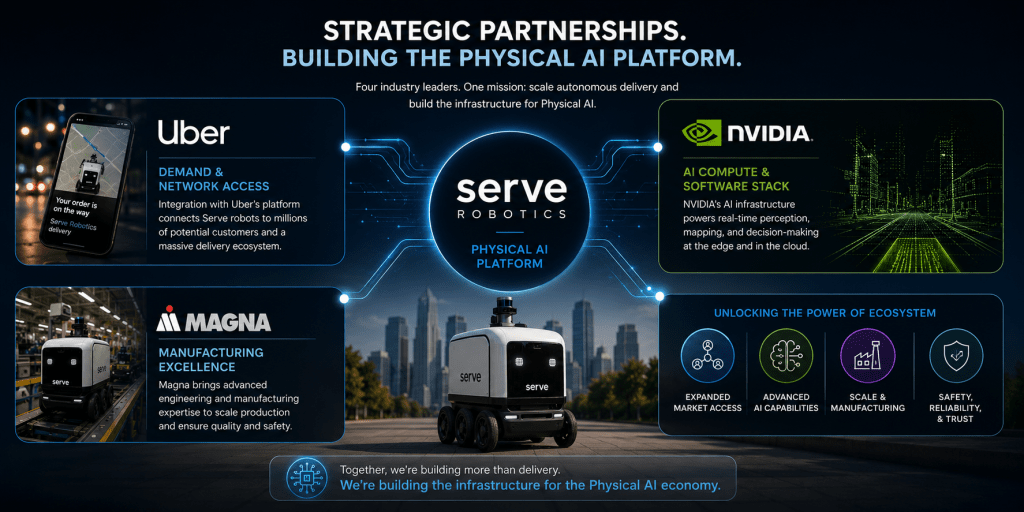
One reason Serve attracts attention from investors is the quality of its strategic relationships.
Uber remains one of the company’s most important partners. Beyond its historical connection through Postmates, Uber provides access to one of the world’s largest delivery ecosystems. This relationship offers both credibility and a potential pathway toward large-scale deployment.
NVIDIA represents another significant endorsement. As the dominant provider of AI computing infrastructure, NVIDIA’s involvement is often viewed as validation that Serve operates within a category possessing meaningful long-term potential. NVIDIA technologies support many of the advanced perception, navigation, and computer vision capabilities required for autonomous operation.
Meanwhile, Magna International helps address one of the most common challenges facing robotics startups: manufacturing scale. While many companies successfully develop prototypes, relatively few manage to transition efficiently into mass production. Magna’s expertise could prove critical as deployment volumes increase.
Taken together, these partnerships provide more than capital or technology. They provide validation.
Demand Partnerships May Be Just as Important as Technology
Autonomous robots have little value without orders to fulfill.
This is where Serve’s commercial ecosystem becomes particularly important. Partnerships with Uber Eats, DoorDash, 7-Eleven, Shake Shack, and other merchants provide the demand necessary to keep robots active and productive.
As the company expands into new markets, these relationships help create utilization opportunities that improve overall fleet economics. They also reduce dependence on any single customer or platform.
The long-term winners in autonomous logistics may not necessarily be the companies with the best technology. Instead, they may be the companies that successfully combine technology with sustained demand generation. Serve appears focused on building both sides of that equation simultaneously.
 Is Serve Becoming a Broader Robotics Platform?
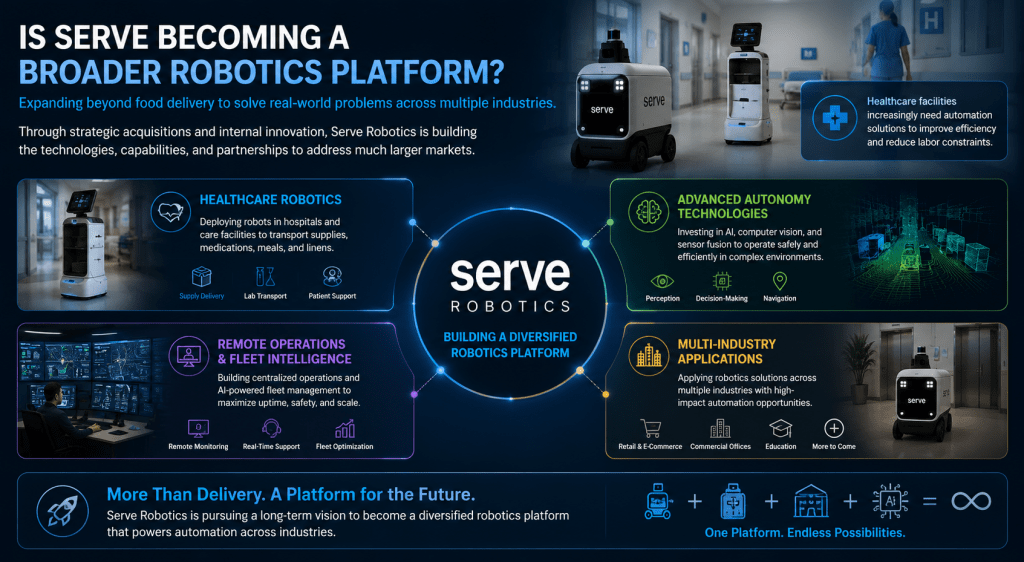
Perhaps the most interesting development in recent years has been the company’s efforts to expand beyond food delivery.
Through acquisitions and strategic initiatives involving healthcare robotics, remote operations, and advanced autonomy technologies, Serve is gradually broadening its addressable market. The company’s growing involvement in healthcare robotics is particularly noteworthy, as hospitals and healthcare facilities increasingly seek automation solutions to improve efficiency and reduce labor constraints.
These initiatives suggest management may be pursuing a much larger vision than autonomous food delivery alone. If successful, Serve could eventually evolve into a diversified robotics platform serving multiple industries.
The Most Important Metric Investors Should Watch
Many investors focus heavily on quarterly revenue reports. For a company like Serve, that may be the wrong approach.
The most important metrics may be robot economics.
Based on current estimates, the company generates approximately $13,000 in annual revenue per deployed robot. While that figure alone provides limited insight, its direction over time may reveal far more about the business than revenue growth alone.
If revenue per robot rises, utilization improves, and contribution margins strengthen, the path toward long-term profitability becomes significantly more credible. If those metrics stagnate, concerns regarding scalability will likely intensify.
For now, investors should pay close attention to active robot counts, deliveries per robot, revenue per robot, gross profit per robot, and daily supply hours. These indicators may provide the clearest window into whether the company’s business model is improving.
The Physical AI Data Moat Thesis
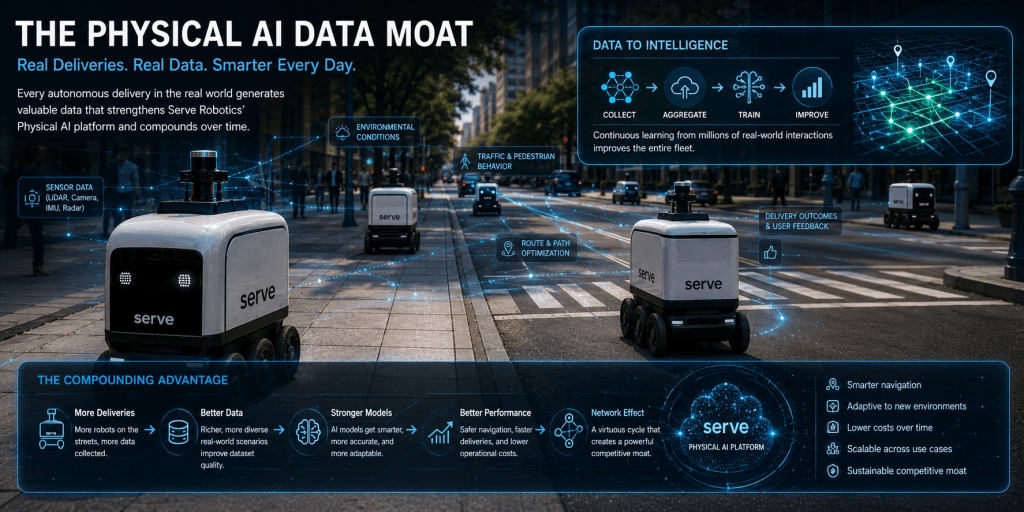
The strongest argument supporting premium valuations in robotics centers on data.
Every robot deployed by Serve generates real-world operational information. Each delivery creates new insights related to navigation, route optimization, traffic patterns, environmental conditions, customer behavior, and fleet management.
Unlike digital AI companies that can train models using internet-scale datasets, Physical AI companies must collect information through real-world interactions. This makes deployment scale incredibly important.
With operations spanning 44 cities, 14 states, and hundreds of active robots operating daily, Serve is accumulating one of the largest autonomous sidewalk delivery datasets in the industry. If that data improves AI performance over time, it could create a self-reinforcing competitive advantage where more deployments generate better data, better data improves performance, and improved performance drives further deployment growth.
Bull Case, Bear Case, and Base Case Outlook
The bull case envisions a future where Serve scales its fleet from thousands of robots to tens of thousands. Utilization improves, revenue per robot increases, margins expand, and autonomous delivery becomes a mainstream logistics solution. Under this scenario, investors may eventually view the company as a Physical AI infrastructure platform rather than a delivery business, potentially supporting a significantly higher valuation.
The bear case remains straightforward. Deployment growth could slow, unit economics may fail to improve, competition could intensify, and regulatory challenges could emerge. If scale fails to materialize, the market may eventually reprice the stock based on current fundamentals rather than future potential.
The most likely outcome may lie somewhere in between. A base-case scenario assumes steady deployment growth, improving utilization, gradual margin expansion, controlled cash burn, and continued partnership development. While this path may not produce explosive returns immediately, it could still support meaningful long-term value creation.
 Final Thoughts
Serve Robotics remains one of the most fascinating companies operating at the intersection of robotics, artificial intelligence, and autonomous logistics. The company now operates across 44 cities in 14 states, has increased average daily active robots from 73 to 812 year-over-year, and continues expanding relationships with some of the most influential names in technology and delivery.
The bear argument is easy to understand. Revenue remains small relative to valuation, profitability is still distant, and investors are being asked to place considerable faith in future execution.
The bull argument, however, is becoming increasingly compelling. As deployment density increases and fleet utilization improves, Serve is accumulating something that may ultimately prove more valuable than short-term revenue: real-world autonomous operating data. If Physical AI becomes one of the defining technology trends of the next decade, companies capable of collecting, learning from, and monetizing that data at scale could become far more valuable than traditional valuation models currently suggest.
The question investors must answer is no longer whether Serve can deliver food autonomously. The real question is whether the company is quietly building the operating system for autonomous last-mile logistics—and perhaps the broader Physical AI economy itself.