



Brazil’s Ethanol Tariff Gives the U.S. Valid Grievance But Not a Risk-Free Strategy
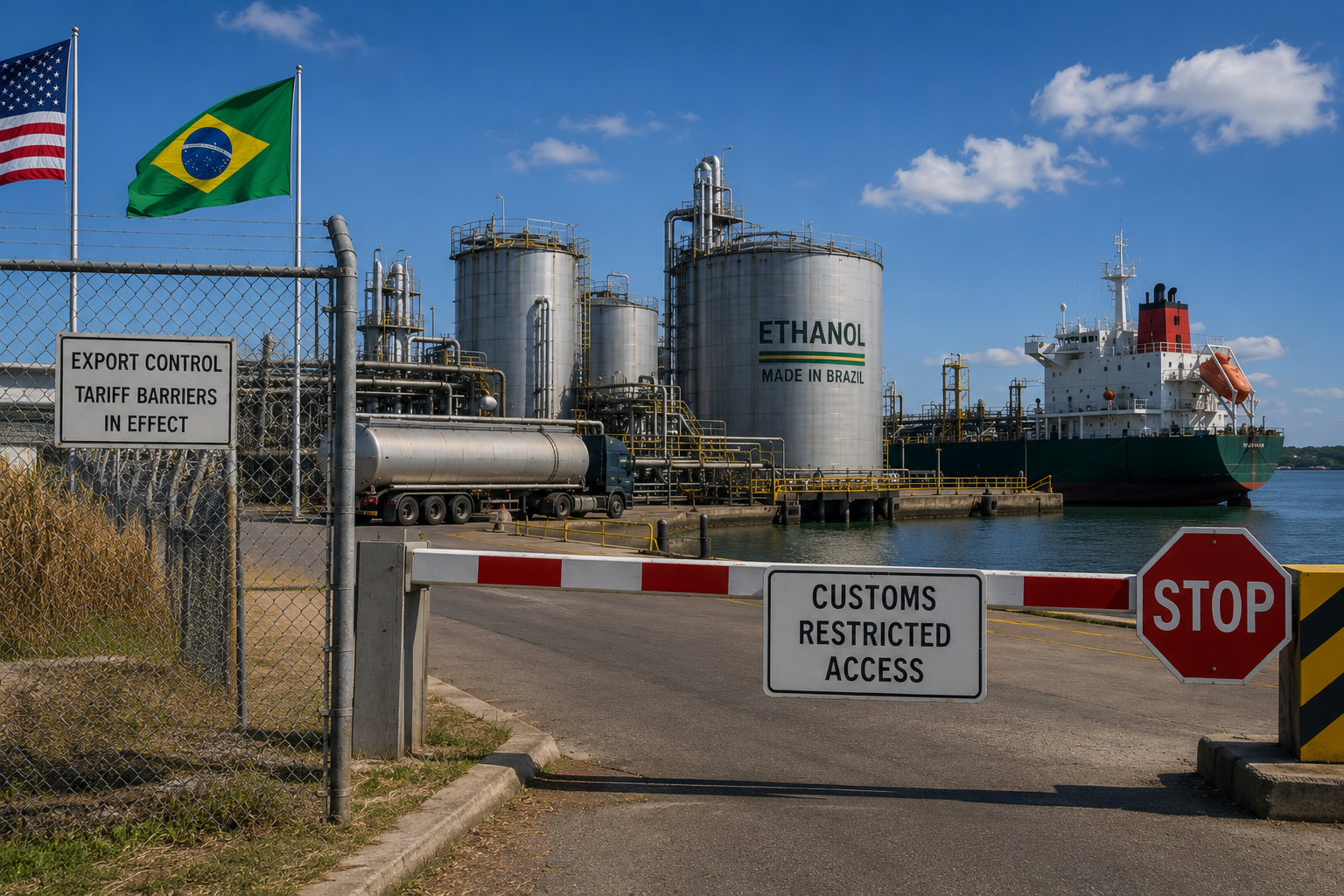
Brazil’s 18 percent tariff on imported ethanol indeed caused measurable damage to U.S. exporters. It helped close a market that once ranked among the largest destinations for American ethanol.
Yet the loss does not, by itself, explain a 25 percent U.S. reciprocal tariff on a broad range of Brazilian goods.
The Trump administration’s action makes more sense as a wider pressure campaign. Ethanol provides a documented agricultural grievance, but the U.S. case also covers digital trade, payment systems, intellectual property, preferential tariffs, anti-corruption enforcement, and deforestation. Washington is using one tariff instrument to pursue several commercial concessions.
That strategy may create leverage. It may also impose costs that exceed the value of the ethanol market the United States hopes to recover.
The Ethanol Complaint Has Substance
Brazil suspended its ethanol import tariff in 2022, restored it at 16 percent in 2023, and raised it to 18 percent in 2024. U.S. exports to Brazil fell sharply after the return of those barriers.
The sequence supports the U.S. argument that the tariff restricted market access. Brazil is a major ethanol consumer, and U.S. producers can supply parts of the country when Brazilian output, logistics, or crop conditions tighten. The tariff raises the landed cost of American ethanol and protects Brazilian producers from foreign competition.
Brazil-U.S. Soybean Clues Weather the Headlines | TradersQue
The dispute was already moving toward formal action in 2025. In August of that year, the National Corn Growers Association and the Renewable Fuels Association had urged USTR to act through its newly opened Section 301 investigation. The groups argued that Brazil’s 18 percent duty had “essentially closed the market” while Brazilian ethanol entered the United States under a much lower 2.5 percent duty. That article foreshadowed both the present U.S. grievance and the policy route later used to impose tariffs.
The complaint therefore contains a clear reciprocity issue. Brazilian ethanol received more favorable tariff treatment in the United States than U.S. ethanol received in Brazil. Washington can point to a measurable policy difference rather than rely only on broad claims about fairness.
Still, the injury has limits. U.S. ethanol producers found other foreign buyers after Brazilian demand declined. Brazil’s tariff damaged a valuable bilateral outlet, but it did not place the wider U.S. ethanol industry in crisis.
The dispute is important enough to justify sustained negotiation and proportionate trade action. But it is not large enough to justify every possible form of retaliation.

Washington Sees More Than Ethanol
The current tariff followed a formal Section 301 investigation, not a sudden response to one Brazilian decision. That process gave the administration a domestic legal basis to classify several Brazilian policies as unreasonable or discriminatory and burdensome to U.S. commerce.
The word “unfair” does not require proof that Brazil violated international law. Section 301 permits USTR to act against a foreign policy it considers unreasonable even without a World Trade Organization ruling against that policy.
The 45Z & Farm-to-Fly Folly: A Betrayal to U.S. Agriculture | TradersQue
This legal structure gives Washington room to combine several disputes. Brazil has expanded its role in BRICS, strengthened commercial ties with China, increased its influence in global agriculture, and adopted policies affecting U.S. technology and payment companies. These developments do not prove that another state prompted the tariff. They do explain why the administration may view Brazil as a broader commercial and strategic concern.
Mexico and India also appear in the U.S. complaint because Brazil grants them preferential tariff treatment in some sectors. Yet the United States uses comparable preferences through its own trade agreements. The dispute is not about whether governments favor selected partners. It is about which countries receive those advantages and which exporters bear the cost.
The Potential Reward
The clearest reward would be a reduction or removal of Brazil’s ethanol tariff. That could restore access to a large fuel market and give U.S. producers another outlet when domestic demand weakens.
A successful tariff campaign might also produce concessions involving digital services, payment platforms, intellectual property, or other market-access rules. The administration also gains a domestic political benefit by showing support for corn growers and ethanol producers facing weak margins and high costs.
The action sends a message beyond Brazil. It tells other trading partners that policies considered lawful under international rules may still face U.S. retaliation if Washington decides that they place a heavy burden on American commerce.

The Larger Risk
The strategy depends on Brazil deciding that compromise costs less than resistance. That outcome is uncertain.
Brazil has repeatedly defended its ethanol policy and has a large domestic industry to protect. It could respond with tariffs, regulation, or pressure on U.S. intellectual property. Agricultural patents, pharmaceutical rights, seed technologies, and digital companies have appeared as possible areas of retaliation, although Brazil has not publicly selected a company or patent portfolio.
The API-Biofuels Alliance is Built to Expire | TradersQue
U.S. agribusinesses such as Corteva and FMC would be plausible points of exposure because they combine American ownership, Brazilian operations, and patent-dependent products. A conflict intended to assist U.S. farmers could therefore reach U.S. seed, biotechnology, and crop-protection interests.
The tariff may also raise costs for U.S. companies that depend on Brazilian goods. Exemptions can reduce that damage, but they may also weaken the pressure on Brazil by protecting influential exporters. Washington faces a difficult balance: a narrow tariff may cause too little pressure, while a broad tariff may cause excessive disruption.
There is also a longer-term strategic cost. If Brazil views the United States as an unreliable market, it may deepen trade and investment ties with China, India, the European Union, and other partners. Those shifts could influence commodity flows, technology agreements, and supply chains long after the tariff dispute ends.
What the Ethanol Dispute Could Trigger
The dispute now depends less on whether the U.S. complaint is valid and more on whether the tariff can force a limited concession from Brazil before retaliation cuts into the tariff’s value.
| Risk | Implication | Outcome |
|---|---|---|
| Market Size | Brazil matters more as a major backup market than as a threat to the survival of U.S. ethanol. | Washington may settle for a tariff-rate quota or partial reopening. |
| Tariff Scope | Broad duties create leverage, but exemptions protect some of Brazil’s strongest exporters. | Pressure may be enough to start talks, but not enough to force a quick reversal. |
| Brazilian Resistance | Brazil can shift some trade toward China, India, and other partners, though not without cost. | Brasília may delay, negotiate, and retaliate in narrow areas rather than escalate at once. |
| U.S. Agribusiness Risks | U.S. seed, chemical, drug, and technology companies have valuable rights and operations in Brazil. | Brazil may threaten patent, licensing, or regulatory action before taking harsher steps. |
| U.S. Policy | Corn and ethanol groups pressed for action and reward visible enforcement. | The tariff may remain longer than its commercial value alone would justify. |
| Settlement Scenarios | Both governments need a result they can present as a gain. | A deal could pair limited ethanol access with concessions in other sectors. |
| Wider Costs | Prolonged pressure may push Brazil toward non-U.S. trade and investment ties. | Even a later settlement may leave lasting changes in supply chains and alliances. |
| Test of success | Tariff revenue and lower imports do not prove leverage worked. | The policy succeeds only if Brazil changes market access or another contested rule. |
The clearest sign of progress would be a tariff-rate quota, temporary suspension, product exemption, or formal review. Without a dignified and measurable concession, the tariff would remain politically volatile but commercially ineffective.

For Investors
The relevant equity risk does not depend on Brazil formally cancelling a patent. Licensing delays, weaker enforcement, regulatory friction, or threats of compulsory access could affect earnings expectations before any final measure takes effect. Investors should therefore track Brazilian policy notices and company disclosures rather than assume that tariff headlines alone will determine the market response.
Corteva Inc Stock Price | Investing.com
TradersQue presently neither provides coverage of nor consults in the following U.S. equities. Corteva and FMC nevertheless represent the clearest listed U.S. agribusiness exposures because both sell patent- or technology-dependent products in Brazil. Neither company has been named as a target by Brazilian authorities.
| Company | Brazil Exposure | Risks | Recent price* |
|---|---|---|---|
| Corteva ($CTVA) | Sells seeds, traits, seed treatments, and crop-protection products in Brazil. Its exposure spans intellectual property, licensing, registration, and local sales. | The main risk is not lost ethanol trade but pressure on trait royalties, seed technology, product approvals, or patent enforcement. Its broad portfolio may soften a narrow action but increases the number of possible pressure points. | $88.78 |
| FMC ($FMC) | Operates in Brazilian crop protection, biologicals, and proprietary pest-control technologies. It also maintains research capacity and product registrations in the country. | FMC may face greater sensitivity to product-level disruption because its Brazil exposure is more concentrated in patented chemicals, formulations, and newer technologies. Regulatory delay could matter even without patent suspension. | $11.69 |
*Prices reflect the latest available U.S. market data from July 23, 2026. They are included for context, not as a valuation or trading recommendation.
FMC Stock Price | Investing.com
The main signal for investors would be a shift from general retaliation language to named patent classes, registration reviews, compulsory licenses, or enforcement changes. Until then, the exposure remains plausible rather than confirmed. Corteva offers the broader set of possible pressure points, while FMC may carry greater company-specific sensitivity if Brazil targets proprietary crop-protection products.
Final Thoughts
Brazil’s ethanol tariff gives the United States a credible grievance. It restricted access to a major market, protected Brazilian producers, and created a marked difference in bilateral tariff treatment. The 2025 industry campaign documented by Ethanol Producer Magazine also shows that the current action followed months of organized pressure and formal legal preparation rather than an improvised complaint.
The U.S. response nevertheless reaches far beyond ethanol. Its success will depend on whether it secures defined concessions before retaliation and uncertainty impose larger costs.
The reward could include renewed ethanol access and leverage across several trade disputes. The risk is that Washington turns a defensible market-access complaint into a wider confrontation that harms U.S. businesses, raises domestic costs, and pushes Brazil closer to other commercial partners.
The practical measure of success is whether Brazil changes policy. Without a concrete concession, the tariff will have imposed pressure without securing a proportionate return.
Additional Coverage
Additional coverage can be found on the author’s X platform in addition to previous archives via TradersQue.com.