



BioLargo Broadens Commercial Reach as Execution and Funding Remain Central
Since TradersQue’s August 2026 update, BioLargo (OTCQX: BLGO) has added several developments that improve visibility into both its commercial progress and financial constraints. The company has expanded Clyra Medical’s access to U.S. government healthcare procurement, formed a new Indigenous-led water-treatment venture in Canada (Tu Nipi), disclosed additional long-duration operating data from the Lake Stockholm Aqueous Electrostatic Concentrator, or AEC, installation, and reported second-quarter results that quantify the scale of its post-Pooph revenue base and continuing capital requirements.
BioLargo Inc | OTCQX: BLGO | Investing.com
The latest disclosures do not fundamentally recast the company’s investment case, but they make it more concrete. BioLargo now has more operating evidence behind AEC, a broader commercial pathway for ViaCLYR™, a defined October target for its consumer-products relaunch, and a new industrial-water initiative in Alberta. At the same time, several of the company’s larger opportunities remain in the transition from technical or distribution progress to recurring revenue. The June balance sheet also shows that this transition is occurring while BioLargo continues to consume capital.
The table below captures the principal developments since the August cutoff and the commercial evidence that remains incomplete.
| Business Area | Post-August Development | Current Significance | Still Missing |
|---|---|---|---|
| Lake Stockholm AEC | More than 10,000 operating hours reported | Strengthens evidence of long-duration reliability | Full lifecycle-cost and maintenance data |
| Clyra / ViaCLYR™ | Spartan reseller agreement and DLA ECAT access | Opens a U.S. government healthcare procurement channel | Recurring order volume and material revenue |
| Tu Nipi Water Solutions | New Canadian venture with C$4.6M grant-supported project | Extends water-treatment activity into industrial applications | Commercial-scale contract and revenue evidence |
| Aquatech | Alliance remains active | Preserves access to larger project opportunities | Binding deployment tied to the relationship |
| BioLargo CPG | October launch target reiterated | Advances direct consumer relaunch | Confirmed launch and early sales performance |
| BLEST | $1.888M first-half external revenue | Continues to provide operating revenue and engineering support | New large external contract |
| Cellinity | Partner and financing discussions continue | Maintains long-term strategic optionality | Financing, factory, licensing, or offtake agreement |
These developments show that BioLargo is building more commercial infrastructure across its portfolio, but most of the next-stage proof points remain financial rather than technical.
Q2 Results Clarify the Post-Pooph Revenue Base
BioLargo reported second-quarter revenue of approximately $1.248 million, up 12% from $1.115 million in the first quarter but down 55% from $2.777 million a year earlier. The year-over-year decline reflects the disappearance of Pooph-related revenue from the current comparison. Excluding Pooph, management said first-half 2026 revenue increased approximately 26%, from about $1.874 million to $2.363 million. Second-quarter gross margin reached 54%.
BioLargo Gains Commercial Ground Across Divisions | TradersQue
The underlying businesses therefore appear to have expanded from a lower base, although the consolidated financial position remains constrained. At June 30, BioLargo reported approximately $2.188 million in cash, $3.499 million in current assets, and $4.765 million in current liabilities, producing a working-capital deficit of about $1.266 million. Operating cash use for the first half reached approximately $5.973 million, while the six-month net loss was approximately $7.405 million. Management also stated that expected 2026 gross profit would not be sufficient to fund the remainder of operating costs and that additional investment capital would be required.
The financing structure is also worth noting. Management said 86% of first-half capital raised came through subsidiaries rather than sales of BioLargo common stock. That may reduce direct parent-level dilution, but it does not remove the broader funding requirement. The company still needs either stronger operating cash generation, additional capital, or both.
Clyra Gains U.S. Government Trust
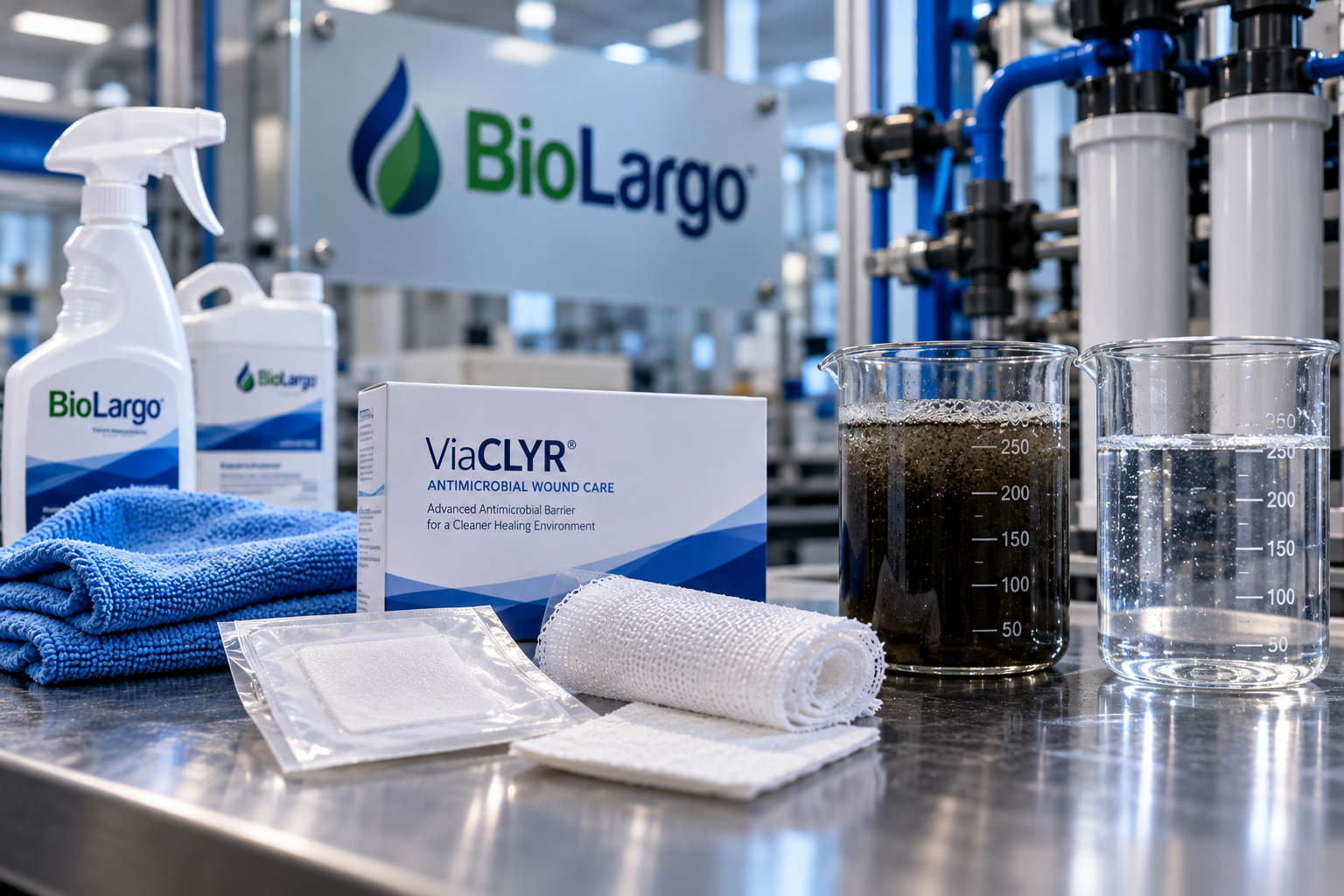
Clyra Medical has made one of the more tangible commercial advances since the August update. On September 3rd, the company entered a reseller agreement with Spartan Medical. On September 15th, Spartan announced that ViaCLYR had been added to the Defense Logistics Agency’s ECAT procurement system, giving eligible U.S. government healthcare facilities a mechanism through which the product can be purchased. At BioLargo’s September 10 town hall, management said approximately six or seven ViaCLYR SKUs had been placed in the relevant catalog.
The significance lies in the procurement mechanism itself. Clyra now has access to a government purchasing channel that did not exist in the earlier update. Management nevertheless cautioned against treating the development as evidence of broad military adoption. The nearer-term opportunity centers on government healthcare procurement, with any wider military use dependent on future purchasing decisions.
The financial contribution remains difficult to assess because BioLargo has not disclosed enough information about order frequency, volumes, or recurring revenue from the channel. Clyra is also advancing a second surgical product and has invested in at-scale manufacturing capacity through an FDA-compliant contract manufacturer. Management said confidentiality obligations prevent it from naming the national distribution partner before launch. No major order or full partner announcement had been disclosed through October 3.
Clyra has therefore moved further into commercialization, but revenue quality will depend on whether distribution access produces repeat purchasing rather than isolated stocking activity.

Tu Nipi Expands BioLargo’s Influence in Canada
BioLargo also expanded its water-treatment business beyond municipal PFAS remediation. On September 10, BioLargo and Fort McKay Oil Services announced Tu Nipi Water Solutions Ltd., an Indigenous-led venture targeting oil-sands process water, wastewater, and other industrial treatment applications in northern Alberta. BioLargo holds a minority interest in the company.
The venture is associated with a conditional Emissions Reduction Alberta grant commitment supporting a C$4.6 million project, and BioLargo said commercial trials were already underway. The initiative broadens the company’s water-treatment exposure into industrial applications where process-water management can represent a persistent operating requirement.
The project remains at an early commercial stage. Grant support and field trials can establish technical credibility and customer access, but they do not establish sustained revenue. BioLargo’s minority ownership also means that the economic contribution will depend on the venture’s structure, contract development, and scale. Even so, Tu Nipi is one of the more substantive post-August additions because it creates a defined commercial vehicle around a new end market rather than merely extending the project pipeline.

Lake Stockholm & BioLargo’s AEC Reliability
BioLargo’s August 17 Q2 disclosure said the Lake Stockholm AEC installation had surpassed 10,000 hours of continuous operation without materially significant degradation of components or performance. The company also reiterated that the U.S. EPA and New Jersey regulators were conducting regular testing. This adds to the earlier six-month operating milestone and more than two million gallons of treated water.
BioLargo’s PFAS Tech Meets New Scrutiny | TradersQue
The additional operating duration strengthens the case that the system can function continuously in a real municipal setting. The central commercial question now concerns lifecycle economics. BioLargo has not published a comprehensive dataset covering membrane replacement intervals, cleaning frequency, energy consumption, scaling rates, downtime, labor requirements, and residual-disposal costs. Those variables will determine how AEC compares economically with established treatment methods such as granular activated carbon and ion exchange.
The technology therefore has a stronger reliability record than it did earlier in 2026, but the available public data still does not establish a complete cost comparison. The eventual release of more detailed operating information from Lake Stockholm could become more important than another removal-efficiency headline because commercial adoption will depend on total operating economics as much as treatment performance.
Aquatech Remains Relevant, Unconverted
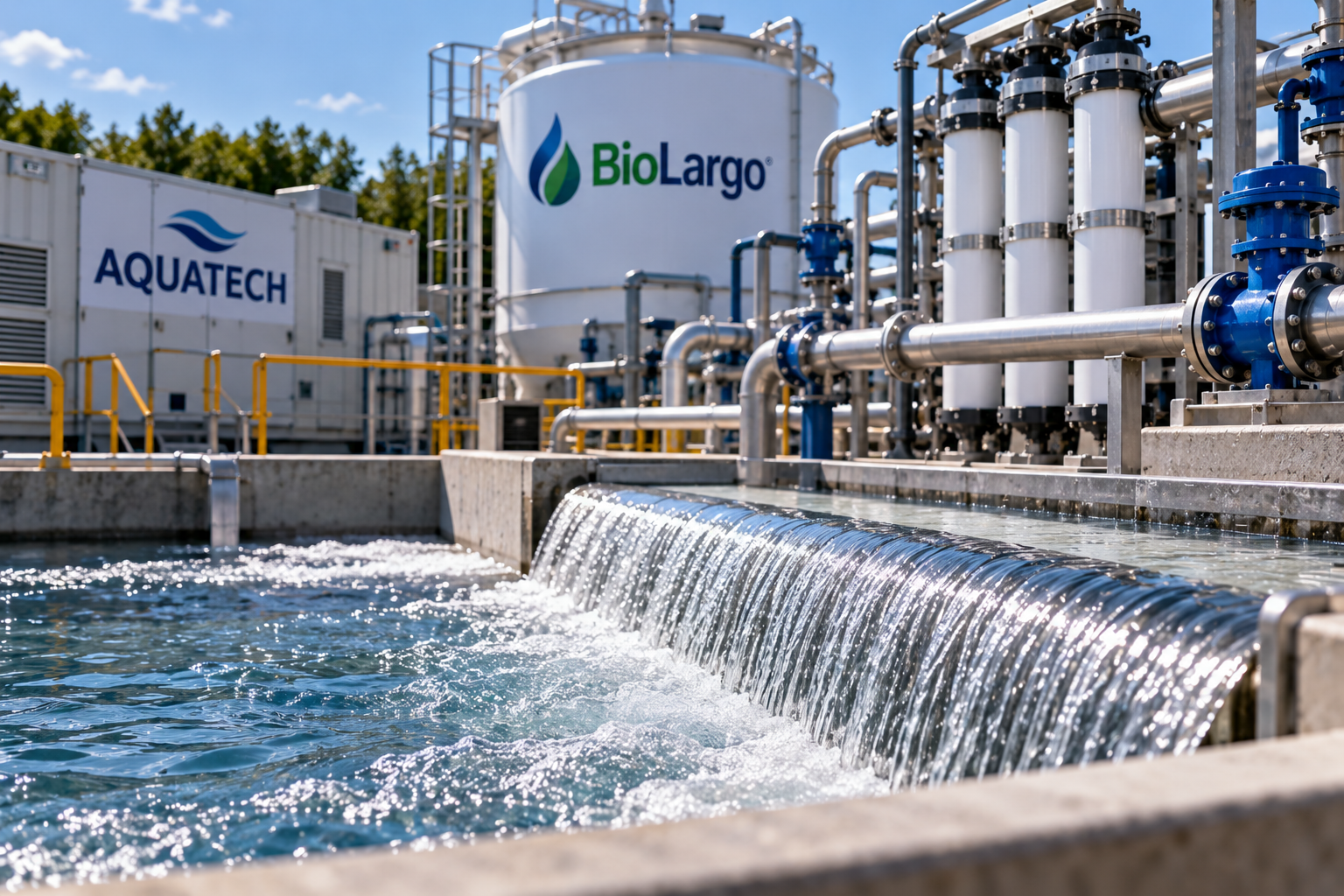
BioLargo’s relationship with Aquatech remains active. During the September town hall, management said the two companies could participate in projects as either prime contractor or subcontractor depending on the opportunity. That arrangement could increase BioLargo’s ability to pursue projects requiring broader engineering capacity, project execution infrastructure, or customer access.
The available research did not identify a post-August announcement converting the May memorandum of understanding into a material binding deployment contract or a major AEC sale directly attributable to Aquatech. The commercial value of the relationship therefore remains tied to future project conversion.
Management also referenced commercial pilots involving water recycling and data-center-related applications. Those disclosures were brief and were not accompanied by detailed contracts or material revenue commitments. They indicate pipeline activity, but there is not enough public information to treat them as booked business.

BioLargo CPG Moves Toward Launch
BioLargo’s effort to rebuild its consumer-products business has become more defined. The August 17th results established October 2026 as the target launch period for company-owned CupriDyne® products, and management repeated that timetable during the September town hall. The planned rollout includes Amazon, Shopify, TikTok, and other digital channels.
The strategy gives BioLargo greater control over branding, distribution, and customer economics than the former Pooph licensing arrangement, but it also transfers more execution responsibility to the company. Customer acquisition, advertising efficiency, repeat purchasing, and brand development will determine whether the relaunch can rebuild a meaningful consumer revenue stream.
Management discussed an aggressive internal sales objective based on capturing part of the former Pooph economics, but the available information does not support treating that figure as a forecast backed by current orders. As of October 3rd, the research did not identify a formal announcement that sales had begun. The Pooph-related federal litigation also remained unresolved publicly, with no identified settlement, judgment, or other final resolution after the August cutoff.
PFAS Regulation Leaves Everything Bullish
The federal PFAS regulatory picture has not materially changed since the August article. The EPA proposal that would allow qualifying public water systems to seek an extension from the original 2029 PFOA and PFOS compliance deadline to 2031 remains proposed rather than final. The public-comment period closed July 20, 2026. Systems would need to qualify and opt into the extension; those without an approved extension would remain subject to the 2029 deadline.
GHG Deregulation Does Not Derail PFAS | TradersQue
For BioLargo, the regulatory backdrop continues to support long-term demand for PFAS treatment, but it does not create a uniform procurement schedule. Individual utilities will respond according to financing, local compliance requirements, treatment selection, and capital-planning cycles. That uneven timing remains important because BioLargo’s commercial opportunity depends on converting regulatory need into specific funded projects.

BLEST’s Operating Revenue, Cellinity’s Pre-Commercialization
BLEST generated approximately $1.888 million of external revenue during the first half of 2026. BioLargo also said the unit performed about $574,000 of internal engineering work for other company businesses, an amount eliminated in consolidation and 46% higher than the comparable 2025 period. Management continues to reference a minerals-processing commercial pilot expected to run through the second quarter of 2027, with potential follow-on engineering work if the project advances. No major new external BLEST contract comparable with previously disclosed Air Force renewals was identified after August 15.
BioLargo Advances Platforms, Faces Revenue Reset | TradersQue
Cellinity remains further from revenue. BioLargo Energy Technologies continues discussions with prospective offtakers, data-center developers, and financing sources, but no formal factory-development agreement or project-financing commitment had been identified through October 3. Management described a business model centered on selling or licensing factories rather than becoming a battery manufacturer and referenced a rough factory cost of approximately $170 million. The platform remains dependent on future financing and partner commitments rather than current operating performance.
The contrast across these businesses is useful because BioLargo now spans several stages of commercialization. The table below separates established operating contribution from the developments that still require additional proof.
| Area | Evidence Now Available | Financial Relevance | Next Useful Indicator |
|---|---|---|---|
| Core company | $1.248M Q2 revenue; 54% gross margin | Shows post-Pooph operating base | Revenue growth versus cash use |
| Liquidity | $2.188M cash; $1.266M working-capital deficit | Additional capital still required | Financing terms and cash-consumption trend |
| Clyra | Government procurement access established | Potential new recurring sales channel | Repeat ECAT orders and disclosed revenue |
| AEC | >10,000 hours continuous operation | Improves technical credibility | Lifecycle-cost and maintenance dataset |
| Tu Nipi | Commercial trials and grant-supported project | New industrial-water opportunity | Contract awards and revenue contribution |
| BLEST | $1.888M H1 external revenue | Existing revenue-generating operation | Larger external engineering contracts |
| Cellinity | Partner and financing discussions | No current revenue contribution | Binding licensing, financing, or factory agreement |
The broader picture is therefore less about the number of initiatives BioLargo has under development and more about how quickly those initiatives begin to contribute financially.
Final Thoughts
BioLargo enters late 2026 with a broader commercial footprint and stronger operating evidence than in August. Clyra gained access to government healthcare procurement, Tu Nipi opened a Canadian industrial-water channel, Lake Stockholm pushed AEC beyond 10,000 operating hours, and Q2 clarified the company’s post-Pooph revenue base.
The remaining uncertainties are more defined. AEC still lacks a complete public lifecycle-cost record; Aquatech has yet to disclose a material deployment; ViaCLYR lacks sufficient repeat-order data to establish durable demand; BioLargo CPG was nearing launch without demonstrated consumer traction; and Cellinity still depends on future partners and financing.
Those execution risks matter more because BioLargo’s balance sheet remains constrained. Management has acknowledged that 2026 gross profit will not cover remaining operating costs, while the June working-capital deficit indicates continued reliance on external funding. The clearest evidence of progress will therefore be contract conversion, repeat orders, operating-cost disclosure, and revenue growth sufficient to narrow the gap between commercial activity and capital consumption.
BioLargo has added channels, field experience, and commercial infrastructure. The next test is whether they produce a larger, more durable financial contribution.
Additional Coverage
Review our archives on BioLargo, Inc. dating back to 2023 that include technical and fundamental analyses. Additional social media coverage can be found on X.