



A Partnership Born of Necessity, Not Ideology
With EVs, SRE indecision, and eventually hydrogen threatening liquid fuel markets, the American Petroleum Institute (API) and U.S. biofuels producers are cooperating under these identical risks. That mutual exposure has created just enough common ground for rare cooperation.
For now, anyway.
Driven by shared industry risks rather than shared business values, both sectors demand an elected Congress and appointed agencies to devise more predictable energy policies that simultaneously quell anxieties competition from alternative fuels (including those still in their infancy) and mobilize the capital required for growth and value.
To conduct business, in other words.
Liquid Fuels Under Pressure
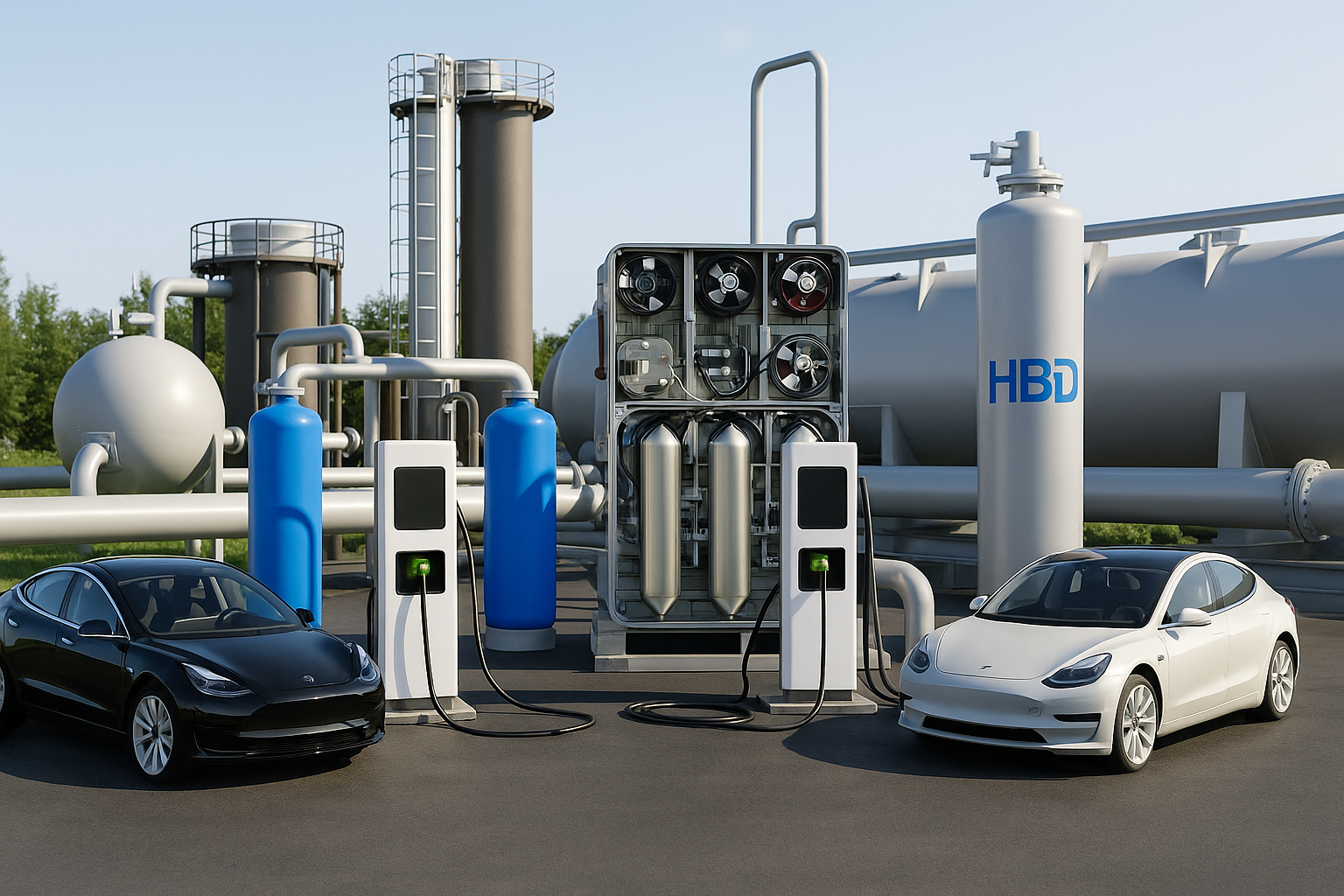
At the center of this coordination lies a mutual adversary: EVs displace both biofuels and gasoline. With each 1% gain in EV market share, the United States uses 1.2 billion fewer gallons of gasoline annually (via a derived ratio from total U.S. gasoline consumption @ ~135–140B gallons/year). That translates into a 120-million-gallon loss in ethanol demand, or roughly 45 million bushels of corn (based on standard E10 blend @ 2.8 gal/bu). Projected EV adoption rates of 20 to 25 percent by 2030 (as of this writing) suggest a 6 to 9 percent erosion in ethanol use, along with concurrent losses in petroleum demand.
Biofuels are also exposed on the diesel side, where hydrogen that is already responsible for roughly 40% of global demand through refining is expanding into transports of all scales and thus signaling a potential shift in how diesel is produced and displaced.
Additionally, Small Refinery Exemptions (SREs) and expanded ethanol policies such as year-round E15 blending, while seemingly at odds, function as a coordinated policy balance between API and biofuels: SREs ease regulatory compliance burdens and reduce mandated blending pressure on refiners, while broader ethanol access increases market-driven consumption, allowing biofuel demand to grow through price and availability rather than strict quotas.
These emerging technologies and policy issues do not require a unified energy ideology to disrupt markets. The pressure alone has driven API and biofuels interests into a limited alignment focused on defending the relevance of combustion fuels, not reimagining their future.
A Timeline of a Temporary Alliance
The shared ground between petroleum and biofuels is defined by a narrow window of overlapping interest. Once certain technical, policy, and infrastructure milestones are reached, that overlap disappears.
| Phase | Timeframe | What Happens | Effect on the Alliance |
|---|---|---|---|
| Defend | 2025–2030 | API supports ethanol blends (E15/E20) to slow EV market and induce balanced SRE reform. Biofuels benefit from API’s lobbying strength. | Alliance holds but remains purely tactical. |
| Diverge | 2030–2035 | API pivots to hydrogen and petrochemicals. Ethanol loses value as refineries pursue integrated SAF strategies. | Cooperation weakens. Policy goals diverge. |
| Dissolve | 2035–2040 | EVs dominate new car sales. Liquid fuels become marginal in revenue models. API withdraws. | Alliance ends. Biofuels return as competitors. |
By the mid-2030s, the value proposition biofuels currently offer to petroleum interests both in political cover and volume defense diminishes sharply. The API’s long-term strategy leans toward molecules that do not rely on agricultural feedstocks and can align more cleanly with decarbonization targets.

After the Break: Biofuels Must Stand Alone
The API will leave the coalition. That exit will be driven by falling gasoline margins, rising petrochemical reliance, and growing returns from non-bio-based decarbonization assets. What biofuels do next determine whether they remain part of the future fuel economy or become a legacy concern tied to declining internal combustion volumes.
LanzaTech (NASDAQ: LNZA) | TradersQue Archives
To remain relevant, biofuels must break from petroleum’s orbit and craft a distinct identity. That starts with messaging, but it does not end there.
First, biofuels must position themselves as the rural decarbonization tool of choice. Most electrification infrastructure (e.g., charging networks, grid upgrades, supply chains) remains concentrated in urban corridors. Liquid fuels will persist longest in rural areas, where biofuels can frame themselves as the practical and available low-carbon alternative.
Electrons decarbonize cities, but Molecules decarbonize rural America.
Second, biofuels need to reassert their cost advantage. Unlike many clean energy technologies that require long lead times and heavy upfront capital, higher ethanol blends reduce emissions immediately. Moving from E10 to E15 cuts transportation-sector greenhouse gases by 3 to 5 percent with no new infrastructure. When paired with carbon capture, ethanol can reach lifecycle carbon intensities as low as 30–40 gCO₂e/MJ—approaching parity with zero-carbon fuels on a marginal basis.
The Section 45Z Clean Fuel Production Credit further strengthens this value proposition by linking tax credits directly to a fuel’s carbon intensity. For biofuels that meet aggressive CI benchmarks, 45Z could create a short-term price advantage that no other liquid fuel currently matches, but the credit continues its complicated route to finality while biofuels risk losing competitiveness. Further loss of political alignment and economic support exposes the sector to compounding vulnerability.
Section 45Z Revisions Reshape U.S. SAF Investment Outlook | TradersQue
Third, aviation is domestic biofuels’ strongest long-term opportunity. Sustainable aviation fuel (SAF) demand is projected to reach 35 billion gallons annually by 2050. If ethanol captures even 20 percent of that market, it creates structural demand for roughly 7 billion gallons (a volume equivalent to 2.5 billion bushels of corn). Electrifying aviation at scale remains technologically unlikely. SAF, by contrast, is viable and increasingly bankable, particularly if 45Z provisions are followed by longer-term SAF-specific incentives and refinery integration pathways.
Finally, biofuels should take ownership of clean combustion. Even in aggressive electrification scenarios, tens of millions of internal combustion vehicles will remain on U.S. roads well into the 2040s. No other liquid alternative offers a more immediate, scalable path to emissions reductions across that legacy fleet. Once petroleum exits, biofuels will be the only sector capable and motivated to defend combustion’s carbon viability.

A Coalition Built to Expire
The API–biofuels partnership is not a strategic realignment but instead a shared pause under pressure. That pause ends once the petroleum sector finishes shifting toward hydrogen, carbon capture, and non-agricultural fuels. The signals are already visible: EV growth, hydrogen subsidies, refinery modifications point to a likely break sometime between 2032 and 2038.
What happens after is not predetermined. But if biofuels fail to sufficiently scale in rural locations or achieve near-term carbon impact and long-term SAF potential, then those biofuels risk becoming the stranded asset of the clean fuels transition.
Petroleum Plays
Petroleum majors retain optionality and can disengage from biofuels once hydrogen, carbon capture and sequestration (CCS), and petrochemicals dominate capital allocation. Their participation in the alliance is conditional and reversible.
Although TradersQue has neither previously covered nor endorsed the ExxonMobil, Chevron, and Occidental Petroleum, these legacy players represent the top beneficiaries of the next bull oil cycle.
| Company | Assets | Role | Forecast | Advantages |
|---|---|---|---|---|
| ExxonMobil ($XOM) | Global refining, LNG, petrochemicals, CCS hubs, SAF pilots | Tactical supporter of liquid-fuel defenses (E15, ICE relevance) | Pivot toward petrochemicals, CCS, hydrogen, refinery-integrated SAF | Unmatched scale, balance sheet strength, chemicals dominance |
| Chevron ($CVX) | Integrated upstream, refining, renewable diesel (RD), hydrogen pilots | Opportunistic alignment to slow ICE erosion | Hydrogen, renewable diesel, SAF, gas-weighted transition | Capital discipline, strong gas exposure, renewable diesel footprint |
| Occidental Petroleum ($OXY) | CO₂ pipelines, EOR, Direct Air Capture (DAC), CCS | Indirect beneficiary | Carbon management, CCS monetization, low-CI oil production | Early mover in CCS/DAC, regulatory leverage (45Q) |
Biofuels Plays
Biofuels firms must act preemptively by locking in ATJ/SAF markets, lowering carbon intensity, and securing independent offtake because they lack the scale and capital flexibility to survive a post-alliance environment.
Gevo (NASDAQ: GEVO) | TradersQue Archives
TradersQue has archived coverage of ATJ/SAF-based firms Gevo and LanzaTech, whose links can be found earlier in this article. Valero Energy represents our optimal choice yet to be formally covered in this sector.
LanzaTech (NASDAQ: LNZA) | TradersQue Archives
| Company | Assets | Markets | Alliance Exposure | Strategy for Relevance |
|---|---|---|---|---|
| Gevo ($GEVO) | Net-zero ethanol platform, SAF development pipeline, CCS integration | SAF (ATJ), renewable hydrocarbons | Low–Moderate | Scale ATJ SAF projects, secure long-term airline offtake, achieve ultra-low CI (<30 gCO₂e/MJ) |
| LanzaTech ($LNZA) | Gas fermentation IP, ATJ SAF platform, airline partnerships | SAF, specialty chemicals | Low | Rapidly scale commercial SAF plants, maintain cost parity with HEFA SAF, protect IP advantage |
| Valero Energy ($VLO) |
Refinery-integrated renewable diesel & SAF units, logistics scale | Renewable diesel, SAF | Moderate | Secure desirable feedstocks, expand SAF capacity profitably, hedge against refinery de-prioritization |
Final Thoughts
Although an API – Biofuels strategic partnership ought to have occurred prior to the previous Administration, this alliance mutually benefits the supply- and value-chains comprising either side. Investors should diligently follow macro- and micro-economic headlines in addition to relevant financial and commodity markets to build a robust understanding of what will prove to be a tense coalition in the foreground of a volatile political landscape.