



BYD’s Easy Growth Narrative Is Over, but Global Expansion Remains Intact
BYD‘s continued international rise derives from successful scaling, battery development, vertical integration, and a wide EV product range via the company’s new-energy vehicles (NEVs) and battery-electric vehicles (BEVs), along with plug-in hybrids (PHEVs) and Fuel Cell Electric Vehicles (FCEVs).
Electric Vehicle Types Explained: BEV vs PHEV vs HEV vs eREV vs FCEV
Still, the BYD story now requires more balanced nuance. Fast growth, low costs, China strength, and smooth global expansion have given way to greater pressures in 2025-2026. Profit has weakened. China’s BEV/NEV/EV market became more crowded. Overseas sales became a greater priority. And although Brazil remains one of BYD’s key growth markets, legal, labor, tariff, and execution risks that require close scrutiny continue to be a drag on the company.
BYD Equities
- BYDDY is the ADR that trades OTC in U.S. dollars and is the most common for a U.S.-trader audience.
BYD Co Ltd ADR Stock Price | BYDDY | Investing.com
- BYDDF is the OTC ordinary-share tied more directly to BYD’s Hong Kong (HK) H-shares. It is used often for technical accuracy when discussing the HK equity but less convenient and often less liquid for U.S. retail trading.
BYD Co Ltd Stock Price | BYDDF | Investing.com
What Critics Misinterpret about BYD
BYD’s model remains durable despite problems that would test weaker automakers.
Any bearish case often reduces BYD to a few simple claims: EV demand is collapsing, tariffs will kill adoption, subsidies explain the company’s success, or falling profit proves the business model is broken.
But BYD is no longer operating in the easy-growth phase of China’s EV boom. Competition has become tighter, margins are under pressure, and trade barriers (tariffs) are rising. These caveats will test BYD’s advantages but in a far more difficult market, but they do not erase the company’s edge despite common myths disguised as skepticism.
| Myth | Reality | Result |
|---|---|---|
| “Demand is collapsing.” | Demand is shifting, not disappearing. | International sales growth shows that EV demand remains active despite domestic growth pressure. |
| “Tariffs kill EV adoption.” | Tariffs accelerate localization. | Higher imports increase the value of local assembly, regional production, and supply-chain investment. |
| “EV business models are broken.” | Weak models are exposed; integrated models adapt. | 2025 revenue growth and profit decline shows resilience but also margin pressure. |
| “China will carry BYD forever.” | China remains critical, but overseas growth is now more essential. | H1 2026 showed that international expansion is becoming central to offsetting domestic weakness. |
| “BYD only wins because of subsidies.” | Policy support helped the sector, but BYD’s edge is also operational. | BYD’s scale, battery control, plug-in hybrid mix, cost structure, and export growth out-muscle subsidies. |
The reality is more nuanced than either the bullish or bearish view suggests. The risks are real, but they do not break the BYD thesis. They instead clarify that investors and analysts should scrutinize: profit, overseas sales, and working capital outside China.
BYD’s 2025 Shows Scale & Margin Pressure
BYD’s 2025 results confirm the company’s scale and show why volume growth cannot be the dominant focus.
For 2025, BYD reported revenue of about RMB $803.97 billion, up about 3.5% YoY. Full-year net profit from shareholders fell roughly 19% to RMB $32.62 billion. Vehicle sales exceeded 4.6 million units, which reinforced BYD as one of the world’s most important new-energy vehicle producers.
The key issue is the mix of record scale and falling profit. BYD is still growing, but it is growing in a market where price competition is compressing earnings. Its cost base remains a major advantage because the company controls key parts of its supply chain, including batteries and power electronics. Yet vertical integration does not make BYD immune to margin pressures even though company has proved resilient.
China’s EV price war has forced even leading manufacturers such as Tesla, SAIC, Geely, and NIO to cut prices, offer incentives, or eat higher costs to defend market share. BYD’s large production base thus gives it opportunities that its rivals lack. The same scale, however, makes volume momentum important. When China slows or price cuts accelerate, the impact reaches earnings quickly.
BYD’s dominance will continue but only if profit remains a central variable rather than an afterthought.
BYD’s Overseas Growth Carries More Weight
In June 2026, BYD reported 403,472 new-energy vehicle sales, up 5.5% from June 2025. On the surface, that suggests renewed momentum, but the year-to-date figures are less simple: For H1 2026, BYD sold 1,808,511 NEVs, down 15.72% from the first half of 2025.
The difference is overseas demand. BYD disclosed that June 2026 exports totaled 175,349 NEVs. That was a record figure and a much larger share of monthly sales than in earlier periods.
This shift matters as BYD’s global ambition now is focused on building demand outside China that can offset softness at home. Latin America, Europe, Southeast Asia, and other emerging markets are becoming more important to the company’s growth profile. BYD recently confirmed new markets in Canada, thus overturning Canada’s 100% tariffs on Chinese EVs from 2024.
Overseas growth creates new revenue but also invites or alters risks like tariffs, labor rules, political scrutiny, logistics costs, currency swings, and consumer preference. BYD’s future will depend not only on how well it makes cars in China, but also on how well it localizes abroad.
BYD Has Surpassed Tesla in Scale
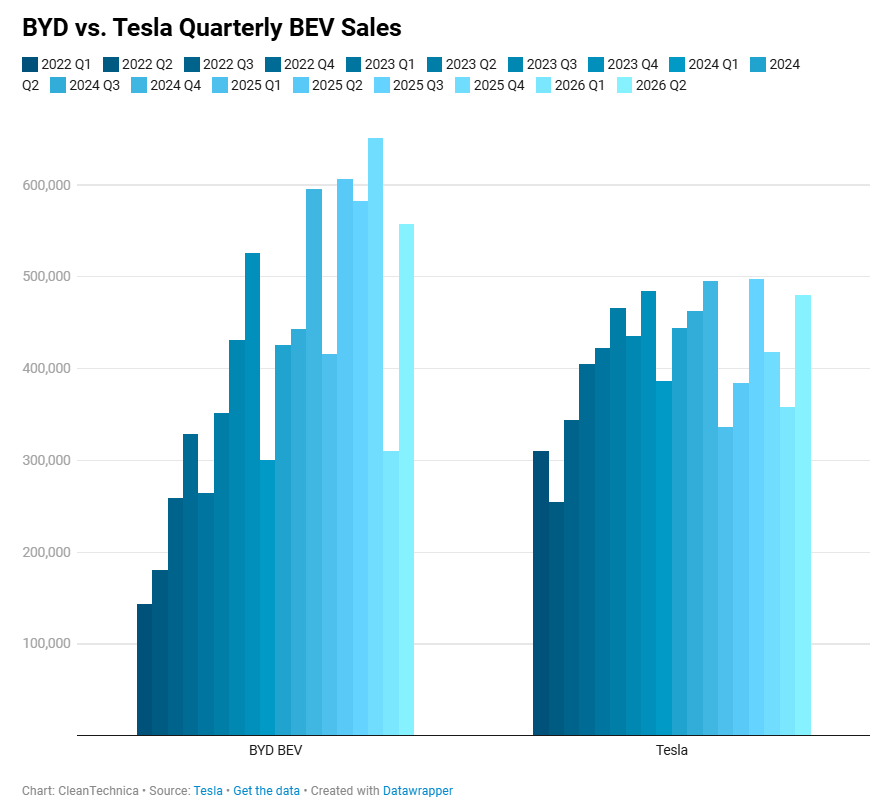
Many discussions of BYD still miss one important point. By volume, BYD is now one of the defining EV manufacturers in its own right.
In 2025, BYD reportedly surpassed Tesla in annual battery-electric vehicle sales. BYD’s total new-energy vehicle volume was larger because it distinctly includes plug-in hybrids aside from just BEVs, which Tesla traffics exclusively.
BYD’s plug-in hybrid lineup has been central to its strength in China and to its global strategy. In markets where charging networks remain limited, plug-in hybrids give buyers a middle path by offering electrification without full dependence on public charging. This gives BYD access to a wider market than pure BEV producers.
Fully electric vehicles remain the long-term benchmark for the shift away from internal combustion engines. But BYD’s ability to compete in both categories gives it flexibility that many peers lack.
China is No Longer a Safety Net
China’s domestic EV market is more competitive, with dozens of automakers fighting for market share. Pricing has become more aggressive and thus pressures margins, even for hyperscalers. BYD is better positioned than most peers because of costs, brand loyalty, and production control. Still, it does not operate in a vacuum.
Policy risk also matters. Chinese industrial policy has supported the EV sector for years. Regulators have also shown concern about excess competition, price wars, and overcapacity. If CCP authorities push automakers to reduce discounting, BYD could benefit from a more stable market. If policy changes alter EV subsidies, purchase incentives, government support, or exports, the company’s path could adversely change.
China’s EV market is maturing. And in a maturing market, the winner is not always the company with the fastest volume growth. It is rather the company that can protect profit, manage inventory, maintain supplier reliability, and sustain brand loyalty while competition intensifies.
BYD is still one of the best placed companies to do that. But China is no longer a simple growth machine.

BYD’s Brazil Market Grows With Risks
Brazil remains one of BYD’s most important overseas markets.
The country offers several advantages: a large population, rising EV support, a fledgling EV market, high urban transport demand, and government subsidies. BYD has subsequently moved quickly to not only build its brand, expand dealerships, and localize production, but to establishing in Latin America an expansive manufacturing and distribution base.
Brazil’s BYD Labor Case
The 2025 Camaçari labor controversy is not negligible as it impacts BYD’s reputation within and beyond Brazil’s borders. Generally speaking, impacts to corporate reputation prove significant to sustainability reporting and ESG disclosures, arguably beyond environmental impacts.
Brazilian authorities added BYD Auto do Brasil to the country’s labor “dirty list” after allegations tied to working conditions at the Camaçari site. Reports linked the case to conditions described by authorities as analogous to slavery. Although allegations involved outsourced contractors rather than internal BYD employees, that important distinction does not remove risk that manifests in four main ways:
- Reputational Risk: BYD presents itself globally as a clean-energy company. Allegations of labor abuse at a flagship overseas factory conflict with that identity.
- Regulatory Risk: A company placed on Brazil’s dirty list can face closer scrutiny from authorities, prosecutors, lenders, and public agencies.
- Financing and ESG Risk: Investors, banks, and partners increasingly monitor supply-chain labor standards. Even if sales continue, the issue can affect the cost of capital, public-sector relationships, and institutional investor perception.
- Execution Risk: Any dispute involving contractors, labor authorities, or prosecutors can affect project timelines, hiring, permits, or operating flexibility.
The labor case does not automatically invalidate BYD’s Brazil strategy, but it should be treated as a critical governance (ESG) issue rather than a brief public-relations problem. Reputation matters.
Exxon, 3M, BP, and United Airlines, among many others, would attest.
Brazilian Tariffs & Domestic BYD
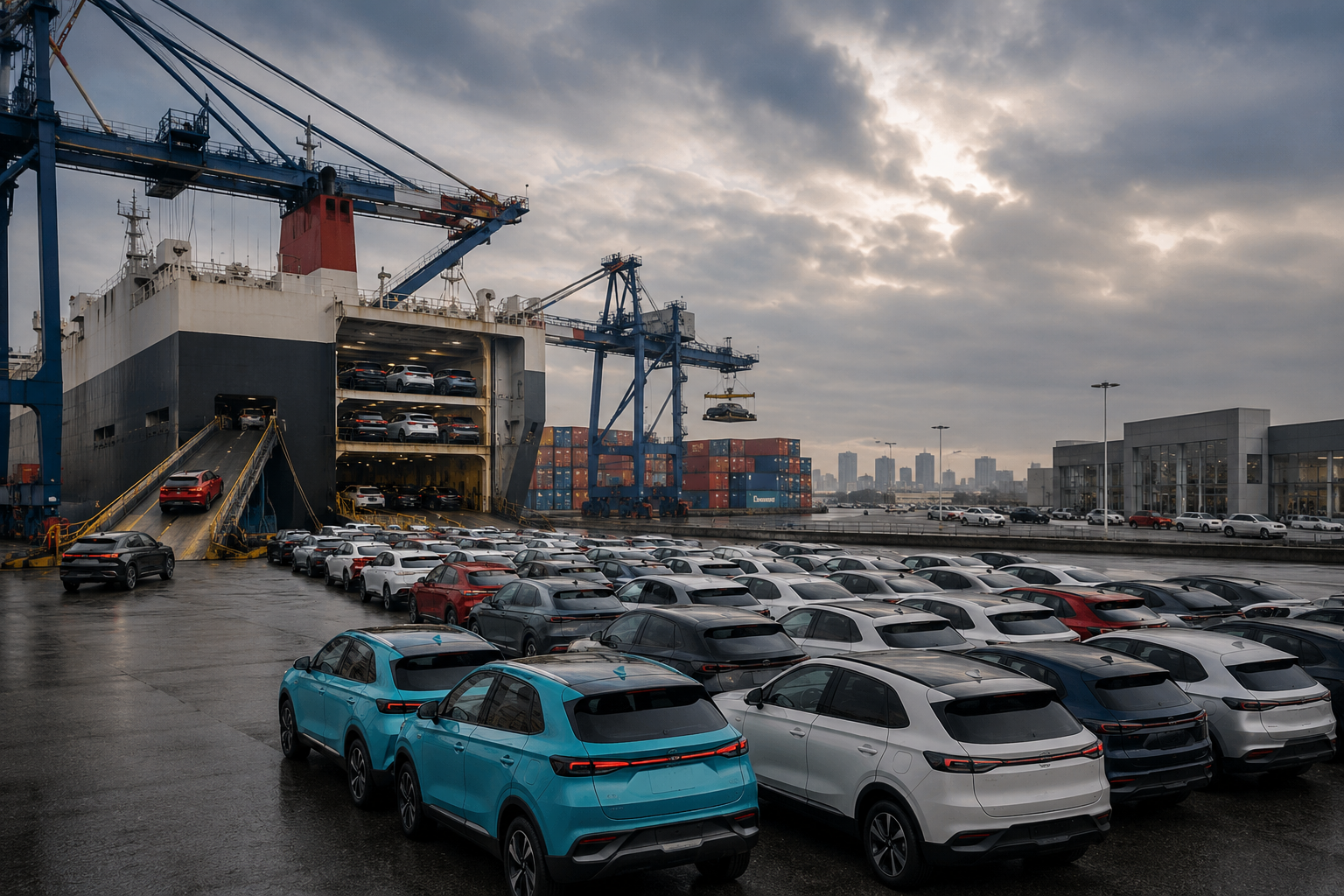
Brazil’s tariff policy is pushing BYD toward local production.
Brazil introduced a 10% import tariff on fully built electric passenger vehicles in January 2024, raised it to 18% in July 2024 and 25% in July 2025, and scheduled it to reach 35% in July 2026. Tariffs on fully and partly disassembled electric and hybrid kits, including CKD and SKD units, are also being raised, with the 35% rate scheduled to apply from January 2027.
Put differently, if imported vehicles become more expensive, local assembly becomes more valuable. BYD’s Brazil presence gives it an advantage over competitors that rely more on fully imported vehicles.
But before the local supply chain reaches scale, tariffs can pressure margins, pricing, and inventory planning. BYD may need to balance imported units, locally assembled vehicles, and consumer prices at the same time.

Practical Scenarios for Brazil BYD
A scenario framework gives a clearer view of BYD Brazil than a simple success-or-failure story.
In the upside case, Camaçari ramps up capacity smoothly, tariff exposure falls, brand trust remains intact, and Brazilian demand keeps growing. Under this outcome, BYD could become a defining EV brand in Brazil and use the country as a Latin America hub.
BYD’s Camaçari project is central to its Brazil strategy. The plant is meant to support local production, reduce tariff exposure, deepen BYD’s presence in Latin America, and provide a base for regional expansion. For Brazil, the project also has political and economic value. It promises manufacturing investment, jobs, supplier development, and a stronger role in the global EV supply chain. For BYD, the plant is part of a broader move toward regional production as trade barriers rise.
In the base case, BYD keeps growing but faces friction. Tariffs pressure some imported models, local production improves gradually, legal and labor issues remain manageable, and consumer demand stays strong. This is the most realistic current scenario.
In the downside case, labor and contractor issues keep drawing regulatory scrutiny, the factory capacity slows, tariffs raise prices to undermine localized manufacturing, and competitors leverage the controversy to challenge BYD’s brand. Sales may still grow, but profit and operating momentum would fall short of expectations.
Brazil’s BYD Demand Remains Strong
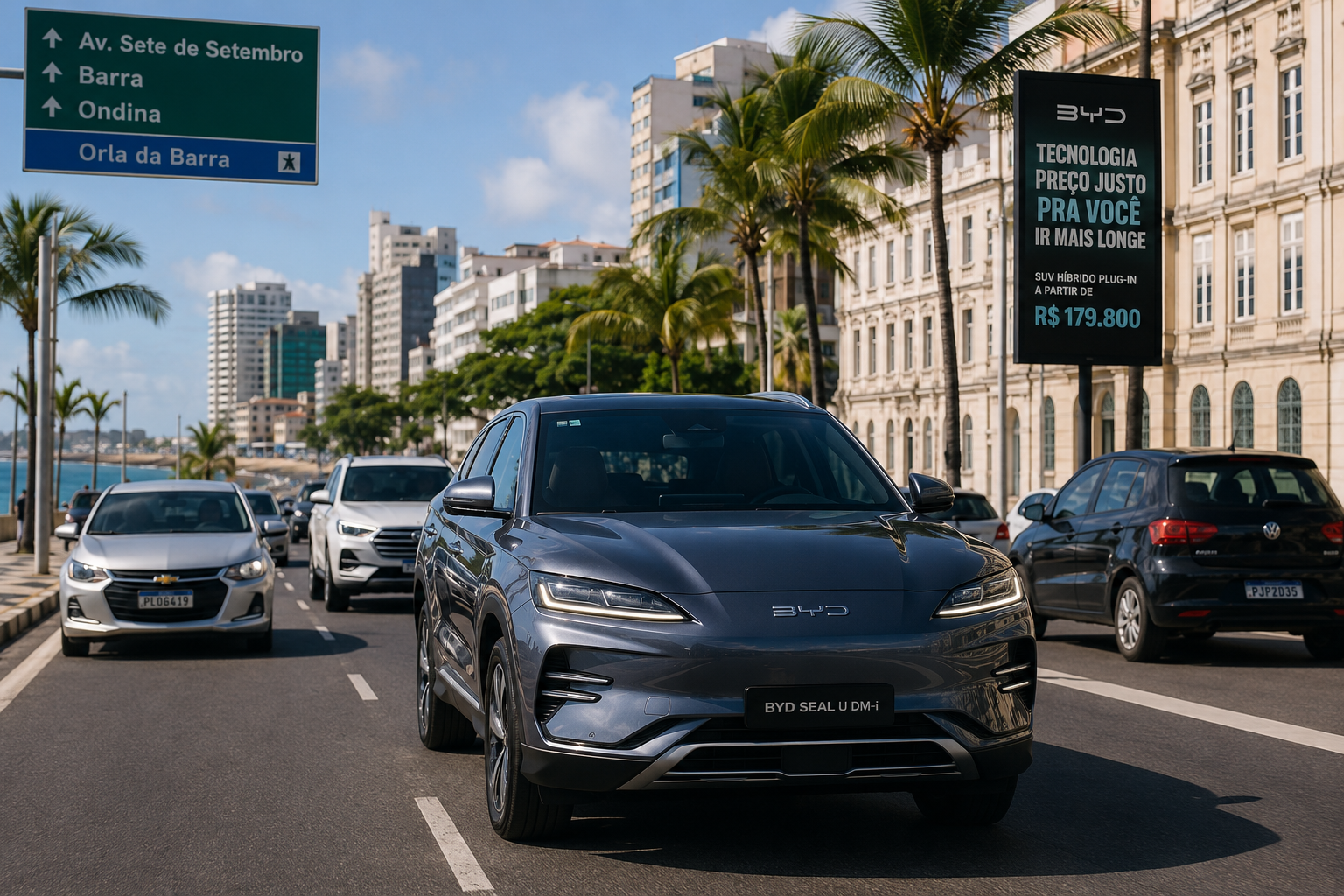
Despite the labor controversy, Brazilian demand for BYD vehicles remains one of the strongest parts of the company’s overseas story.
BYD has benefited from competitive pricing, a broad lineup, rising consumer awareness, and limited availability of similarly priced EV alternatives in Brazil. Its vehicles appeal to early EV buyers and to consumers looking for lower fuel costs, modern interiors, and advanced technology at prices that increasingly compete with internal-combustion vehicles.
This supports the bullish case. Consumers are still buying the cars. Dealer visibility is rising. BYD has become one of the most recognizable Chinese auto brands in Brazil. If local production scales well, BYD could strengthen that position.
A reasonable 2026 Brazil base-case forecast can still fall in the 145,000 to 165,000 vehicle range if demand continues and the factory capacity increases. Upside depends on faster local market capture, strong dealer support, and continued consumer increases. Downside could derive from tariffs, factory delays, labor-case fallout, or tougher competition.
BYD Peers for Comparison
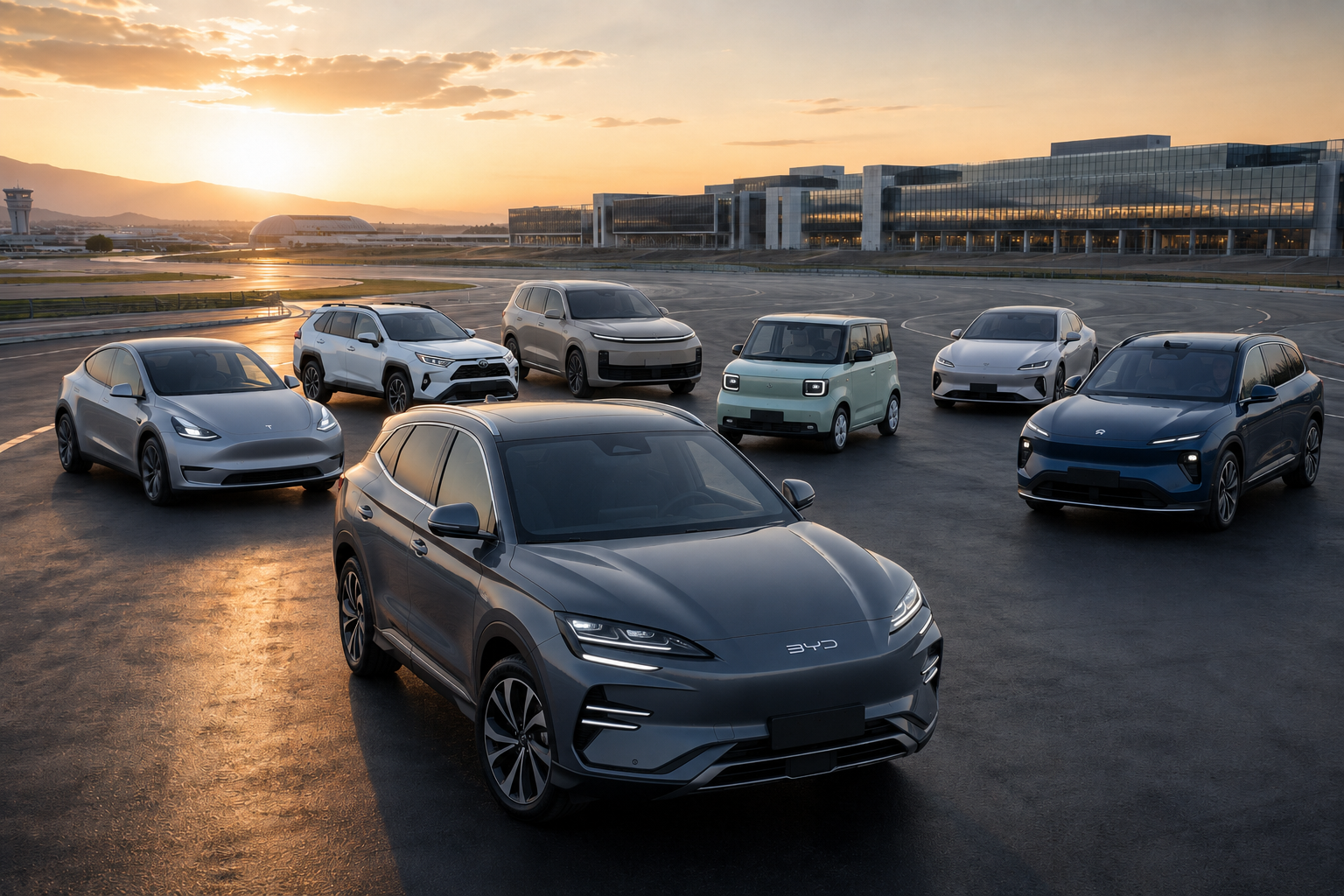
Compared with smaller Chinese EV makers like Li Auto, XPeng, and NIO, BYD has more ability to absorb cost volatility since it sells at far greater volume and controls more of its supply chain.
Compared with legacy automakers like Volkswagen, Toyota, and General Motors, BYD has a more advanced EV cost base and faster product cycles, particularly relative to automakers’ EV programs.

And compared with Tesla, BYD has a broader product ladder and stronger plug-in hybrid exposure. Tesla still retains advantages in software perception, brand strength in some developed markets, and operating simplicity as a BEV-only manufacturer.
BYD’s defenders are right that the company is often judged more harshly than peers that are less profitable, less integrated, or more dependent on outside suppliers. BYD’s critics are also right that rapid growth can hide working-capital strain, margin erosion, and governance risks.
BYD for Investors
The most important indicators for BYD over the next 12 to 18 months are clear.
- Watch margins. Revenue growth matters, but gross margin, auto-segment margin, and net margin will show whether BYD can maintain profit while defending share.
- Watch the China trend. If China sales stabilize in the second half of 2026, BYD’s earnings outlook improves. If domestic sales remain weak, overseas growth will need to carry more weight.
- Watch overseas sales. Export volume alone is not enough. Analysts should track whether global growth is profitable, whether local distribution costs are rising, and whether tariffs are being offset by localization.
- Watch Brazil. The Camaçari factory, tariff changes, labor case, and consumer demand all matter. Brazil can become a major success story, but it now requires closer governance and execution monitoring.
- Watch working capital. Payables, inventory, receivables, operating cash flow, and supplier financing should be reviewed alongside sales growth. A manufacturer can grow quickly while creating future balance-sheet pressure if cash conversion weakens.
- Watch policy risk. EV policy, tariffs, subsidy rules, industrial competition guidelines, and local-content requirements can all affect BYD’s growth path.
BYD’s vertical integration can reduce outside dependence, but it does not remove working-capital pressure. A high-growth manufacturing business often carries large payables, inventory commitments, and capital spending needs. That is not automatically a warning sign, but it does require analysis.
Moreover, BYD should be measured against its peers for greater clarity: Tesla, Geely, SAIC, Li Auto, XPeng, and NIO are fair game competitors to comparatively analyze gross margins, net margins, inventories, payables, OpEx, and capital intensity.
Final Thoughts
BYD’s rise is not based only on subsidies or temporary pricing power. The company’s scale, vertical integration, battery control, manufacturing efficiency, and broad product range remain important advantages. These strengths help explain its position among the world’s largest automakers.
The company now faces a more difficult phase. Its 2025 results showed record scale and weaker profit. First-half 2026 sales showed greater reliance on overseas demand as China softened. Brazil remains a major growth market, but labor scrutiny, tariff changes, and factory execution create material risk. BYD’s balance sheet and working-capital structure also require greater analysis.
These risks do not, by themselves, invalidate TradersQue’s thesis. BYD must show that it can expand abroad, localize production, protect margins, and maintain financial discipline under pressure throughout 2026 earnings.
Additional Coverage
Additional social media coverage can be found on the author’s X platform.