



China’s Centralized Computing Hubs Could Reshape the Global AI Race
China is concentrating more of its computing infrastructure in national hubs, based on recent U.S. intelligence gathering. That shift may help Beijing get more value from scarce chips, electricity, capital, and industrial data. It will not erase the United States’ lead in advanced processors and frontier-scale computing. But it could narrow the practical gap between the two countries by reducing waste and speeding deployment.
How U.S. Data Openness Strengthens China | TradersQue
Data centers are more than buildings filled with servers. Their location, power supply, network links, and operating rules affect how fast organizations can train and run AI systems. They also shape which firms and public agencies receive access to computing capacity.
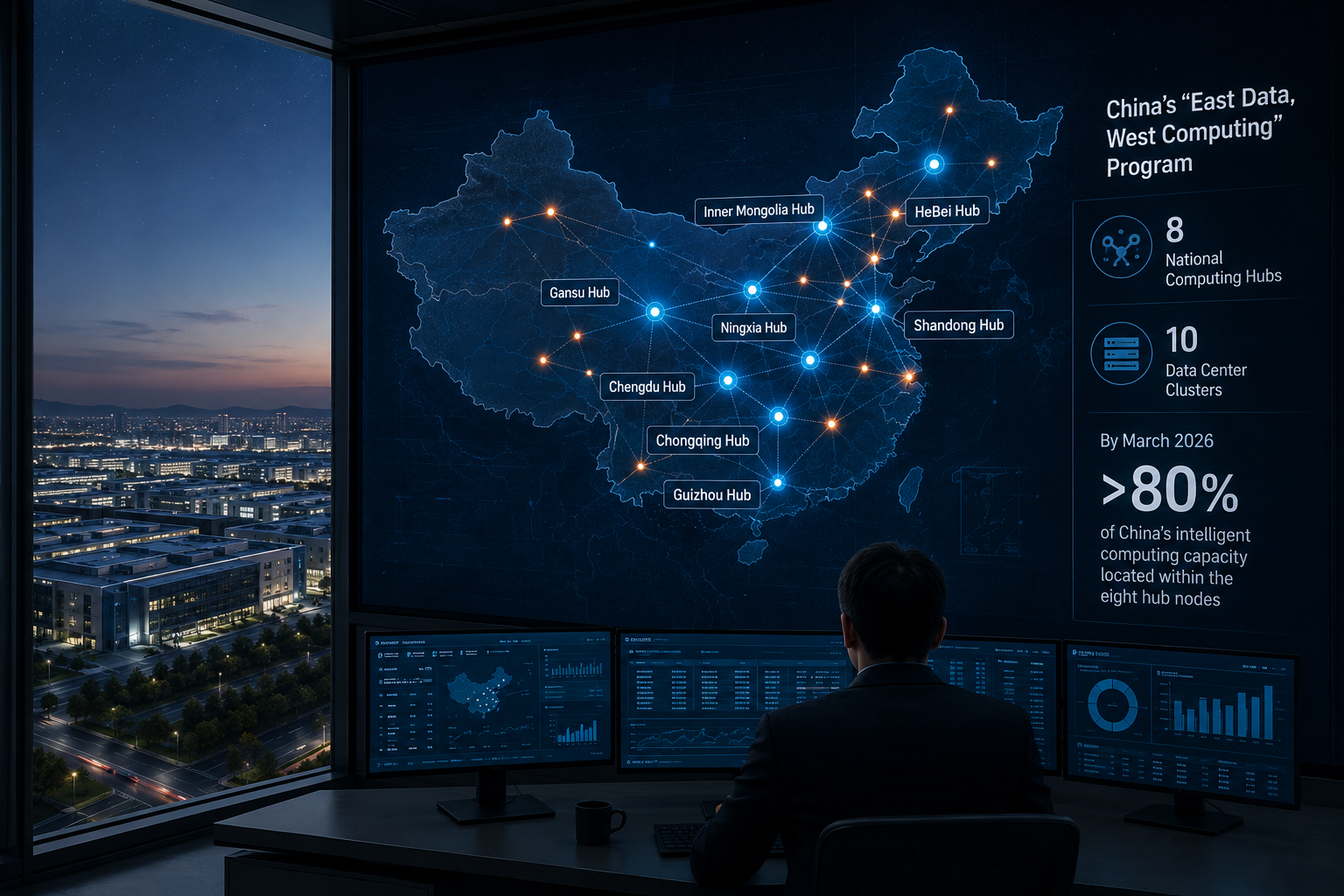
China Centralizes Its Computing Hubs
China’s national “East Data, West Computing” program provides the clearest evidence of centralization. The program links eight national computing hubs and ten data-center clusters. By March 2026, more than 80 percent of China’s intelligent computing capacity was located within the eight hub nodes, according to Chinese state media. This is a stronger and more verifiable point than claims that Beijing has imposed a nationwide ban on small centers or a uniform approval system for medium and large projects. Those more specific rules should not be stated without the underlying policy document.
Centralization can improve the use of limited hardware. U.S. export controls restrict China’s access to the most advanced AI processors. China still faces a major disadvantage in top-end chips, memory, software tools, and energy efficiency. Yet national and provincial authorities can steer available processors and power toward selected hubs, favored firms, and priority uses. They can also reduce some duplication caused by local governments building similar facilities for political or development goals.
Evidence of low utilization supports the need for reform, but the available figures are uneven. Industry reporting has found that some locally sponsored AI computing centers used only about 20 to 30 percent of their capacity. That does not prove that all Chinese centers are underused. It does show that hardware shortages can exist at leading firms while capacity remains idle elsewhere because chips, software, networks, and customer demand do not match.

Efficiency Helps Offset China’s Chip Constraints
China has also shown that better engineering can partly offset limits on raw computing power. DeepSeek’s V3 and R1 models used methods such as mixture-of-experts design, selective parameter activation, and model distillation to deliver strong performance at low usage prices. DeepSeek’s published training-cost figure for V3 covered one final training run, not the full cost of research, staff, data, earlier experiments, hardware, or deployment. The episode therefore supports a limited claim: efficient design can reduce the compute needed for competitive models, but it does not prove that frontier AI can be built cheaply in total.
Chinese labs often release model weights and price access below leading U.S. providers. This can speed adoption, local customization, and community improvement. Price comparisons, however, change quickly and depend on the model version, reasoning setting, token mix, and benchmark. A July 2026 comparison by Artificial Analysis rated GPT-5.2 higher than Kimi K2.5 on its updated intelligence index, while listing Kimi’s token price at roughly one-quarter of GPT-5.2’s. The safer conclusion is that some Chinese models offer a lower price for somewhat lower, but still competitive, measured capability.

Industrial Data Strengthens China’s AI Strategy
The strongest part of China’s position may be the link between low-cost models and a large industrial base. Factories, robots, vehicles, warehouses, logistics systems, and payment networks generate data that cannot be copied from public web pages. Local governments have funded more than 40 robot-training and data-collection centers. These facilities can gather demonstrations, sensor readings, errors, and task outcomes for embodied AI. Yet scale alone does not guarantee useful data. Quality, labeling, interoperability, consent, and access rights will determine whether the data can improve models.
This creates a possible feedback loop. Wider deployment produces more operational data. Better data can improve systems for physical tasks. Better systems may then attract more users and more deployment. The U.S.-China Economic and Security Review Commission has argued that China’s open-model strategy and manufacturing base reinforce each other in this way. The logic is plausible, but the outcome is not automatic. Firms may keep data in separate systems, factories may use incompatible formats, and legal or commercial barriers may limit sharing.
Centralization Creates Strategic Leverage
The next phase will likely turn on execution, not just model quality. The practical question is whether centralized hubs can convert scattered assets into repeatable industrial workflows. If they can, the payoff will show up first in lower deployment friction, steadier access to power, and faster reuse of specialized data.
| Asset | Significance |
|
|
Compute Allocation |
Scarce accelerators can be reserved for priority users instead of dispersed across weak projects. | Higher useful output from the same chip base. |
|
Power Siting |
Large hubs can be tied to planned energy supply and transmission rather than local subsidy races. | Fewer stranded or delayed facilities. |
|
Model Distribution |
Lower-cost open models can spread across firms that cannot afford frontier U.S. systems. | Broader experimentation and adoption. |
|
Industrial Data |
Factories, robots, logistics networks, and public systems produce hard-to-copy operational data. | Better feedback for physical-world AI. |
This path is not automatic, however. The more China depends on shared hubs, the more it must solve queueing, data-quality, and security problems across many users. A plausible forecast is a two-speed system: strategic sectors receive stable compute and fast integration, while lower-priority firms face rationing or slower access.
U.S. AI Strengths Prevail Save for Regulation
The United States still holds major advantages. It has greater frontier-compute capacity, leading chip designers, deep private capital markets, major cloud providers, and several of the strongest model developers. Its challenge is not a complete lack of coordination. Federal agencies, states, grid operators, utilities, laboratories, and firms already coordinate in many areas. The harder problem is that authority is divided, incentives differ, and projects must pass through several approval and planning systems.
Electricity is one clear constraint. U.S. data centers last year used about 176 terawatt-hours of electricity, or 4.4 percent of national consumption. The Department of Energy estimated that use could rise to 325 to 580 terawatt-hours by 2028, equal to about 6.7 to 12 percent of U.S. electricity. These are scenarios, not a single forecast. They should not be extended to a 2030 range without a named and current source.
The AI Cybersecurity Hype: A Technical Reality Check | TradersQue
Grid access may matter as much as total generation. In July 2026, the Department of Energy released a draft National Transmission Needs Study. It found a pressing need for added transmission because of data centers, manufacturing, large industrial loads, and broader demand growth. The report identifies needs and possible high-value links, but it does not itself approve or build projects.
Federal regulators are also revising large-load connection rules. In June 2026, the Federal Energy Regulatory Commission ordered the six regional grid operators under its jurisdiction to defend or change their tariffs for data centers and other large loads. The orders address study processes, cost allocation, transparency, co-location, flexible loads, and nearby generation. They show that current rules are under stress, but they do not establish that every delay is caused by speculative data-center requests.
Equipment and construction limits add further risk. Large power transformers, substations, transmission lines, and skilled labor can take years to secure. Money alone cannot remove these bottlenecks. Projects also face land, water, permitting, community, reliability, and cybersecurity concerns.
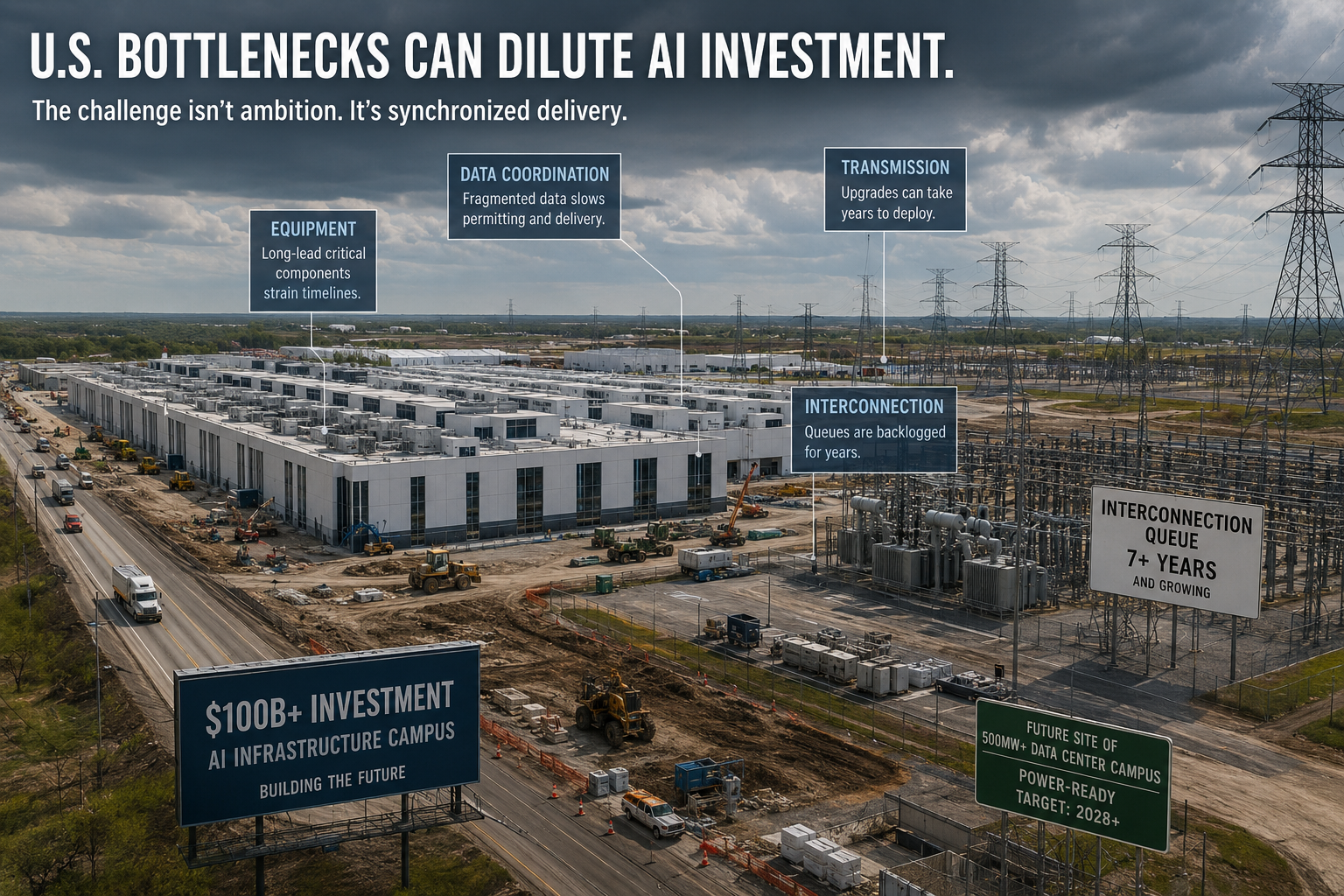
U.S. Bottlenecks Can Dilute AI Investment
For the United States, the main issue is less a shortage of ambition than a shortage of synchronized delivery. AI capacity depends on several systems moving together. A delay in any one of them can make funded projects less useful than headline investment totals suggest.
| Bottleneck | Risk | Implication |
| Interconnection | Speculative or poorly sequenced requests consume engineering attention and slow real projects. | Approved capital may wait for usable grid access. |
| Transmission | Regional planning, siting, and cost allocation do not always match the speed of data-center demand. | Compute clusters can emerge where power is least ready. |
| Equipment | Transformers, substations, and skilled crews remain hard to scale quickly. | Money does not convert into capacity on demand. |
| Data Coordination | Firms, agencies, labs, and industrial operators often hold data in separate systems. | Model improvement may be slower outside closed platforms. |
This creates an opening for policy that is narrower than a full industrial plan but broader than normal permitting reform. The highest-return moves would likely be shared queue standards, faster large-load screening, transformer supply expansion, and trusted data-sharing channels for manufacturing, energy, health, logistics, and defense-adjacent work.
AI Risk Becomes ESG’s Next Flashpoint | TradersQue
China’s centralized system may shorten some decisions, but it creates different risks. Political allocation can favor connected firms, hide poor investments, reduce competition, and move capacity toward state priorities rather than the highest-value use. Western China also faces latency, network, climate, and renewable-power balancing limits. Central control can reduce fragmentation, but it does not guarantee efficiency.
Final Thoughts
The strategic conclusion should therefore be conditional. China does not need to exceed total U.S. computing capacity to gain ground in selected markets. It may benefit if it raises utilization, lowers deployment costs, and links AI systems to industrial data faster than the United States. The United States can preserve its lead by expanding power and transmission, improving large-load interconnection, easing equipment shortages, supporting secure data sharing, and accelerating AI use in industry. The contest will depend not only on how much computing capacity each country builds, but also on how reliably, cheaply, and productively that capacity is used.
Additional Coverage
Additional coverage can be found on the author’s X platform in addition to previous archives via TradersQue.com