



AI Risk is Displacing DEI and Climate-risk as ESG’s New Darling
The next major shift in ESG-related reporting is likely to come less from traditional DEI or climate-risk proposals than from artificial intelligence (AI). Board oversight, data sourcing, privacy, copyright exposure, cybersecurity, deepfakes, child-safety harms, algorithmic bias, model governance, and regulatory readiness represent the current core of AI-based concerns.
That framing makes technology proposals harder for companies and opposing investors to dismiss. But such framing may also help gain support from investors and their influencers who often either reject conventional anti-ESG proposals.
“Woke” ESG: The Timeworn Bear Reawakens | TradersQue
The central issue in the next Rule 14a-8 season will be whether companies can demonstrate how AI-related risks are identified, governed, and reduced and, as importantly, how AI-integration directly generates revenue and profit increases.
Regulatory Pressure Is Building
The regulatory backdrop supports this shift to AI disclosures whose scope overlaps with traditional ESG metrics. The SEC Investor Advisory Committee has called for more consistent AI disclosure because company use of generative AI has grown while transparent disclosure remains uneven. SEC disclosure-review comments have also focused on AI-related risk disclosure and “AI washing.”
Global evidence is evident beyond just broad ethics claims: In Europe, the EU AI Act’s general-purpose AI obligations took effect on August 2, 2025. In the United States, Colorado, California, Texas, Connecticut, Utah, New York, New York City, and Illinois have adopted AI-specific regimes addressing automated decision systems, frontier AI, generative AI disclosures, employment AI, bias audits, transparency, incident reporting, or anti-discrimination duties. Internationally, South Korea and China have adopted binding AI frameworks, while Japan has enacted a lighter national AI governance statute.
| Season | Notes |
|---|---|
|
FY: October 1st, 2025 – September 30th, 2026. |
SEC correspondence for this proxy season is covered on the SEC’s 2025–2026 Rule 14a-8 page. The major procedural shift occurred when Corp Fin announced that, for this proxy season, it would not respond to most Rule 14a-8 no-action requests. |
|
FY: October 1st, 2026 – September 30th, 2027. Voting Season: January 1st – June 30th, 2027 |
This is the forward-looking application of the SEC’s normal seasonal archive convention. The precise filing and voting windows will remain company-specific, based on each issuer’s prior proxy-mailing date and annual-meeting calendar. |

Risks Related to Technology and Artificial Intelligence
Technology-focused anti-ESG proposals remain a small category by volume. They are likely to carry more weight in the next Rule 14a-8 season because AI risk is now easier to frame as a financial, legal, operational, and reputational issue.
AI Risk Widens the Opening
Most anti-DEI and anti-climate proposals still draw very low shareholder support. AI-related proposals can reach a wider investor base when they focus on board oversight, data governance, privacy, intellectual-property exposure, child safety, deepfakes, fraud, platform integrity, and regulatory readiness.
ESG and Anti-ESG Shareholder Proposals in 2026 | Harvard Business Review
The most repeatable proposal template in 2025 and 2026 asked companies to report on risks to operations, finances, and public welfare from the actual or potential misuse of external data in developing, training, or deploying AI products. It also asked what steps the company takes to reduce those risks and how it measures results.

Microsoft Shows the Ceiling
This proposal type appeared at major technology companies, including Microsoft, Amazon, Alphabet, Meta, and Apple. Its strongest showing came at Microsoft in 2024, where a similar AI data-sourcing accountability proposal received more than 36% support, far above the usual level for anti-ESG proposals. Later versions received lower but still notable support, including low-double-digit outcomes at several large technology companies.
Deepfakes Shift Visa’s Risk
The next branch of technology proposals is likely to focus on AI-enabled child exploitation, deepfakes, and payment-system facilitation. Visa’s 2026 proposal asked for a transparency report on risk-management strategies tied to the use of Visa products in facilitating the sale of deepfake content, especially child exploitation. It received about 8% support.
That result was not close to passage. Still, it exceeded most anti-ESG outcomes and showed that AI-enabled harm can draw investor attention when tied to legal compliance, transaction monitoring, reputational exposure, and platform integrity.
Apple Maps the Route
A related child-safety proposal at Apple asked for a transparency report on the costs and benefits of Apple’s decisions on child sex abuse material identifying software. Apple sought exclusion under Rule 14a-8’s ordinary-business exception. SEC staff did not concur, finding that the proposal transcended ordinary business and did not micromanage the company.
That outcome gives future proponents a procedural roadmap. Technology proposals are more likely to survive when framed as board-level risk oversight and significant policy issues, rather than product-design mandates.
AI Oversight Spreads Out
The likely next wave will broaden beyond AI model developers. Payment networks, cloud providers, app stores, social platforms, marketplaces, enterprise software firms, data brokers, insurers, banks, healthcare companies, and employers using high-risk AI systems may all become targets.
The strongest proposals will ask for risk reports, governance disclosure, impact-assessment processes, safeguards, effectiveness metrics, and board oversight. The weakest will demand specific product choices, content-moderation outcomes, or technical design changes, leaving them more exposed to ordinary-business and micromanagement objections.
ESG Labels Fall Short
The key caveat is classification. These proposals may be labeled anti-ESG when filed by anti-ESG activists or framed as opposition to perceived ideological uses of technology. In substance, many AI-risk proposals overlap with mainstream investor concerns, including fiduciary oversight, material risk disclosure, cyber risk, privacy, intellectual property, human rights, and regulatory compliance.
That overlap explains why this category is likely to receive more attention, and possibly more support, than traditional anti-ESG proposals in the next proxy season.

2027 Anticipated 14a-8 Proposals
The 2027 proposal set is likely to test whether AI oversight has moved from abstract policy concern to routine risk governance. The strongest proposals will ask whether boards and management can demonstrate credible controls over the specific risks their scope of AI creates: data sourcing, copyright exposure, child safety, biased media, misinformed automated decisions, false AI claims, and infrastructure limits.
That shift matters because it gives proponents a more durable materiality argument and gives companies less room to dismiss the category as ideological.
| Proposal Type | Rationale | What Investors Demand |
|---|---|---|
| AI Data Usage Oversight | Already repeated across Microsoft, Amazon, Alphabet, Meta, Apple and others. | Ask for board-level governance, safeguards, and effectiveness metrics; avoid demanding disclosure of proprietary datasets. |
| AI Training Data / Copyright Risk | Copyright and licensing litigation remain visible, and model-training provenance is still poorly disclosed. | Tie request to financial exposure, litigation reserves, licensing strategy, and controls for copyrighted/proprietary material. |
| AI Child Safety / Deepfake Risk | Visa’s 2026 proposal created a template outside the model-developer sector. | Expand from platforms to payment networks, cloud providers, marketplaces, app stores, hosting providers, and social media. |
| AI Content Integrity / Deepfake Disclosure | Media fraudulence is now mainstream and easily framed as fraud, brand, election, and safety risk. | Focus on governance, detection, enforcement, escalation, and incident reporting rather than content-level moderation commands. |
| AI Impact Assessment / High-Risk AI Systems | U.S. state and EU frameworks normalize impact assessments. | Ask whether the company performs AI impact assessments for high-risk use cases and how results are escalated to management or board committees. |
| AI-Washing Controls | Companies are monetizing AI narratives heavily, and investors worry about overstatement. | Request controls over AI-related claims in securities filings, earnings calls, product marketing, and customer-facing claims. |
| AI Infrastructure Risk | AI capex has made power, water, grid, permitting, and data-center siting files. | Ask for risk analysis of AI infrastructure constraints rather than generalized climate reporting. |
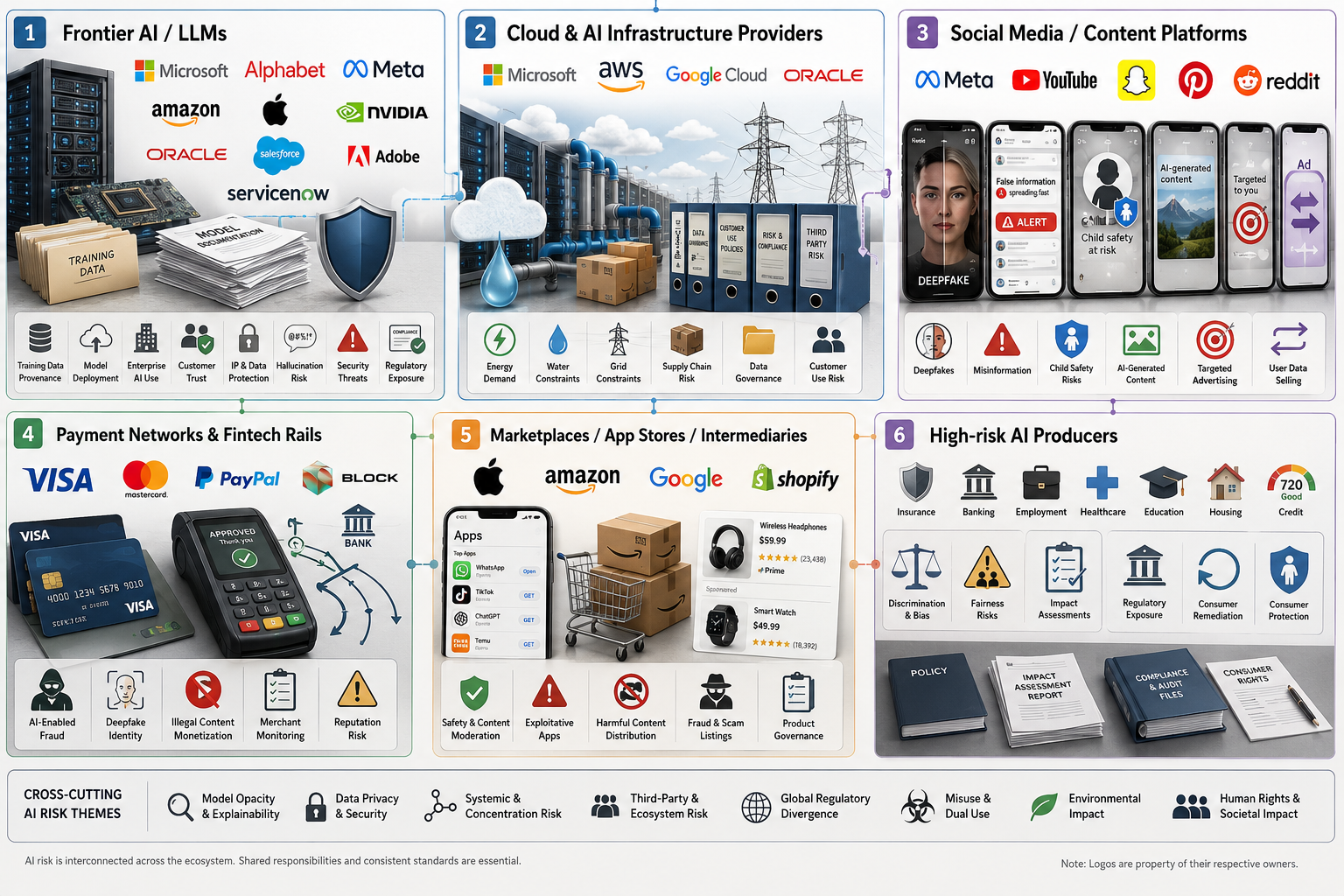
Companies in Focus
| AI Focus | Likely Companies | Rationale |
|---|---|---|
| Frontier AI/LLMs | Microsoft, Alphabet, Meta, Amazon, Apple, Nvidia, Oracle, Salesforce, Adobe, ServiceNow | Training data, model deployment, enterprise AI, customer trust, IP, hallucination, security, and regulatory exposure. |
| Cloud and AI Infrastructure Providers | Microsoft, Amazon, Alphabet, Oracle | Energy, water, grid constraints, supply chain, data governance, and customer-use risk. |
| Social Media / Content Platforms | Meta, Alphabet/YouTube, Snap, Pinterest, Reddit | Deepfakes, misinformation, child safety, AI-generated content, targeted advertising, and user-data selling |
| Payment Networks and Fintech Rails | Visa, Mastercard, PayPal, Block, banks with payment networks | Monetization of AI-enabled fraud, deepfake or illegal content, merchant monitoring, and reputational risk. |
| Marketplaces / App Stores / Intermediaries | Apple, Amazon, Alphabet, Shopify-type commerce platforms | Distribution of AI tools, exploitative apps, harmful content, fraud, product governance. |
| High-risk AI Producers | Insurers, banks, employers, healthcare, education, housing, credit platforms | Discrimination, impact assessments, regulatory exposure, and consumer recourse. |
Final Thoughts
AI-risk proposals may become the next higher-traction category in ESG-related shareholder engagement, even when filed by proponents linked to anti-ESG activism. Their strength is that they do not depend on broad support for ESG. They can be grounded in financial materiality, legal exposure, regulatory readiness, consumer trust, child safety, cybersecurity, intellectual-property liability, and board oversight.
That makes them more difficult to dismiss than many recent anti-DEI or anti-climate proposals, which continue to draw limited shareholder support. For companies, credible disclosure proves the strongest response to pressure and criticism. Companies will need to show who owns AI risk, how the board oversees it, what controls govern data and model deployment, how harms are tracked, and how management measures whether safeguards work.
In the next Rule 14a-8 season, the most exposed companies will be those using or monetizing AI aggressively while offering only generic principles, incomplete governance detail, or thin risk disclosure.
Additional Coverage
Additional coverage can be found on the author’s X account.