



After a Mild Hibernation, Anti-ESG Rhetoric Emerges with a Yawn.
The SEC’s proposed rollback of shareholder rights on the premise of political capture misreads market data, undermines investor autonomy, and itself politicizes reform without sufficient cause.
This past Thursday, the U.S. Securities and Exchange Commission Chair Paul Atkins proposed new limits on shareholder proposals, notably those of environmental and social (E+S) concerns, by allowing companies to block them under state corporate laws irrespective of existing, sufficient federal shareholder procedure.
Read: SEC’s updated shareholder proposal rules exclude E+S submissions
For background, the SEC does possess legitimate authority to revise Rule 14a-8, which governs shareholder proposals. That authority, however, carries a burden of proof: any revision the SEC imposes must demonstrate that any shareholder rights to engagement have become costly and are often either immaterial or unaligned with majority investor demand.
But no such case was made.
Notably for non-binding proposals that allow investors to recommend action on matters of climate disclosure, board composition, or political spending, Atkins has not grounded his petition empirically showing evidence of burden, loss, or overreach. Rather ironically, a regulatory narrative shaped by ideology instead of institutional realities appears. Atkins nonetheless frames E+S proposals as a material threat but not without raising red flags.

Declining Volume, Diminishing Impact
Whereas sufficient evidence lacks in Atkins’ own claims, such is not the case to the contrary. Shareholder proposals have actually declined by 45 percent during the 2025 proxy season among just S&P 1500 firms alone. Average support for such measures fell to 14 percent, marking the fourth consecutive annual decline. What Atkins seeks to curtail is already contracting organically without necessitating SEC intervention. Shareholder behavior continues adjusting in real time to changes in institutional priorities and risk appetite. This dynamic reflects functioning governance, not regulatory failure.
And even at historical peaks, E+S proposals rarely achieved a consensus as institutional investors very ably deprioritized proposals viewed as immaterial, redundant, or prescriptive through existing channels.
Likewise, money flows into U.S. ESG assets have reversed. Between 2021 and 2023, ESG fund inflows in the U.S. slowed sharply from $70 billion in 2021 to just $3 billion by late 2023. Outflows turned decisively negative as U.S. sustainable ETFs posted net outflows of $19.6 billion in 2024, with 2025 following suit thus far. Such money flows are forecast to remain flat or negative through 2026 as political pushback, greenwashing concerns, and benchmark underperformance dampen enthusiasm.
Atkins’ proposal seeks to constrain an oversight mechanism from a market threat whose evidence comes as either anecdote or estimate.

Regulatory Retaliation with Fiscal Costs
More ironical yet are the concerted, more expansive anti-ESG campaigns that have imposed measurable costs on public budgets in states where such sentiment is concentrated. State-level legislation vowing to protect from ESG creep has instead generated losses quite significant.
Texas legislation penalizing firms deemed to be hostile to fossil fuel industries cost municipal bond issuers in 2021 an estimated $303 million to $532 million in additional interest costs. Continuation of these constraints would cost $445 million annually. Oklahoma legislation increased municipal bond interest rates up to 16 percent, producing an estimated $164 million to $180 million in losses in under 18 months. And Missouri spent $1.2 million in taxpayer funds to enact and defend similar rules in court, only to lose. Tribunals have commenced in these states and others to investigate similar discrepancies, often at the behest of industry unions and workforce associations whose pensions have incurred real losses and forfeited gains. In Kansas (and similarly Indiana), draft anti‑ESG legislation was rolled back amid warnings from state pension officials that the proposed rules could lead to $3.6 billion (Kansas) or $6.7 billion (Indiana) in pension losses over 10 years.
Such costs in the name of regulatory symbolism call into question the true premise of such campaigns and the integrity of agency leadership and its immediate superiors.
 Markets, Misread
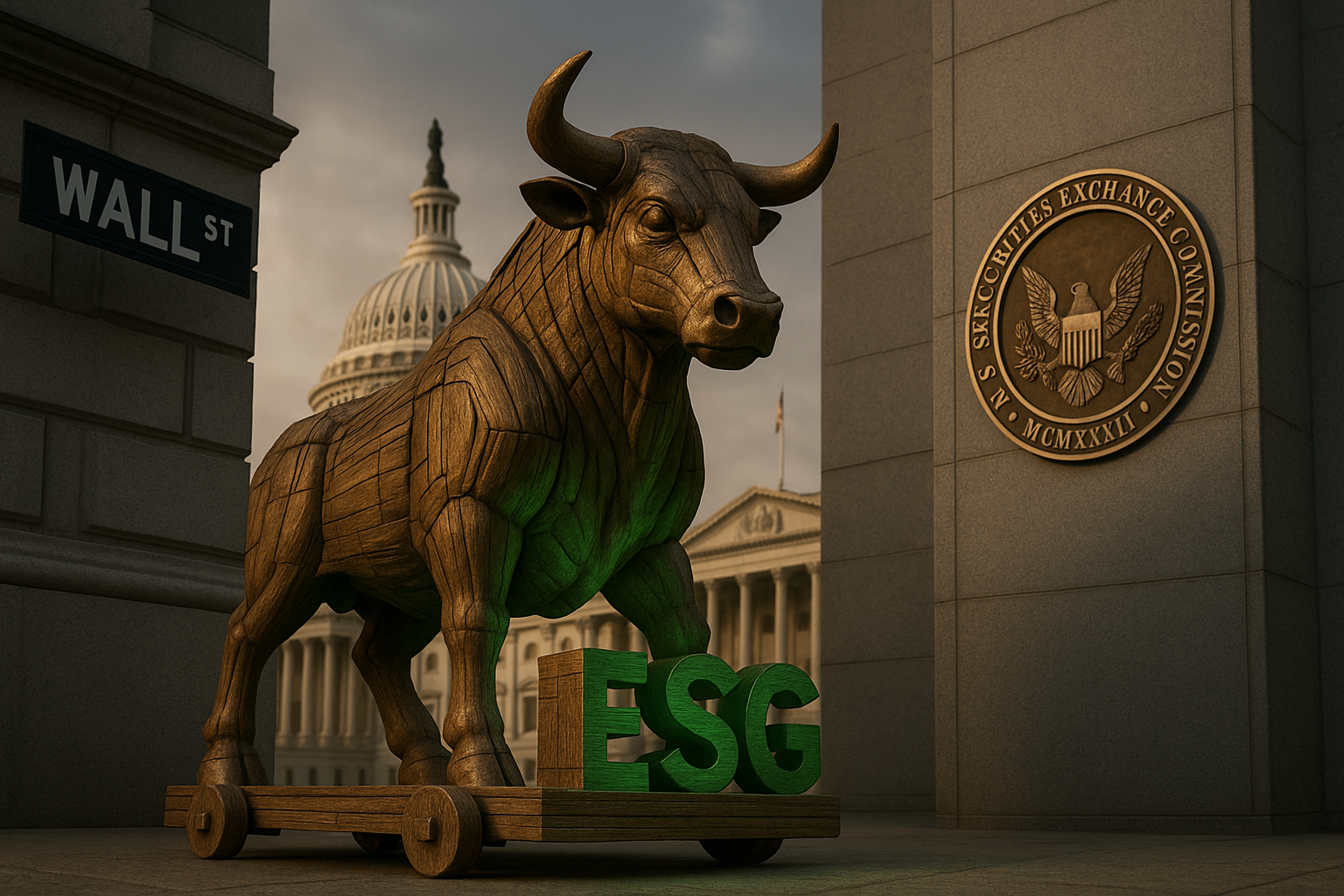
Above all, however, these anti-ESG initiatives reveal an ideological contradiction among its fanbase, as those who at once champion private enterprise and investor discretion now also advocate statutory constraints in what people can invest, what disclosures are allowed, and which corporate risks merit attention. ESG is treated as dangerous, then dismissed as trivial. Or as a joke until it gains traction, then as a threat when it does. ESG has morphed into a Trojan horse for progressive overreach by those who have historically vilified such market interference.
No state mandate compels ESG investing. No federal rule requires asset managers to prioritize sustainability over financial returns, thus preserving Friedman doctrine. If a private investor desires a climate-focused fund, the transaction reflects voluntary choice, not political subversion. The capacity to allocate capital based on risk, return, or ethical preference is a core free market function, government be damned. If an investor bases financial investments on any ideology, then that represents consumer choice: another pillar among historical conservative ideology.
What renders the SEC’s actions here additionally needless is that inflows to U.S. ESG funds often neither fund any environmental project, nor eradicate illegal labor practices, nor regenerate critical bioregions. More performative than proactive, such investments are as ideologically threatening as a student council coup. Unlike the European Union, which regulates sustainable investments under a legislated taxonomy, the U.S. has no comparable framework that neatly categorizes and validates the fidelity of such funds.
Yet the SEC persists in framing simple financial transactions as existential threats requiring policy intervention when, in fact, such investments amount to little more than moral grandstanding.
 A Proposal Without a Problem
There is nothing inherently improper in revisiting the conditions under Rule 14a-8. Regulatory agencies must evolve alongside institutional practices. But such revisions must be justified by empirical analysis, consistent with fiduciary logic, and narrow in scope to preserve shareholder rights.
Atkins’ petition meets none of these criteria. Rather than sufficiently validate levels of dysfunction in governance rampant enough to warrant interference, his proposal instead redefines the legal foundation of shareholder rights based on approximation and conjecture. And by asserting that Rule 14a-8 only applies to proposals permissible under state corporate law, companies could cite arbitrary state-level constraints like Delaware’s silence on non-binding proposals or Texas’s heightened ownership thresholds to exclude proposals that would otherwise qualify under current federal rules.
This shift amounts to regulatory gerrymandering, enabling companies to avoid engaging with investors merely by redomiciling businesses in legal jurisdictions that insulate from scrutiny. Shareholders of otherwise identical firms may then face drastically different rights based solely on the firm’s location. Access then becomes a function of geography, not governance.
This also injects uncertainty into the process: Companies navigating the labyrinth of overlapping federal and state rules will face greater litigation risk and SEC challenges that are purely procedural but potentially ruinous. Shareholders would encounter a patchwork of rights that undermines the very uniformity that Rule 14a-8 had been intended to provide. The result will be a splintered system by paranoic design.
Final Thoughts
Markets do not require ideological protection from investors. Regulation used to enforce cultural judgments rather than to correct structural failures is anathema to present Party principles. And shareholder governance is not strengthened by arbitrarily curating consensus.
Anything to the contrary is ideologically incompatible with free market capitalism. Unpatriotic, even.
Disclaimer
The views and opinions expressed in this article are solely those of the author and do not necessarily reflect the official policy, position, or opinions of TradersQue, LLC or its affiliates. All information is provided for informational purposes only and should not be construed as investment, legal, or other professional advice.
About the Author
Todd Anderson is Chief Operating Officer at TradersQue. He is a GRI-certified sustainability reporting professional experienced in designing, authoring, and aligning impact disclosures across corporate sectors, industry contexts, and reporting landscapes. He holds multiple advanced certifications spanning climate disclosure, framework and standards interoperability, and stakeholder engagement. He also advises on preparing sustainability disclosures for external assurance. Carbon credits and carbon markets guidance represent additional services.
He has authored sustainability reports in reference to the Global Reporting Initiative (GRI) and U.N. Sustainable Development Goals (SDGs), with additional alignment to the EU Corporate Sustainability Reporting Directive (CSRD) through the European Sustainability Reporting Standards (ESRS), as well as the Taskforce on Nature-related and Climate-related Financial Disclosures (TNFD/TCFD). His reporting integrates Greenhouse Gas (GHG) Protocol carbon accounting (Scopes 1–3) alongside SASB, IFRS/ISSB, and ISO 14000 guidance.
Additional Coverage
Additional coverage can be found on the author’s X and LinkedIn accounts.

🌿 From Compliance to Competitive Advantage:
Your Sustainability Story Starts Here
In global business, sustainability remains no longer a sidebar — it represents the storyline. At TradersQue, we guide organizations with disclosures ranging from CSR initiatives to basic ESG metrics to sustainability strategy and leadership, registering a narrative that resonates with investors, regulators, and stakeholders.
TradersQue delivers a viable framework for impact, investment, and integrity. Our reports are not simply documents; they are proof of foresight, accountability, and long-term value.
We align your assessed sustainability and ESG goals with the Global Reporting Initiative (GRI) Standards, the world’s most widely adopted sustainability reporting framework. We then identify what matters most through materiality analysis, and translate complex data into visual, stakeholder-ready reports for any business, from start-up enterprises to legacy conglomerates.
Through every stage, your organization gains:
- Visual, presentation-ready reports tailored for internal or public audiences
- Alignment with GRI Standards and UN SDGs for global recognition
- Sector-specific insights and optional third-party assurance preparation to enhance stakeholder confidence
With TradersQue, ESG and sustainability reporting become your company’s collective growth narrative—one grounded in data, shaped by vision, and certified for tomorrow’s global standards.
Your corporate resilience deserves recognition. Let us author its legacy.