



How Sweetwater & UEC’s Strategic Investment are Reshaping Uranium Royalty Corp.
TradersQue continues coverage on Uranium investments since 2022.
Uranium Royalty Corp. (NASDAQ: UROY) has completed the largest transformation in its history, but the company can no longer be analyzed apart from Uranium Energy Corp. (NYSE: UEC).
Uranium Royalty Corp | NASDAQ: UROY | Investing.com
The firms still serve different roles. UEC develops uranium mines and processing assets. UROY owns royalties and physical uranium. After Sweetwater, it also owns a large land and mineral-rights platform. Both firms track the uranium cycle, but they do not carry the same risks.
Uranium Royalty Corp. completed its acquisition of approximately 92% of Sweetwater Royalties on July 27, 2026. The acquired platform includes roughly 850,000 fee-surface acres and 4.5 million mineral-right acres.
The purchase consideration consisted of approximately $330 million in cash and about 223.3 million newly issued UROY shares. The transaction assigned an attributable equity value of approximately $1.1 billion to the acquired Sweetwater interest. Based on the transaction circular, the combined company was expected to have approximately 381.1 million shares outstanding, subject to final closing adjustments.
Uranium Energy Stock | NYSE: UEC | Investing.com
Uranium Energy Corp. contributed $40 million through an equity subscription priced at $3.64 per receipt. After closing, UEC held 28,967,375 UROY shares, equal to approximately 7.6% of the estimated post-transaction share count.
UROY also drew $40 million under a senior secured revolving credit facility to help fund the transaction. Sweetwater reported adjusted EBITDA of $66.2 million in 2025, compared with $80.8 million in 2024.

UROY No Longer Limited to Uranium
Just days ago, Uranium Royalty Corp closed a plan-of-arrangement deal combining UROY with entities that held about 92% of the Sweetwater royalty and land port. The new group now operates under a U.S.-based parent called Uranium Royalty Corp.
The deal added about 850,000 acres of fee-surface rights and 4.5 million acres of mineral rights. It also added royalties from five active trona mines as most of the estate lies in Wyoming, Utah, and Colorado. Its main source of current revenue is soda ash from trona deposits in Wyoming’s Green River Basin.
Uranium Royalty Corp: A Different Uranium Bet | TradersQue
This deal changes UROY’s financial profile. Before the purchase, UROY relied heavily on sales of physical uranium. Most of its uranium royalties covered projects that had not reached meaningful output. Sweetwater adds current income that does not depend on uranium mine growth.
Sweetwater is a material cash-flow asset, not only a future option. The Sweetwater entities reported adjusted EBITDA of about $66.2 million for 2025. That was down from $80.8 million in 2024. Royalty revenue for the three months ended March 31, 2026, was about $12.2 million. The same period in 2025 produced $19.0 million. Adjusted EBITDA is a non-GAAP measure and is not free cash flow.
The Flagship U.S. Uranium Producer: UEC | TradersQue
Management expects this cash-flow base to support new uranium royalty and streaming deals. In theory, UROY may need to sell less uranium inventory or issue less stock when it buys new assets.
Management still calls UROY uranium-focused and a pure-play uranium-listed company. Its economic base is now wider. Trona royalties, surface income, mineral rights, and other land uses are now material parts of the business.

UEC as Strategic Financial Partner
UEC bought 10,989,011 subscription receipts at $3.64 each. The purchase supplied about $40 million of equity for the Sweetwater deal. The receipts became shares when the deal closed.
NLR’s Nuclear Exposure Runs Deep | TradersQue
After closing, UEC held 28,967,375 New URC shares. The transaction circular estimated about 381.1 million shares after closing. On that basis, UEC owned about 7.6%, subject to final changes. UEC is a major strategic holder, but it does not control the company.
UEC’s importance is easier to assess by separating its functions from the risks each function creates. The table below shows how the relationship affects UROY’s capital base, asset exposure, and governance.
| UEC Role | UROY Gains | Investor Constraint |
| Strategic shareholder | A sizeable sponsor with about 7.6% of estimated post-closing shares. | Influence is meaningful, but UEC does not control UROY. |
| Transaction financier | $40 million of equity helped fund the Sweetwater closing. | The financing added shares and diluted existing owners. |
| Project operator | UEC advances assets that underlie some UROY royalties, including Roughrider and U.S. projects. | UROY cannot set UEC’s project schedule or capital budget. |
| Uranium producer | UEC gives the relationship direct exposure to mine output, processing assets, and uranium sales. | UEC carries permitting, operating, cost, and execution risk. |
| Potential royalty counterparty | Future deals could expand UROY’s uranium royalty base. | Related-party pricing and governance require close review. |
The structure is complementary rather than interchangeable. UEC offers operating leverage to uranium production. UROY offers financial claims on production, uranium inventory, and Sweetwater income. The link improves strategic capacity, but it also increases UROY’s dependence on UEC’s capital choices and on disciplined related-party oversight.
UEC Essentially Counters UROY for Value
UROY owns interests tied to several UEC-controlled assets. These include Roughrider in Saskatchewan and uranium projects in the United States.
Roughrider remains a development asset for UEC, which has completed drilling and technical work for further economic study. More progress could raise the value of UROY’s royalty interest.
India’s Energy Push Continues Going Nuclear | TradersQue
But UROY does not control the project schedule or UEC’s capital budget. That limit is central to the relationship. UROY benefits when UEC moves covered projects forward. UEC must still place capital where it expects the best return for its own holders.
Both firms benefit from stronger uranium prices, more utility contracts, higher U.S. output, and federal support for domestic nuclear fuel. Their interests may split on deal prices, project rank, and the timing of capital spending.
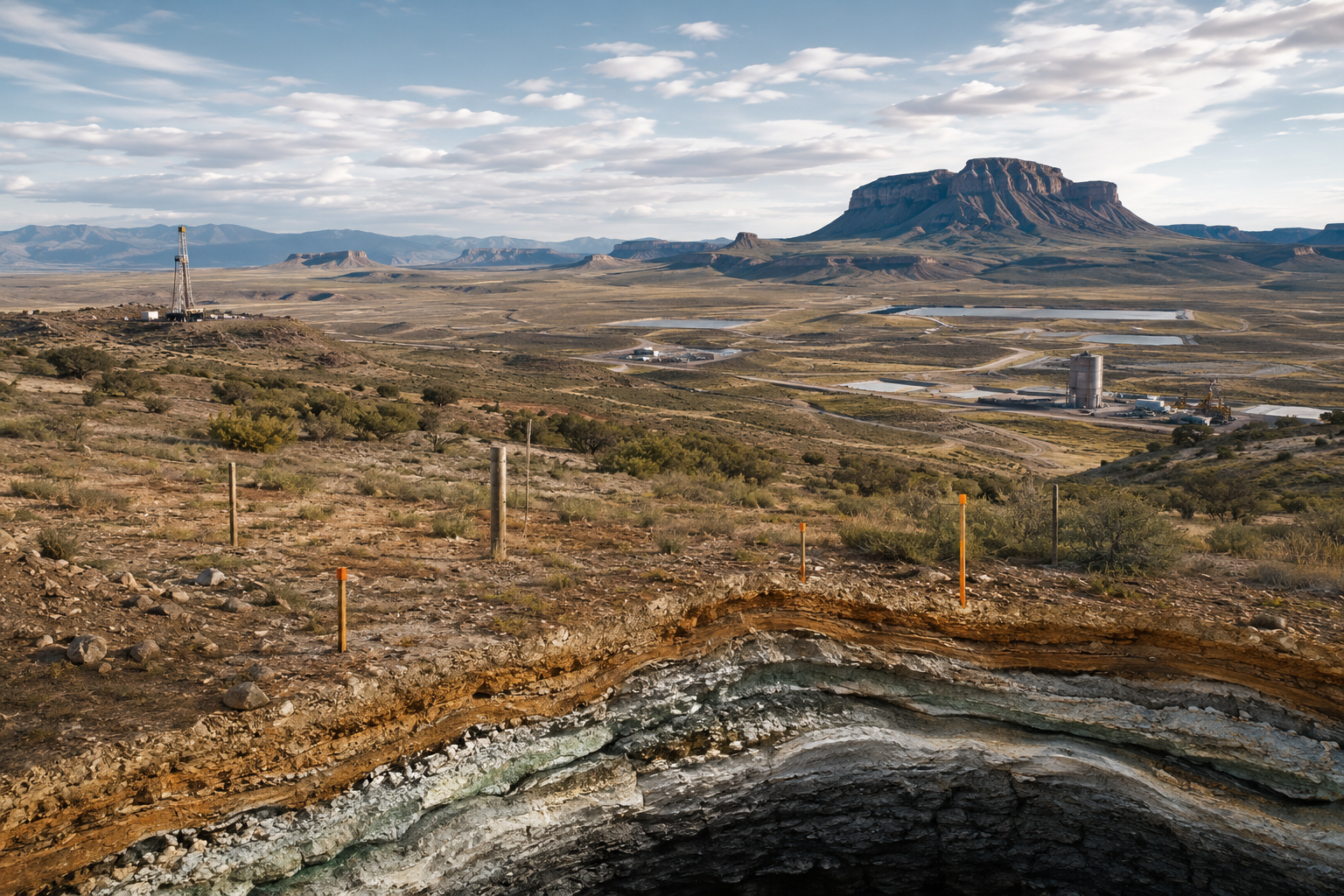
Burke Hollow Strengthens UEC’s Operating Case
UEC began production and ramp-up at its Burke Hollow in-situ recovery project in South Texas on April 8, 2026.
The site’s satellite ion-exchange plant links to UEC’s Hobson central processing plant. Hobson is licensed to produce up to 4 million pounds of uranium each year.
This step supports UEC’s status as an active U.S. producer, not only a holder of undeveloped resources. During its fiscal third quarter, UEC produced 32,195 pounds at Christensen Ranch, while Burke Hollow commenced operations and was expected to begin contributing production in the fourth fiscal quarter. UEC also reported about $794 million in liquid assets and no debt at the end of its fiscal third quarter.
Rare Earth & Critical Minerals Stocks in Focus | TradersQue
That balance sheet gives UEC more control over output timing and sales contracts than a highly indebted miner would have. It can fund wellfield and plant work without the same need to sell uranium in a weak market.
The benefit is real, but not complete. In-situ recovery still depends on permits, wellfield results, plant capacity, cost control, and steady capital spending.
Sweetwater Adds Cash Flow but also Dilution & Leverage
Sweetwater addresses a key UROY weakness: limited recurring royalty income. Its trona royalties add current revenue while uranium projects develop. Planned mine expansions may also raise UROY’s share of output without forcing it to fund mine construction.
Sweetwater improves UROY’s recurring income, but the purchase changed the company’s capital structure. The key terms below separate the asset contribution from the dilution, debt, and refinancing burden.
| Transaction | Reported Gains | Significance |
| Cash Consideration | About $330 million | A large upfront use of capital that raises the importance of sustained cash generation. |
| Shares Issuance | About 223.3 million New URC shares | Material dilution; total value must grow faster than the share count. |
| Weighted-average Shares | About 126.8 million legacy shares versus about 361.0 million combined shares in the pro forma period | Per-share cash flow and net asset value are more useful than total revenue growth. |
| UEC Financing | About $40 million | Strategic support, but also additional dilution. |
| Bridge Draw* | $40 million; matures January 31, 2027 | Creates a near-term refinancing and repayment test. |
| Long-term Debt | About $612.6 million | Makes interest coverage, debt reduction, and recurring Sweetwater cash flow central to valuation. |
* A bridge draw is a short-term borrowing used to complete a transaction before longer-term financing or other funds become available. In this case, UROY borrowed under its credit facility to help fund the Sweetwater acquisition.
The table does not establish whether the deal was accretive. It defines the test. Sweetwater must increase cash flow and asset value per diluted share after interest, transaction costs, and debt repayment. Until post-closing accounts provide those measures, claims of accretion remain expectations rather than demonstrated results.

Geography Creates Optionality, Not Evidence
The Sweetwater estate covers parts of Wyoming, Utah, and Colorado. It places UROY near uranium resources, energy assets, and possible federal nuclear projects.
That location may create future options. It does not prove that UEC invested to secure land near proposed federal nuclear campuses. The public record reviewed for this report does not establish that motive. No public agreement links UROY’s Sweetwater land to a Department of Energy nuclear campus. And UEC has not said that its investment aimed to gain access to those sites.
The shared name can also cause confusion. UEC’s Sweetwater project is a Wyoming uranium mine and processing project. UROY’s Sweetwater deal covers land and mineral rights led by trona royalties. They are separate assets. Nearby locations may allow future work together, but they do not prove current integration.
Federal Policy Supports the Sector, Not a Specific Asset
The Department of Energy chose Utah, Tennessee, Oklahoma, Louisiana, and Idaho as possible host states for more federal and state review under its Nuclear Lifecycle Innovation Campus plan.
A Nuclear Lifecycle Innovation Campus could include uranium enrichment, fuel fabrication, used-fuel reprocessing, waste management, and advanced nuclear development. The plan supports the broader view that U.S. policy increasingly favors a complete domestic nuclear fuel chain.
Federal support for the domestic nuclear industry has expanded substantially. In January 2026, the Department of Energy awarded $2.7 billion over 10 years to strengthen U.S. low-enriched uranium and high-assay low-enriched uranium capacity. In June, DOE announced a conditional $17.5 billion nuclear-supply-chain loan commitment intended to finance long-lead-time components and accelerate the deployment of 10 large commercial reactors.
The government is also evaluating Nuclear Lifecycle Innovation Campuses that could combine enrichment, fuel fabrication, used-fuel processing, advanced reactors, power generation, and co-located data centers. DOE estimates cited by the American Nuclear Society indicate that the proposed campuses could attract as much as $50 billion in capital investment. That figure represents potential investment associated with the campuses, not a $50 billion federal appropriation or confirmed government expenditure.
The initiatives support the broader UROY-UEC thesis by expanding prospective domestic demand for uranium, enrichment, processing capacity, and nuclear-fuel infrastructure. The policy trend may benefit both firms, but it is not committed revenue and should not enter either company’s asset value as though every proposed project were certain.

The Gist of it All
The two firms offer related but distinct forms of uranium exposure.
UEC supplies the operating platform. It owns uranium resources, licensed processing plants, physical stock, and active mines. It also has strong liquidity and direct exposure to U.S. nuclear-fuel policy.
UROY supplies the financial platform. It owns uranium royalties, physical uranium, buying capacity, Sweetwater mineral income, and a large U.S. land and mineral-rights base. UROY carries less direct mine risk. It depends more on outside operators, sound capital use, funding terms, and balance-sheet control.
Sweetwater income could fund new uranium interests. Royalty capital could help mine growth. Producers such as UEC could then bring covered projects into output and create new royalty income for UROY.
The model is still unproven at scale. It does not remove execution, dilution, debt, or valuation risk.
Final Thoughts
UEC is now a major shareholder and a source of deal funding. It also runs projects behind some UROY royalties and may take part in future royalty deals. Shared leadership through Amir Adnani makes the link more important. UEC and UROY still remain separate public companies.
The Sweetwater deal gives UROY current royalty income and a large land and mineral-rights base. It also brings heavy dilution, debt, refinancing risk, and non-uranium commodity risk.
UEC remains the more direct play on U.S. uranium output. UROY offers a mix of royalties, physical uranium, and land-based income. It carries less direct mine risk but relies more on other operators, deal discipline, and balance-sheet control.
The main issue is no longer only the uranium price. Sweetwater must raise value per diluted share after interest, deal costs, and debt payments.
UEC’s support improves UROY’s strategic position. Yet the deal must be judged by post-closing cash flow, debt, and per-share value. The size of the asset base is not enough.
Additional Coverage
Additional coverage can be found on the author’s X platform in addition to previous archives via TradersQue.com.