



Project Vault and the New Critical Minerals Cycle
Critical minerals and rare earth elements have transitioned from niche commodities into core strategic assets. This shift is not being driven by price cycles alone, but by geopolitics, national security concerns, and an evolving U.S. policy framework aimed at reducing dependence on China-dominated supply chains. Initiatives such as Project Vault, alongside Department of Energy and Department of Defense funding programs, are reshaping how markets view companies across the sector, from established producers to early-stage developers listed on both major exchanges and the OTC market.
Investing.com – Stock Market Quotes & Financial News
Why Critical Minerals Have Become a Strategic Priority
Rare earths, lithium, graphite, uranium, antimony, and other critical minerals underpin modern economic and military infrastructure. They are essential to electric vehicles, advanced batteries, semiconductors, renewable energy systems, and defense technologies. While many of these materials exist globally, production and more importantly, processing remains highly concentrated in a small number of countries, with China occupying a dominant position.
This concentration has transformed critical minerals into a policy issue rather than a purely commercial one. In response, U.S. legislation and agency programs increasingly emphasize domestic production, allied-nation sourcing, and strategic reserves designed to insulate manufacturers and defense systems from supply disruptions.
These materials are essential for:
-
Electric vehicles, batteries, and grid storage
-
Semiconductors, AI infrastructure, and consumer electronics
-
Defense systems, munitions, and aerospace components
-
Renewable energy technologies and advanced manufacturing
The challenge is not geological scarcity, but supply-chain concentration, particularly in processing. This reality has driven U.S. policymakers to support domestic production, allied sourcing, and strategic reserves across a widening list of minerals.
 Project Vault and Strategic Reserve Frameworks
Project Vault should be understood as part of a broader strategic-reserve and supply-chain resilience framework rather than a standalone policy. Its core objective is to support long-term access to critical materials through a combination of public funding and private capital, mirroring earlier models such as the Strategic Petroleum Reserve.
From a market perspective, the significance of Project Vault lies less in immediate material purchases and more in the signaling effect it provides. It reinforces government willingness to support domestic and allied supply chains, which in turn influences how investors and analysts evaluate companies with U.S.-based assets, processing capacity, or explicit alignment with federal priorities.
Project Vault objectives
-
Strategic Rare Reserve (SRR) concepts
-
DOE critical-minerals funding initiatives
-
DoD supply-chain security mandates
-
Federal permitting acceleration under recent legislation
From a market perspective, these frameworks favor companies with:
-
Domestic or allied-nation assets
-
Explicit inclusion in DOE or DoD programs
-
Exposure to defense-critical or battery-critical minerals
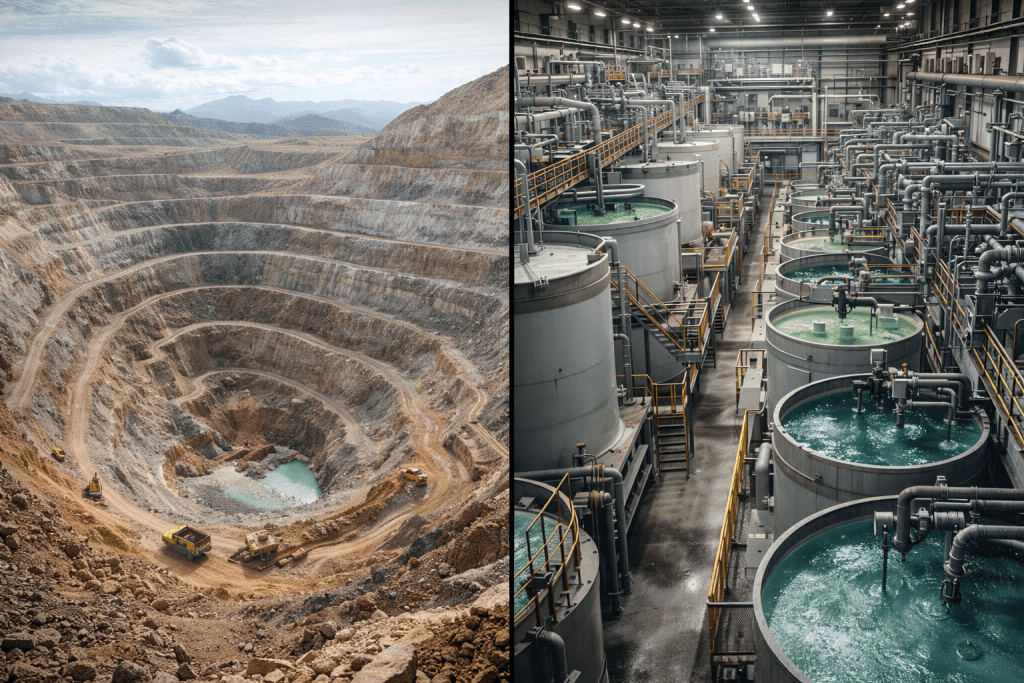 Understanding the Critical Minerals Supply Chain
Where the Bottlenecks Exist
Mining alone does not solve the critical minerals challenge. Processing, separation, and refining represent the most constrained and geopolitically sensitive segments of the supply chain. For rare earths and graphite in particular, China’s dominance in midstream processing has proven far more difficult to replicate than upstream extraction.
Furthermore, policy attention has increasingly focused on companies capable of supporting full or partial supply chains within the U.S. or allied jurisdictions. This distinction helps explain why some firms attract disproportionate attention relative to their current production levels.
As a result:
-
Vertically integrated companies gain strategic relevance
-
Processing assets attract disproportionate policy attention
-
Small-cap and OTC names often respond first to funding or bill language
 Major Listed Stocks Impacted by Project Vault Themes
MP Materials Corp. (NYSE: MP)
MP Materials operates the Mountain Pass mine, the largest, rare earth mining operation in North America. Its expansion into domestic processing places it at the center of U.S. rare earth supply-chain discussions and federal policy narratives.
Lynas Rare Earths Ltd. (OTC: LYSCF)
Lynas is the largest producer of separated rare earths outside China. As an allied-nation supplier with established processing, it is frequently referenced in Western diversification strategies.
Energy Fuels Inc. (NYSE: UUUU)
Energy Fuels bridges uranium and rare earth processing, particularly through monazite sands. Its U.S. processing footprint aligns with both nuclear-fuel and critical-minerals policy goals.
The Metals Company (NASDAQ: TMC)
TMC focuses on polymetallic nodules containing rare earths and battery metals. Its relevance is tied to long-term diversification narratives and regulatory outcomes rather than near-term production.
NioCorp Developments Ltd. (NASDAQ: NB)
NioCorp targets niobium, scandium, and rare earths within a U.S.-based project. These specialty metals are frequently cited in advanced manufacturing and defense applications.
Critical Metals Corp. (NASDAQ: CRML)
Critical Metals represents the exploration-stage segment of the rare earth market, where policy announcements and thematic momentum often drive attention before production begins.
VanEck Rare Earth & Strategic Metals ETF (NYSE: REMX)
REMX offers diversified exposure across producers, developers, and processors, often serving as a proxy for overall sector sentiment.

OTC / QB Stocks with Direct Policy Exposure
The following OTC and OTC-adjacent names have explicit alignment with U.S. policy language, DOE or DoD priorities, or strategic-reserve concepts.
United States Antimony Corp. (UAMY)
Mineral: Antimony
Antimony is one of the most defense-critical minerals, used in ammunition, flame retardants, and alloys. With minimal domestic production, UAMY stands out as one of the few U.S.-aligned processors connected to DoD supply-security priorities.
Texas Mineral Resources Corp. (OTCQB: TMRC)
Minerals: Rare earths, gallium, heavy REEs
TMRC’s Round Top project in Texas is frequently referenced in discussions around domestic heavy rare earth supply, particularly for defense electronics and magnet applications.
U.S. Gold Corp. (NASDAQ: USAU)
Minerals: Copper, gold
Copper is increasingly cited in strategic stockpile and permitting-acceleration language. Projects like Copper King (Wyoming) highlight the overlap between base metals and critical-supply policy.
Piedmont Lithium (OTCQX / NASDAQ: PLL)
Mineral: Lithium
Lithium remains central to DOE funding programs and domestic battery supply-chain initiatives. Piedmont is regularly cited within U.S. lithium ecosystem discussions.
Westwater Resources (NYSE-A: WWR)
Mineral: Natural graphite
The U.S. remains fully import-reliant for graphite. Westwater’s Alabama graphite project aligns directly with DOE battery-materials priorities and strategic-reserve considerations.
Emerald Resources NL (OTC: EMBYF)
Minerals: Rare earths, lithium (exploration)
Allied-nation sourcing plays a formal role in U.S. policy. Australian-linked explorers like EMBYF fit diversification strategies tied to Project Vault-style frameworks.
Manganese X Energy (OTCQB: MNXXF)
Mineral: Manganese
Manganese is listed on the DOE Critical Minerals List due to its importance in EV batteries. North American sources are emphasized in recent funding roadmaps.
Rare Element Resources Ltd. (OTCQB: REEMF)
Mineral: Rare earths
REEMF’s Bear Lodge project in Wyoming has been directly linked to DOE-funded rare earth separation demonstrations, giving it one of the clearest policy connections among OTC REE names.
PolyMet Mining Corp. (OTCQB: PLMNF)
Minerals: Copper, nickel, cobalt
Polymet’s NorthMet project sits at the intersection of multiple battery and defense-critical metals, all cited in federal permitting and supply-chain reform discussions.
UEX Corp. (OTCQX: UEXCF)
Mineral: Uranium
Uranium is explicitly included in U.S. nuclear fuel reserve programs, which operate alongside broader critical-minerals legislation and energy-security initiatives.
 Why Policy Often Moves Them First
OTC and QB-listed companies play a unique role in policy-driven cycles. These firms are typically smaller, earlier-stage, and more sensitive to shifts in legislative language, permitting reform, or agency funding announcements. As a result, they often move first when new policy frameworks emerge.
United States Antimony Corp., for example, operates in a segment that is repeatedly cited as defense critical. Antimony’s use in ammunition and flame retardants, combined with near-total U.S. import reliance, places it squarely within DoD supply-security discussions.
Texas Mineral Resources, through its Round Top project, is frequently referenced in conversations around domestic heavy rare earth supply, particularly for defense electronics. Similarly, Rare Element Resources stands out due to its direct involvement in DOE-funded rare earth separation demonstrations, giving it one of the most explicit policy linkages among OTC names.
 Battery and Energy Materials Expand the Policy Map
The critical minerals narrative extends well beyond rare earths. Lithium, graphite, manganese, and uranium are all increasingly embedded in U.S. policy language. Piedmont Lithium and Westwater Resources reflect the government’s focus on domestic battery material supply chains, while Manganese X Energy highlights the growing emphasis on manganese for EV batteries.
Uranium, through companies such as UEX Corp., operates in parallel with these initiatives via nuclear fuel reserve programs that share similar energy-security objectives.
Final Thought
Critical minerals and rare earths now sit at the intersection of economics, technology, and national security. Project Vault and related policy frameworks reinforce a long-term commitment to supply-chain resilience, bringing sustained attention to companies across the value chain. From large exchange-listed producers to OTC-listed developers, policy alignment has become a defining characteristic of relevance in the sector. This evolution underscores the importance of understanding not just what a company produces, but how it fits within the broader strategic priorities shaping the market.