



U.S. Manufacturing Investment Is Rising While Its Employment Growth Stalls
The United States does not lack manufacturing ambition. Yet trending employment data reveal that U.S. manufacturing continues increased vacancies but without broad labor growth. America has spent several years strengthening its case for reshored domestic manufacturing but all while sloppily selling the pitch. God help any conversation mentioning the ugly “T” word again.
Tariff. Tax. Tyranny.
Pick any one as all are fair game.
Subsidies, tax incentives, procurement rules, infrastructure spending, trade restrictions and national security concerns have continued to redirect Capex toward priced-out smart factories, unproven supply chains, and unaffordable technologies just to appease the headlines and the electorate.
Add in the aforementioned sloppy, political rhetoric that insists domestic production is both an economic imperative and a source of broadly shared employment, and common sense will immediately discover that that math just ain’t mathing.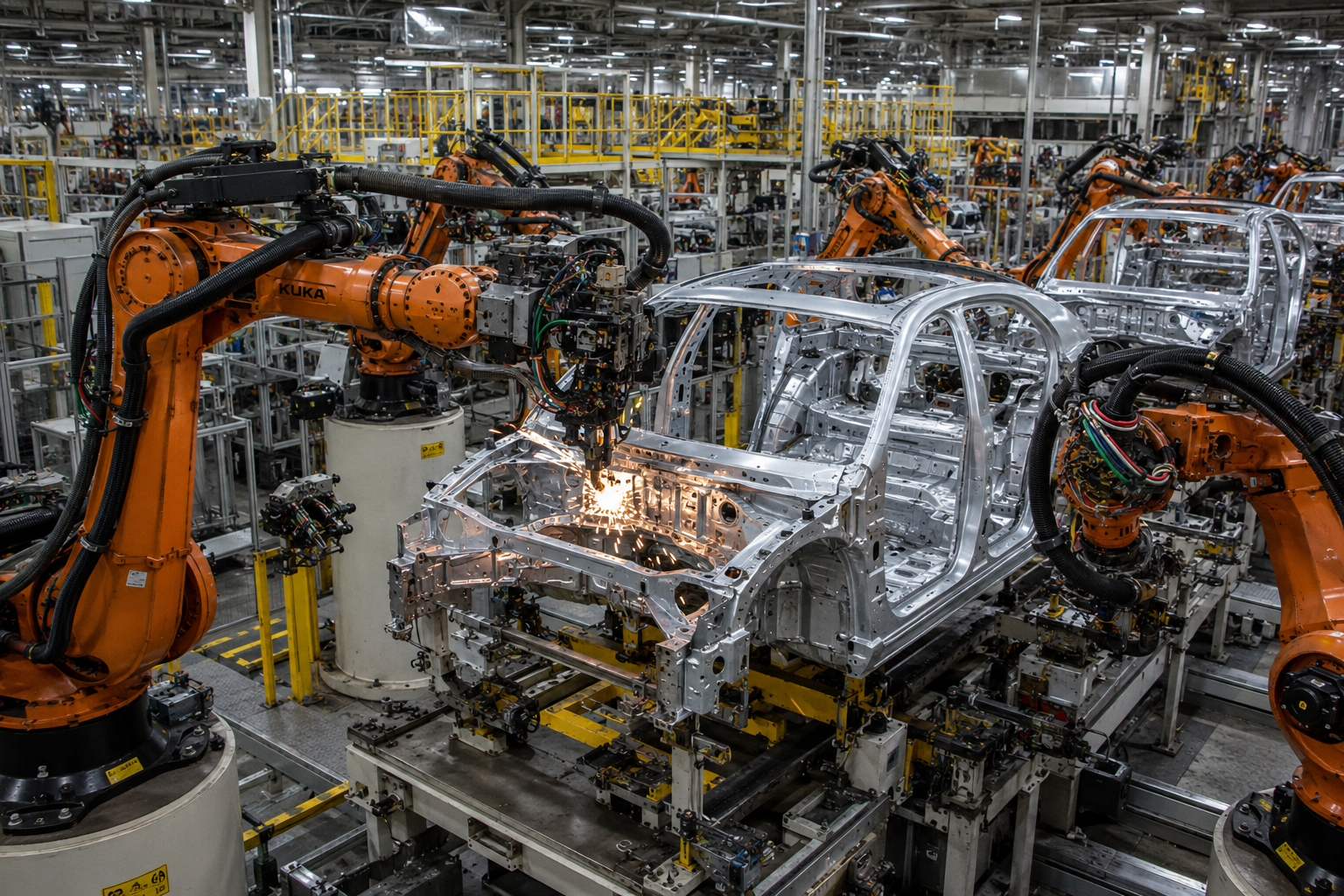
American manufacturing is attracting investment, announcing facilities, and reporting hundreds of thousands of vacancies, albeit with a recent legacy of “fake” job postings for roles that are neither hiring or existent. As such, this data does not reveal a productively broad, sustained national payroll growth. That gap is undoubtedly the central weakness in any U.S. manufacturing roadmap.
Seasonally adjusted manufacturing unemployment stood at 12.598 million in June 2026, according to the Bureau of Labor Statistics. That was 38,000 below the June 2025 level of 12.636 million, a YoY decline of 0.3 percent. A decline of 0.3 percent does not constitute industrial collapse. It does, however, contradict the proposition that American manufacturing has entered a broad-based employment expansion.
Political narratives too often conveniently collapse multiple, different developments into an oversimplified aggregate that conflates investment, production, and employment into a single metric. They are all related, but they are not interchangeable.
And the end metric trends largely to be incorrect.
A company can commit billions of dollars to a new facility without proportionally creating permanent jobs. Or any jobs at all. A strategically important industry can expand capacity even as employment contracts elsewhere in the same sector. And public incentives can alter the location of capital expenditure without materially changing the aggregate number of workers.
Industrial policy can succeed in strengthening productive capacity while producing much weaker employment effects than its advocates imply, tout, and deceive.
U.S. Manufacturing Vacancies & Turnover Trump Hiring
The Job Openings and Labor Turnover Survey (JOLTS) adds another layer to the diagnosis.
In May 2026, seasonally adjusted manufacturing job openings reached 529,000, up from 401,000 in May 2025. That represented an increase of 128,000 openings, or approximately 32%. Manufacturing hires rose much more slowly, from 276,000 to 287,000, an increase of 11,000, or approximately 4%. Total separations declined from 284,000 to 277,000. (June 2026 data is expected for release in early August 2026.)
The discrepancy is substantial as openings increased almost 12-fold as completed hires. Yet manufacturing employment still declined over the year.
Now, this neither establishes that American workers have rejected manufacturing, nor does it prove that employers face an economy-wide skills shortage. Rather, the data is more consequential: manufacturers reported substantially more demand for labor, but that demand did not translate into comparable hiring or net payroll expansion. That failure of transmission sits at the center of the sector’s labor problem.
Job openings measure positions available on the final business day of the month. Hires and separations measure payroll movements throughout the month. The categories therefore capture different dimensions of labor demand and turnover, and they should not be treated as if they were directly interchangeable. BLS also classifies the May 2026 estimates as preliminary.
Even with those qualifications, the imbalance cannot be dismissed. Employers reported more vacancies, completed only modestly more hires, and ended the period with fewer manufacturing employees than one year prior. A labor shortage alone does not fully explain that pattern.
Manufacturing Turnover Still Creates a Replacement Burden
The latest available BLS JOLTS data show that U.S. manufacturing’s turnover burden remained material in May 2026, even though total separations were not rising sharply year over year. BLS defines total separations as quits, layoffs and discharges, and other separations, including retirement, death, disability, and transfers to another location of the same firm.
| Category | May 2026 Total Separations & Rate | Annualized Turnover | Explanation |
|---|---|---|---|
| Manufacturing, total | 277,000 / 2.2% | 26.4% | Manufacturing still carried a large replacement burden. At this pace, exits would equal more than one-fourth of payroll in a year. |
| Durable goods manufacturing | 151,000 / 1.9% | 22.8% | Durable-goods manufacturers had less churn than the broader sector. Still, exits would equal close to one-fourth of payroll in a year. |
| Nondurable goods manufacturing | 126,000 / 2.6% | 31.2% | Nondurable manufacturing had the highest churn burden. At this pace, turnover would top 30 percent over a full year. |
The larger point is that turnover did not need to worsen for manufacturing employment to remain weak. A 2.2% monthly separations rate still creates a heavy replacement requirement. Before manufacturers can expand payrolls, they must first replace workers lost through quits, layoffs, discharges, retirements, disability, death, and internal transfers.
The Manufacturing Labor Market Is Not One Market
The broad manufacturing total also conceals substantial differences in classification among industries and sectors with persistent overlaps but that are often conflated or oversimplified.
Durable and nondurable manufacturing operate under different labor, capital and demand structures. Within those categories, conditions vary further among semiconductors, fabricated metals, food processing, chemicals, machinery, transportation equipment, textiles and aerospace.
June YoY Manufacturing Employment
| Manufacturing Sector / Industry | Jun. 2026 Employment | YoY # Change | YoY % Change | Signal |
|---|---|---|---|---|
| Total Manufacturing | 12.598M | -38.0K | -0.30% | Slight Decline |
| Durables | 7.840M | +7.0K | +0.09% | Flat Gain |
| Nondurables | 4.758M | -45.0K | -0.94% | Clear Decline |
| Wood Products | 391.9K | -13.1K | -3.23% | Strong Decline |
| Nonmetallic Minerals | 420.4K | +3.4K | +0.82% | Modest Gain |
| Primary Metals | 367.3K | +3.5K | +0.96% | Modest Gain |
| Fabricated Metals | 1.453M | +17.7K | +1.23% | Relative Strong Gain |
| Machinery | 1.084M | -3.4K | -0.31% | Slight Decline |
| Electronics | 995.1K | -1.9K | -0.19% | Slight Decline |
| Computers | 100.2K | +0.4K | +0.40% | Flat Gain |
| Communications | 82.6K | +3.8K | +4.82% | Strong Gain |
| Semiconductors & Electronic Components | 368.6K | -11.9K | -3.13% | Strong Decline |
| Electronic Instruments | 417.2K | +7.9K | +1.93% | Relative Strong Gain |
| Electrical Equipment & Appliances | 440.3K | +10.5K | +2.44% | Moderate Strong Gain |
| Transportation Equipment | 1.743M | -2.1K | -0.12% | Negligible Decline |
| Motor Vehicles & Parts | 949.6K | -21.4K | -2.20% | Strong Decline |
| Furniture | 330.8K | -8.9K | -2.62% | Strong Decline |
| Misc. Durables | 613.9K | +0.4K | +0.07% | Flat Gain |
| Food Manufacturing | 1.771M | -13.9K | -0.78% | Clear Decline |
| Textile Mills | 77.8K | -4.2K | -5.12% | Strong Decline |
| Textile Product Mills | 93.8K | -0.2K | -0.21% | Negligible Decline |
| Apparel | 72.6K | -6.4K | -8.10% | Strong Decline |
| Paper Productd | 356.5K | +1.4K | +0.39% | Flat Gain |
| Printing | 340.0K | -5.2K | -1.51% | Weak |
| Petroleum & Coal | 109.9K | +0.7K | +0.64% | Modest gain |
| Chemicals | 903.1K | +2.8K | +0.31% | Flat/slight gain |
| Plastics & Rubber | 687.1K | -16.2K | -2.30% | Moderate-to-Strong Decline |
| Misc. Nondurables | 346.6K | -3.3K | -0.94% | Clear Decline |
The earlier sectoral analysis showed employment gains concentrated in a limited number of industries, including communication equipment, electrical equipment and appliances, electronic instruments and fabricated metals. Losses were more pronounced in apparel, textile mills, wood products, semiconductor and electronic components, motor vehicles and parts, furniture, plastics and rubber products, and food manufacturing.
This dispersion matters because the phrase “manufacturing resurgence” implies a breadth that the data do not establish. Selected industries may expand because of federal incentives, defense demand, infrastructure investment, energy-system modernization or technology spending. Other industries may remain exposed to import competition, weak consumer demand, productivity pressures, consolidation or long-term structural contraction.
A semiconductor fabrication plant and an apparel factory share a statistical category but little else. Their capital requirements, labor intensity, wage structures, training pipelines and exposure to international competition differ sharply. Treating them as a unified employment system produces policy imprecision.
The United States may be experiencing a strategic reallocation within manufacturing rather than a general manufacturing labor revival.
Such a reallocation could still carry considerable economic and geopolitical value. Employment volume, however, cannot be inferred from strategic importance. Industries central to defense, computing, communications or energy infrastructure often require substantial capital but comparatively limited direct labor. Their expansion can strengthen national capacity without recreating the employment density associated with earlier phases of industrialization.

The “Worker Shortage” is a Myth
Manufacturers frequently describe recruitment difficulties as evidence that workers are unavailable, insufficiently trained or unwilling to enter industrial occupations. Those constraints may be real in particular regions and occupations. The aggregate data do not establish that they are the only, or even the dominant, cause of weak employment growth.
A posted vacancy is not a neutral measurement of labor scarcity. It reflects an employer’s preferred combination of wages, location, scheduling, credentials, experience and working conditions.
When a position remains unfilled, several explanations are possible. The local labor market may lack the required technical skills. The facility may sit beyond practical commuting distance from available workers. The wage may not compensate for shift work, physical demands or schedule volatility. Qualification requirements may exceed the actual needs of the position. Employers may also keep openings active while delaying or limiting hiring because of uncertainty about demand, financing or production schedules.
The available national data cannot determine the relative importance of these explanations. They do, however, challenge the assumption that every unfilled manufacturing job represents a worker deficit.
Some vacancies may reflect a pricing problem.
Labor markets allocate workers partly through compensation. Employers facing persistent recruitment difficulties can increase wages, improve schedules, invest in training, reduce unnecessary credential requirements or redesign jobs. When firms instead maintain vacancies without materially increasing completed hires, the constraint may lie as much in the employment offer as in the labor supply.
This does not imply that compensation alone resolves every shortage. Skilled trades, engineering roles and specialized production occupations can require years of training. Regional demographic decline can leave facilities with genuinely limited labor pools. Housing costs and weak transportation infrastructure can prevent workers from moving closer to expanding industrial centers.
But those are institutional and investment problems, not evidence of an abstract national unwillingness to work.
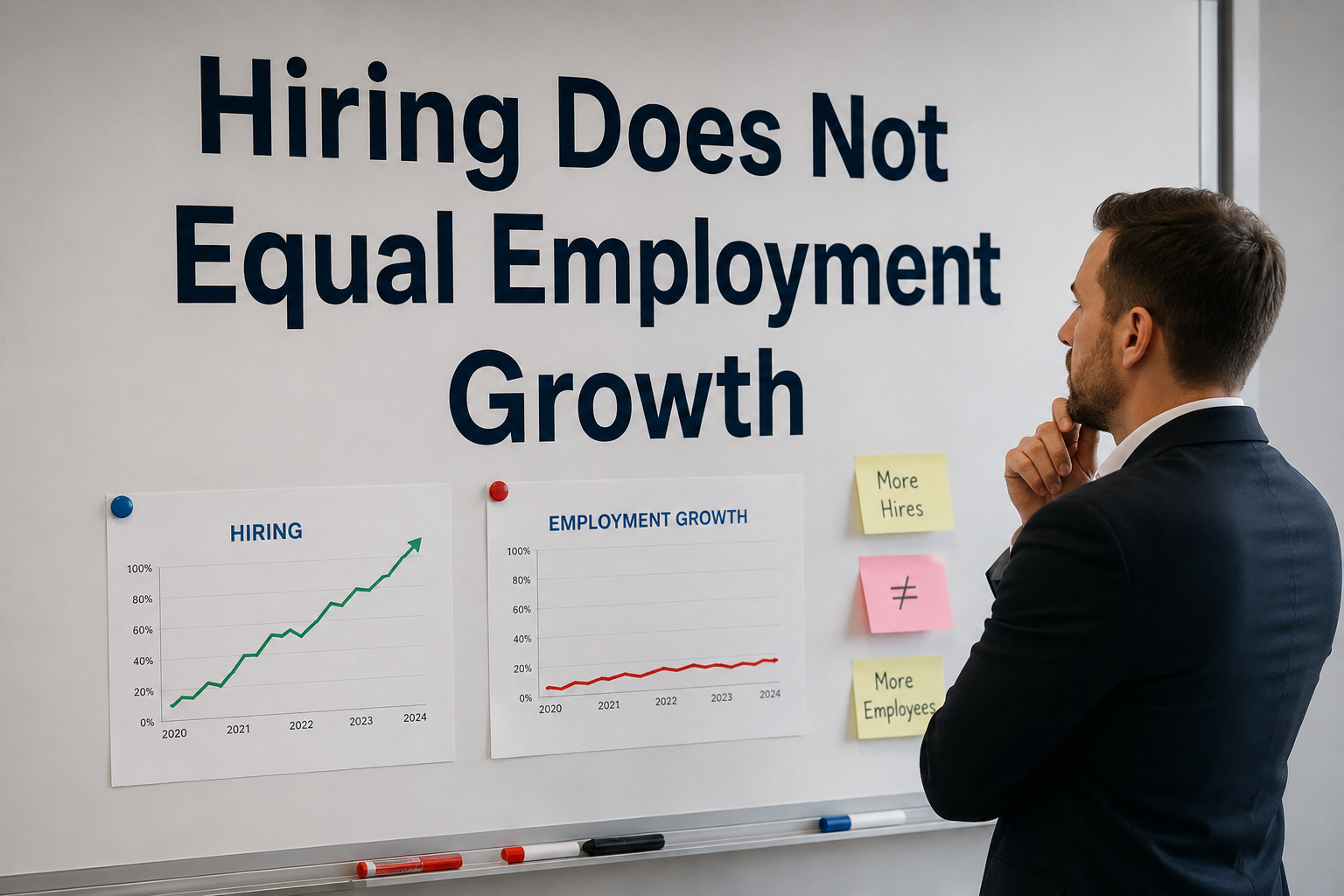
Hiring Does Not Equal Employment Growth
The labor debate also suffers from a basic accounting failure.
A company can hire thousands of workers while producing no net employment growth if a similar number leave, retire or lose their positions. Hiring measures gross inflows. Payroll employment reflects the net outcome after labor-market flows and business changes have taken effect.
In May 2026, manufacturing recorded 287K hires and 277K total separations. Those figures suggest a positive monthly flow balance of approximately 10,000, subject to survey error and revision. Yet total manufacturing payrolls remained lower than one year earlier.
There is no contradiction. Monthly JOLTS flows and CES employment levels measure different concepts and come from different surveys. A single month’s positive balance does not negate cumulative weakness over the preceding year. It also does not capture establishment births, closures, benchmark revisions or every source of difference between the two programs.
The broader point remains: a high volume of hiring activity does not demonstrate that an industry is expanding.
Turnover can create the appearance of dynamism while leaving the employment base unchanged. Firms repeatedly recruit to replace departing workers, spending more on hiring without adding productive capacity or institutional knowledge. In that environment, vacancy counts rise, recruitment pressure persists and payroll growth remains weak.
The labor problem becomes one of retention and job quality as much as attraction.

Offshoring Cannot Be Isolated from These Data
The employment weakness also requires caution in assigning causality.
BLS payroll data measure workers employed by domestic establishments. They do not identify why a position disappeared or failed to materialize. The statistics cannot distinguish among offshoring, automation, weak demand, productivity gains, business closures, consolidation, import competition, supply constraints or changes in corporate organization.
Offshoring remains part of the historical and strategic context of American manufacturing. Production networks developed over decades cannot be reconstructed instantly, and some firms continue to allocate labor and production across borders. But the current employment figures do not permit a reliable estimate of how much of the year-over-year decline resulted specifically from foreign relocation.
Claims that offshoring fully explains present payroll weakness therefore exceed the evidence.
The same limitation applies to automation. Capital-intensive technology can reduce labor requirements per unit of output, but aggregate employment data alone do not measure the number of jobs displaced by machinery, software or process redesign. Automation may eliminate some tasks, complement others and create demand for different technical occupations.
The reliable conclusion is more restrained: domestic manufacturing payrolls declined despite increased reported vacancies, and the available national data do not identify a single cause.
Industrial Policy Has Favored Capital Formation
The employment gap reflects a deeper imbalance in the architecture of American industrial policy.
Government programs can subsidize construction, equipment, research, energy use and production. They can reduce a company’s cost of locating a facility in the United States. They cannot, by themselves, create a functioning regional labor market.
Factories depend on a broader institutional system: technical education, apprenticeships, transportation, housing, childcare, health care and predictable career progression. Workers evaluate jobs within that system. A higher hourly wage may not overcome a long commute, unstable scheduling, expensive housing or the absence of childcare. A training program has limited value when participants cannot afford to remain out of full-time work long enough to complete it.
This is where the American manufacturing strategy remains underdeveloped. It treats the plant as the principal unit of industrial policy while treating the workforce as an input expected to appear after the capital commitment.
That sequence is increasingly unsustainable.
Labor supply must be built alongside productive capacity. Training must connect directly to actual positions and wage progression. Regional planning must account for housing and transportation constraints. Employers must share the cost of developing skills rather than expecting workers or public institutions to absorb the full burden. Public subsidies should carry measurable employment and training obligations where those objectives form part of the political justification for the support.
Without that scaffolding, industrial subsidies can produce facilities that compete for the same limited pool of experienced workers, raising vacancy counts without materially expanding the labor force.
Productivity Complicates the Employment Narrative
Manufacturing policy must also confront a politically uncomfortable reality: higher output does not necessarily produce large employment gains.
Modern manufacturing is more capital intensive than the industrial system embedded in much of the national political imagination. Robotics, software, advanced machinery and process automation allow factories to produce more with fewer workers. This can improve productivity, reduce costs and strengthen international competitiveness. It can also weaken the relationship between industrial investment and employment growth.
A new advanced manufacturing facility may create fewer direct jobs than an older plant while generating greater output. From a strategic perspective, that can represent progress. From a regional employment perspective, the outcome may be less transformative.
The policy error lies in refusing to distinguish the two.
Industrial capacity deserves evaluation through output, productivity, supply-chain security, technological capability and resilience. Employment policy deserves evaluation through job creation, compensation, retention, mobility and access. A project may perform well under one framework and poorly under the other.

U.S. Manufacturing Is Embarassingly Underperforming
The relative comparison reinforces the diagnosis.
Manufacturing’s 0.3 percent year-over-year employment decline placed it below the broader private labor market. Health care and social assistance continued to add workers, while manufacturing remained essentially flat to negative. The June 2026 BLS release showed monthly job growth continuing in health care and social assistance, even as manufacturing recorded only a small monthly increase after prior declines.
This does not mean service-sector growth is inherently superior to manufacturing growth. Manufacturing supports exports, research, supply chains, regional productivity and national-security capacity. Its indirect economic effects can exceed its direct employment count.
But as a destination for net new workers, manufacturing is not currently outperforming the wider economy.
That finding should change the language used by policymakers and executives. Sub-1 percent employment changes should not be described as substantial growth. A subsector adding 0.3 or 0.8 percent year over year is holding ground, not undergoing a labor revival. Even growth above 1 percent requires context when the base is small or the expansion follows earlier losses.
Precision matters because inflated descriptions obscure the scale of the policy challenge.
A Better Standard for Measuring Manufacturing Policy
The United States needs a more disciplined framework for evaluating industrial policy.
Announced investment is not enough. Construction employment is not the same as permanent manufacturing employment. Job openings are not completed hires. Hires are not net job creation. Production growth is not equivalent to labor-force expansion.
A serious assessment should examine several outcomes together:
- Sustained manufacturing payroll growth after construction ends;
- Inflation-adjusted wage gains and benefit quality;
- Retention and separation rates;
- Apprenticeship enrollment and completion;
- Conversion of trainees into permanent employees;
- Local labor-force participation;
- Supplier and logistics employment;
- Productivity and domestic value added;
- Operational persistence after public incentives expire.
These measures would distinguish durable industrial development from subsidized capital expenditure with limited labor-market transmission.
Public reporting should also separate direct, indirect and induced employment. Companies and political officials often aggregate them into a single headline number, even though the categories carry different levels of certainty. Direct manufacturing jobs can usually be observed. Supplier effects require modeling. Induced employment depends on assumptions about local spending and economic multipliers.
The more remote the claimed employment effect, the greater the need for methodological transparency.
Employers Must Reassess Industrial Employment
Corporate strategy also requires adjustment.
Manufacturers cannot treat labor shortages solely as external constraints while leaving job design unchanged. Persistent vacancies should trigger examination of compensation, scheduling, training, credential requirements, management quality and advancement pathways.
An industrial employer competing with health care, construction, logistics and technical services must offer more than nostalgia about the social value of manufacturing. Workers make allocation decisions under financial and household constraints. They respond to predictable earnings, stability, mobility and working conditions.
The industry’s labor proposition has often relied on an outdated assumption: manufacturing work is intrinsically attractive because it provides tangible production, relatively strong wages and long-term security.
That proposition has weakened in many parts of the sector. Temporary staffing, rotating shifts, mandatory overtime, plant closures and cyclical layoffs have reduced the credibility of lifetime industrial employment. Some firms still provide strong compensation and advancement. Others ask workers to accept industrial discipline without offering industrial security.
Recruitment campaigns cannot resolve that asymmetry.
Manufacturers seeking durable labor supply must rebuild the institutional bargain. Training should lead to recognized credentials and wage progression. Employees should understand how skills translate into advancement. Scheduling should become more predictable where production systems permit it. Supervisory quality should receive the same operational attention as equipment efficiency.
Retention is not a secondary human-resources metric. It is a productive asset.
The Strategic Case Remains Strong
None of this weakens the strategic argument for domestic manufacturing.
The United States needs productive capacity in sectors where foreign dependency creates economic or security exposure. Defense production, semiconductors, communications equipment, pharmaceuticals, energy systems and critical infrastructure carry significance beyond their immediate payroll counts.
A narrow employment test would undervalue those capabilities.
But strategic importance should not become a license for imprecise economic claims. A policy designed primarily to strengthen resilience should be defended on resilience grounds. A subsidy intended to develop technology should be measured against technological capability. When employment creation forms part of the justification, policymakers should report actual permanent jobs and retention outcomes rather than announced vacancies or projected multipliers.
Institutional credibility depends on matching claims to results.
The Real Constraint Is Conversion
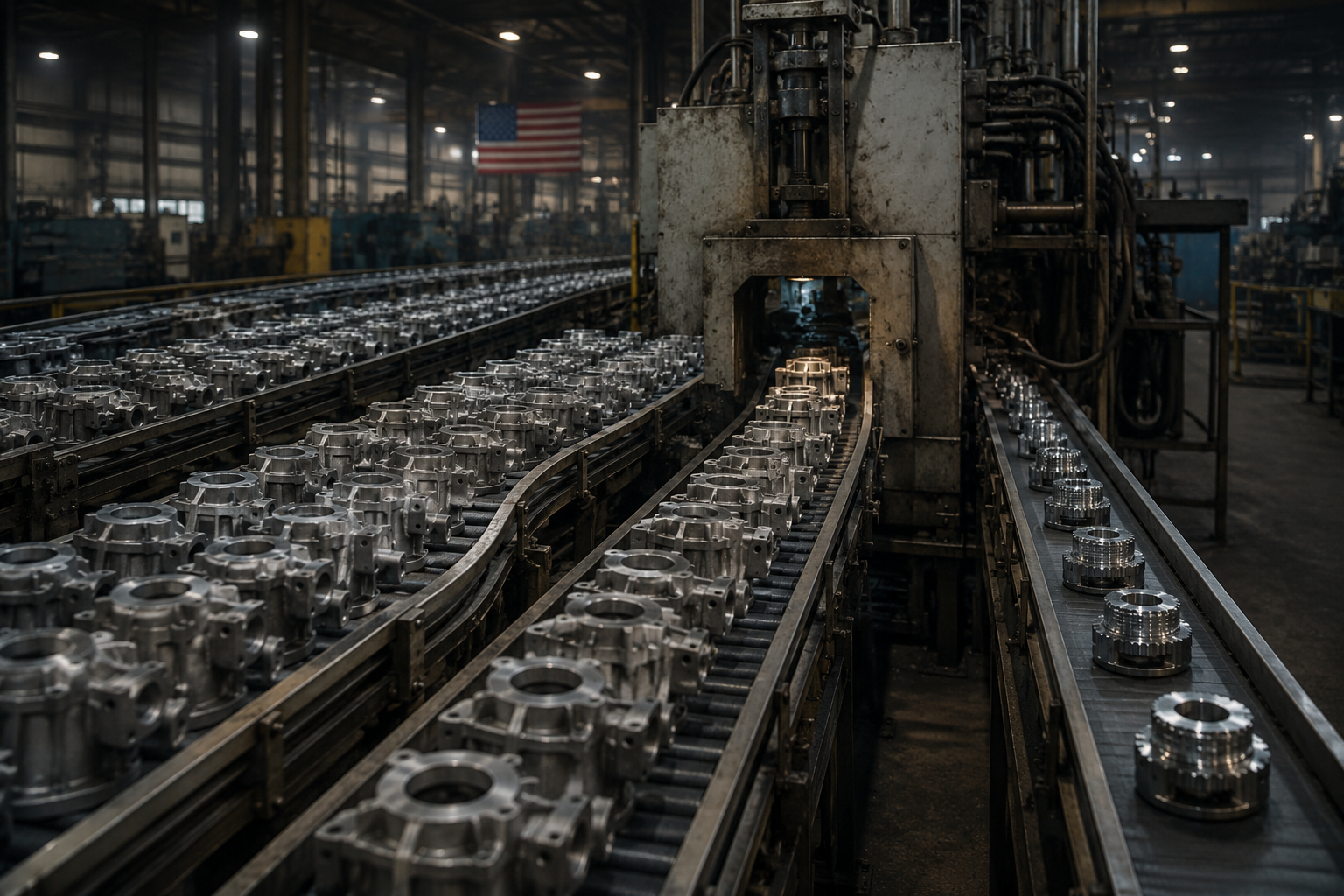
The central weakness in American manufacturing is not simply that the sector cannot find workers. It is that the industrial system is failing to convert capital commitment and reported labor demand into broad, durable employment growth.
The causes likely differ across subsectors and regions. Skills mismatch, compensation, geography, demographic constraints, automation, weak end-market demand, employer selectivity and long-term industrial restructuring may all contribute. The national data do not establish the precise share attributable to each force.
They do establish that the current strategy is incomplete.
The United States has created stronger incentives to build factories. It has not yet created a labor-market system capable of turning those factories into a broad employment expansion. Capital policy has moved faster than workforce policy. Vacancy creation has moved faster than hiring. Strategic rhetoric has moved faster than payroll growth.
A genuine manufacturing revival will require more than plants, subsidies and job postings. It will require an employment model that workers can enter, sustain and trust.
Until that conversion occurs, America will continue building manufacturing capacity without building a manufacturing workforce.
Additional Coverage
Additional social media coverage can be found on the author’s X platform.