



AI Security Promises vs Engineering Reality
Artificial intelligence has rapidly moved from experimental labs to boardroom strategy, and nowhere is the excitement louder than in cybersecurity. Recent claims around AI-driven vulnerability detection and autonomous remediation have amplified investor enthusiasm, fueled sharp stock movements, and reignited debate over whether generative models can fundamentally disrupt traditional security infrastructure.
Cybersecurity stocks drop as Anthropic launches Claude Code Security tool By Investing.com
The narrative is compelling: intelligent systems that not only identify complex vulnerabilities but also simulate attacks and deploy production-ready fixes at scale and without human intervention. For markets hungry for the next structural shift, that promise signals efficiency, cost reduction, and competitive advantage.
Yet cybersecurity is not a theoretical domain, it is an engineering discipline grounded in execution, runtime behavior, architecture, and rigorous validation. The distinction between assisting developers and autonomously securing systems is not semantic, it is foundational.
This article examines the widening gap between market narratives and technical reality, analyzing whether current generative AI capabilities align with the sweeping claims now influencing investor sentiment and cybersecurity valuations.
Rates Risk Off and the Trump Factor Shape Markets
 The Core Claim: Autonomous AI Security
Recent narratives suggest that advanced AI models can identify non-trivial vulnerabilities, simulate attacks, detect systemic coding weaknesses, and even generate production-ready patches. Framed this way, the implication is clear: autonomous comprehension and remediation at scale.
But there is a meaningful difference between AI-assisted pattern recognition and true autonomous engineering judgment. In cybersecurity, that distinction is not subtle, it is critical.
Code Errors Are Not Just Text Problems
Large language models generate output by predicting statistically likely sequences of tokens. They do not execute code, evaluate runtime state, or formally reason about system behavior. That limitation matters because real-world vulnerabilities rarely exist at the syntax layer.
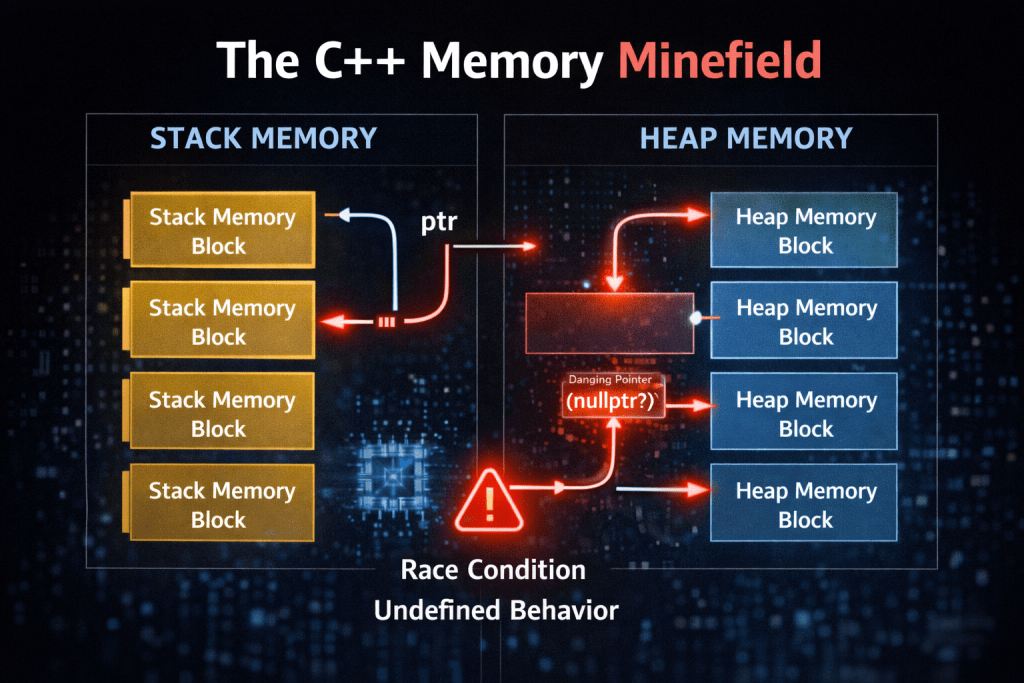 C++: The Memory Minefield
In production C++ environments, issues often revolve around memory ownership violations, undefined behavior, template complexity, concurrency race conditions, and ABI compatibility conflicts. Many of these problems compile cleanly and only fail under specific runtime or concurrency conditions.
An AI-generated fix may look correct on inspection while quietly introducing a race condition, violating RAII guarantees, breaking allocator contracts, or triggering silent undefined behavior. These are not obscure edge cases; they are everyday realities in complex C++ systems.
 Python: Dynamic Doesn’t Mean Simple
Python’s flexibility does not eliminate complexity. Production failures frequently stem from dependency mismatches, async event loop deadlocks, serialization inconsistencies, environment-specific state bugs, or subtle API contract violations. These are architectural and contextual failures, not just syntactic mistakes.
While AI can rewrite a function or suggest cleaner logic, it cannot validate distributed system behavior, confirm runtime compatibility, guarantee idempotency in asynchronous workflows, or ensure deterministic behavior under concurrency. Those outcomes require execution, testing, and domain expertise.
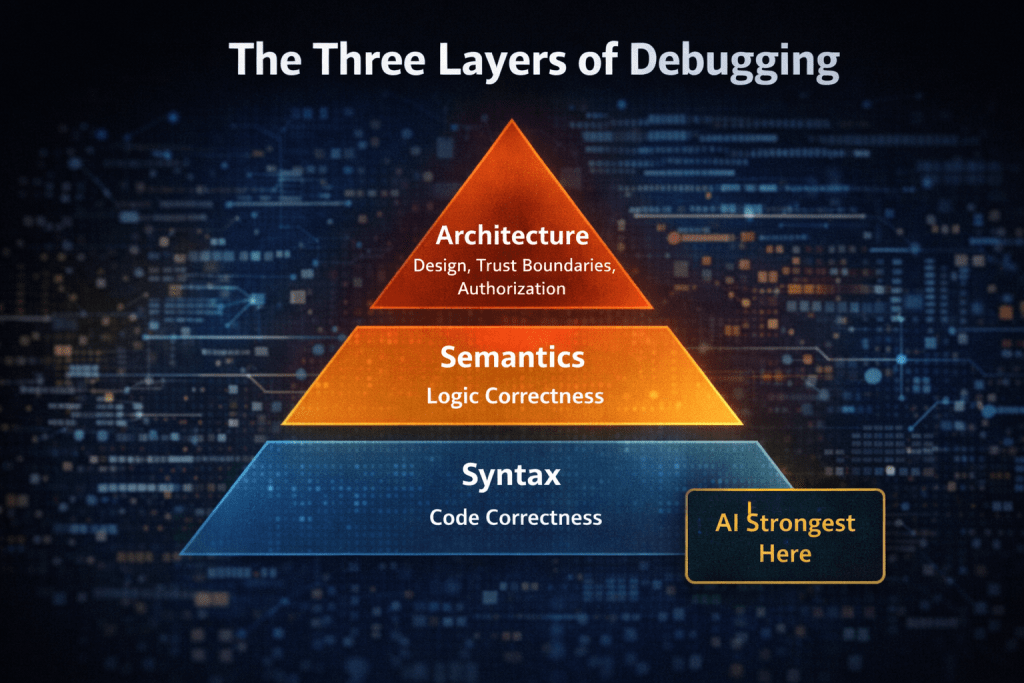 Syntax vs. Semantics vs. Architecture
Debugging operates across three levels: syntax correctness, semantic correctness, and architectural correctness. AI tools are often helpful with syntax and can sometimes approximate semantic reasoning. Architectural flaws, however, remain a different category entirely.
Most security vulnerabilities arise from broken trust boundaries, misapplied cryptography, flawed authorization logic, microservice data leakage, or improper sandboxing. These are design failures. They cannot be reliably solved through token prediction alone.
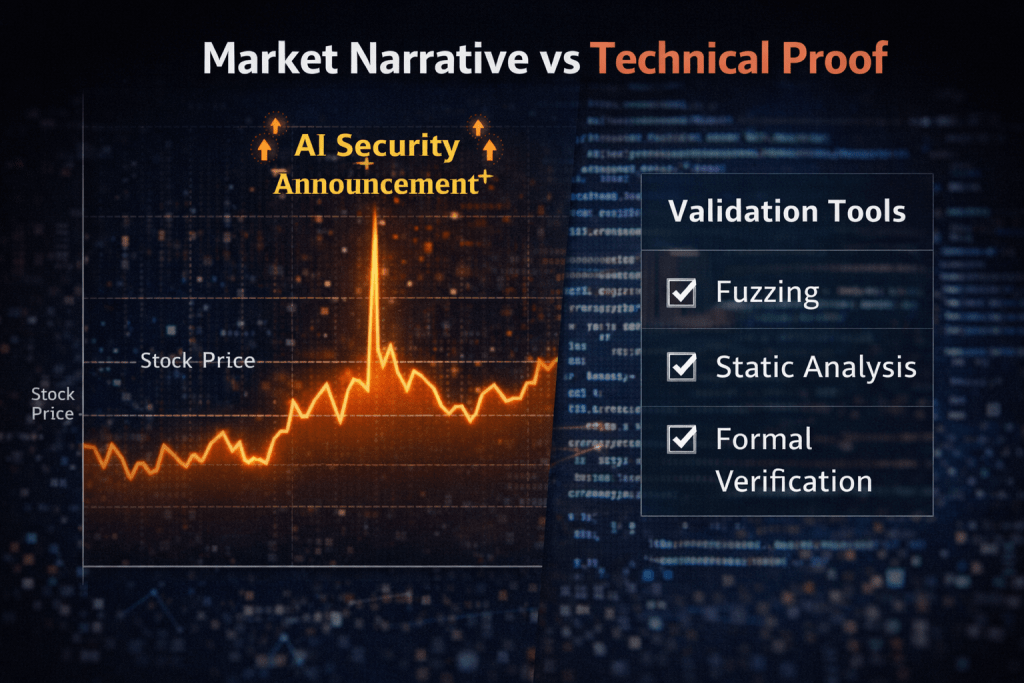 Market Reaction vs. Technical Validation
When AI claims suggest the displacement of static analyzers, fuzzers, or enterprise security platforms, markets tend to respond quickly. But market reaction is not the same as technical validation.
There is no publicly verified evidence that generative AI models have independently uncovered foundational cloud infrastructure flaws, autonomously remediated complex production vulnerabilities, or replaced formal verification and compiler-level guarantees. Recent volatility appears driven more by narrative repricing than demonstrated technological replacement.
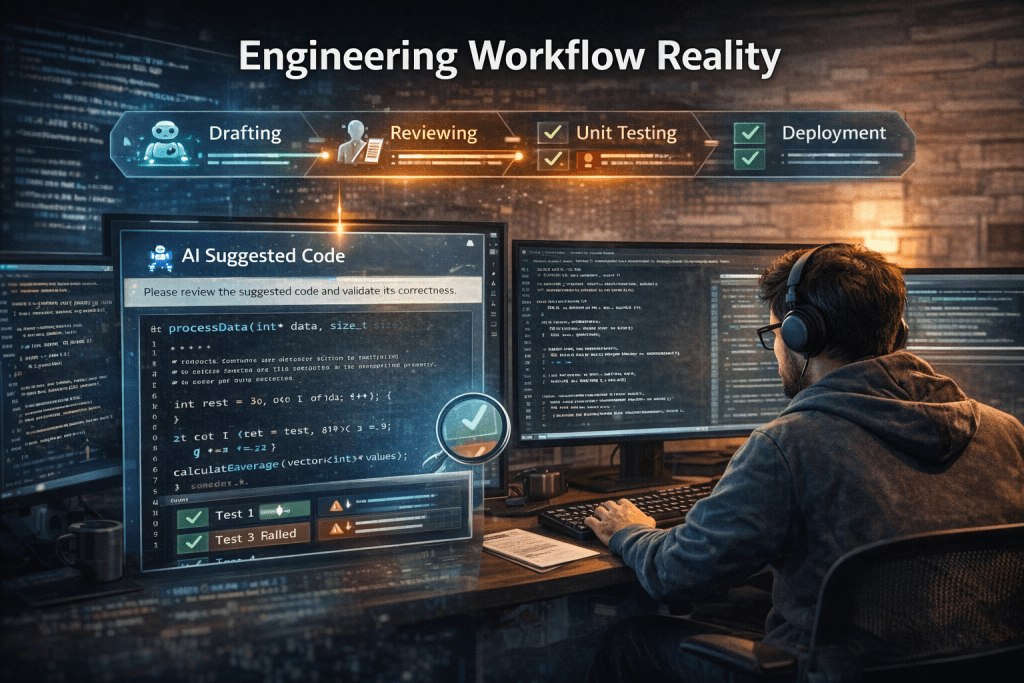 Engineering Workflow Reality
In production workflows, AI-generated C++ often compiles yet fails under edge-case conditions. Python suggestions can overlook environment-specific constraints. Patches may resolve a visible issue while introducing a subtler one.
Every AI-generated change still requires manual review, unit testing, integration validation, and architectural assessment. AI can accelerate drafting and iteration, but it does not assume engineering liability.
 The Illusion of Autonomy
The phrase “AI-orchestrated security” often obscures an important reality: humans remain deeply embedded in every step of the process. Engineers craft prompts, review outputs, deploy changes, and debug failures.
AI generates candidate solutions. Humans validate and own the outcome. The gap between “AI-assisted” and “AI-autonomous” remains substantial.
Where AI Truly Adds Value
To maintain balance, generative AI does offer measurable benefits. It can accelerate boilerplate generation, flag obvious insecure coding patterns, explain documentation, guide junior developers, and speed up early-stage prototyping.
What it does not do is replace formal verification systems, static analysis engines, runtime instrumentation, memory safety tooling, or security architecture design. In its current state, AI complements cybersecurity workflows, it does not substitute for them.
 Final Thoughts
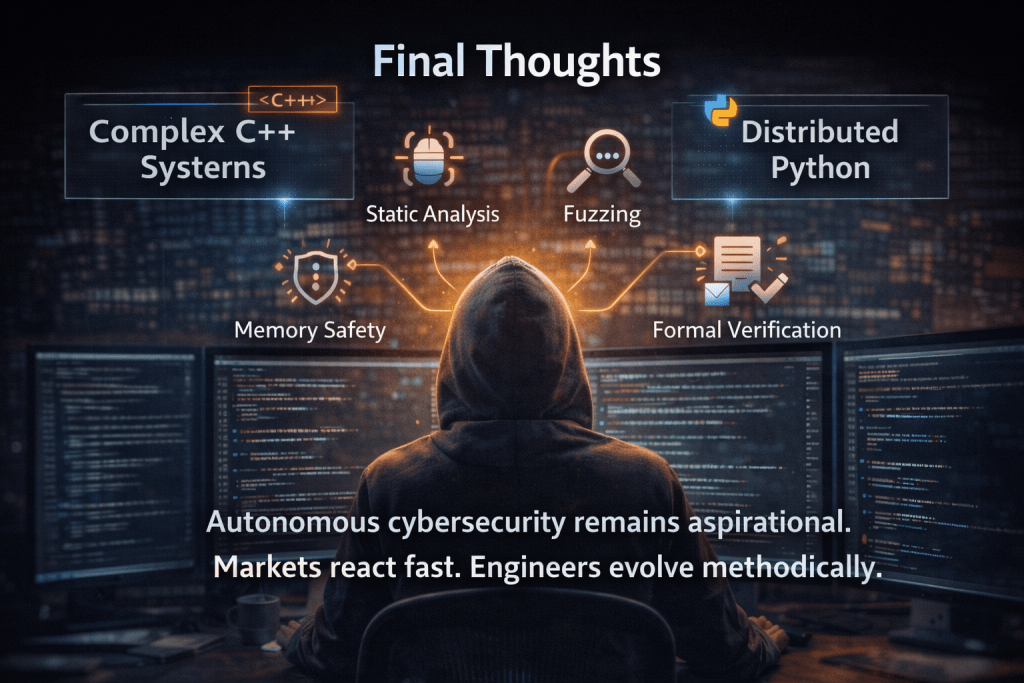
The idea that generative AI can autonomously identify and remediate deep systemic vulnerabilities, particularly in complex C++ or distributed Python systems, overstates current capabilities.
Coding flaws are contextual, architectural, and state-dependent. They are not merely linguistic artifacts.
Until AI systems can formally reason about execution states, memory models, distributed architectures, and concurrency, not just generate plausible syntax, the narrative of autonomous cybersecurity remains aspirational.
Markets may price disruption quickly.
Engineering reality, however, moves methodically, through compilers, analyzers, runtime checks, and human expertise.
And in cybersecurity, caution tends to outperform hype.