



U.S. Uranium Continues Poised for Structural Upside as Policy Tailwinds and Energy Demand Converge
Uranium Futures Price Today – Investing.com
Uranium continues influencing TradersQue’s earlier thesis defined by scarcity and state intervention. Federal procurement, long-term contracting, and geopolitical fracturing are converting the uranium fuel cycle into a protected growth asset.
U.S. Uranium’s New Era Continues
With uranium spot prices climbing above $83 per pound in October 2025, the market has clearly moved beyond mid-year expectations. The run from $63 in February to above $80 by autumn confirms the tightening trajectory forecast in TradersQue’s February coverage. The early-summer rally was financially driven, led by the Sprott Physical Uranium Trust and new entrants such as Mercuria, Citi, and Natixis, which absorbed near-term supply. By late summer, utilities re-entered long-dated contracting, transferring price discovery from spot into term structures.
U.S. Uranium Poised for Growth Amid Nuclear Revival – TradersQue
That surge reflects not speculative enthusiasm but the convergence of policy realignment, supply fragility, and expanding electricity demand from AI-driven infrastructure.
President Donald Trump’s second administration has already acted. In September 2025, a DOE–NRC joint working group was established to accelerate mine and enrichment permitting, signaling that Washington intends to rebuild domestic capacity rather than merely subsidize imports. This shift positions uranium not as a cyclical commodity but as a strategic resource, linking energy independence, industrial policy, and digital resilience.
 Geopolitical Risk and the Tightening Global Uranium Supply Chain
Politics and geography now influence uranium prices as decisively as geology. Jurisdictional risk representing the stability of where uranium is mined, processed, and traded has become the primary determinant of value.
Kazakhstan, producing over 40 percent of global supply, remains the axis of systemic vulnerability. In September 2025, Kazatomprom cut its 2026 guidance by 8 million pounds (10 percent of global output), citing sulfuric-acid shortages. That technical disruption erased two years of expected growth in a market already structurally short.
Simultaneously, Russia’s export restrictions continue to constrain Western access; Niger’s nationalization of Orano’s assets and a court-ordered export freeze on 2.2 million pounds removed additional supply. Flooding at Namibia’s Langer Heinrich Mine further exposed how climate volatility amplifies price risk.
A recent lever of volatility has also emerged: policy liberalizations in major consuming countries. In August 2025, India signaled plans to allow private firms to mine, import, and process uranium, thereby loosening a long-standing state monopoly and potentially unlocking large new demand and supply sources. Such moves have now invited speculation that trade flows will reroute, that utilities will seek more direct procurement, and that contracts may shorten or shift to more flexible structures.
Additionally, China has now tightened export controls on rare-earth metals and associated technologies, expanding licensing requirements and narrowing the flow of critical inputs used in clean energy, magnetics, and advanced manufacturing. While these controls are not directly on uranium itself, they raise extraction, processing, and downstream cost risks (e.g., equipment, magnetics for reactors, or ancillary technologies), increasing input scarcity and supplier leverage. The tightening also elevates the strategic premium on supply chains isolated from Chinese chokepoints.
These cumulative disruptions reveal a stark asymmetry: supply remains concentrated in geopolitically or environmentally unstable regions even as demand diversifies across the developed and emerging world. Western utilities are redirecting procurement toward Canada and Australia, which together supply roughly 30 percent of global exports, while China and Russia deepen their control across Africa and Central Asia. Two markets are now emerging: an allied sphere emphasizing traceability, ESG compliance, and contractual transparency; and an eastern sphere dominated by state-to-state deals largely insulated from conventional pricing.
The World Nuclear Association Fuel Report 2025 projects a 28 percent rise in demand by 2030, though that figure likely understates the acceleration from Japan’s restarts, India’s 100-GW expansion, and new European reactors.
For investors, the signal is unambiguous: supply security now carries outsized premium. Producers in stable jurisdictions such as North America and Australia stand to be re-rated as utilities increasingly pay for traceable, resilient material. Government-backed contracting and reserve programs further anchor long-term revenue, drawing institutional capital into what was once a speculative niche. Uranium is now a policy-protected scarcity asset.
The Strategic Gap in U.S. Domestic Uranium Supply
Despite policy urgency, production remains minimal. The EIA reports 677,000 pounds produced in 2024, the highest since 2018 but negligible versus 51 million pounds consumed annually.
By Q3 2025, the Department of Energy had initiated purchases for the U.S. Uranium Reserve with the first awards in December 2022 (up to 1 million pounds U₃O₈) and, in parallel, launched separate programs to procure domestic sourcing to rebuild a resilient nuclear fuel cycle. The Nuclear Fuel Security Act enacted as part of the FY2024 National Defense Authorization Act establishes and expands programs to onshore nuclear fuel production, in conjunction with S.452 and H.R.1086 bills. DOE’s FY2026 Budget Justification further details the Office of Nuclear Energy request and priorities here and here.
The structural gap between consumption and production creates asymmetric upside for compliant U.S. miners as procurement guarantees set durable price floors.
Digital Infrastructure and Nuclear Convergence
Data-center electricity demand is expected to reach 9 percent of total U.S. power by 2030, according to the EIA Annual Energy Outlook 2025. Technology firms are responding by aligning with nuclear providers. The Microsoft–Helion Energy fusion pilot, slated for 2028, marks the first commercial fusion supply agreement and symbolizes the broader fusion of digital infrastructure with baseload nuclear power. Uranium thus occupies a new strategic nexus: it fuels not only reactors but the computational backbone of the modern economy.
 Trump’s Policy Catalysts for Domestic Uranium
Federal policy now targets the reconstruction of an end-to-end U.S. nuclear fuel cycle.
- Permitting Reform: The DOE–NRC task force is shortening timelines for new ISR and conventional projects in Texas, Wyoming, and Utah.
- Capital Deployment: The Advanced Reactor Demonstration Program allocates $3.2 billion to SMR and HALEU reactor developers such as TerraPower and X-energy. Enrichment work continues at Piketon, Ohio, via Centrus Energy’s HALEU Demonstration Project. These initiatives represent the first commercial-scale push into high-assay low-enriched uranium (HALEU) that is material enriched between 5 and 20 percent uranium-235 that will power advanced reactors and small modular designs. With no Western commercial supply chain currently operating at that level, HALEU development marks a strategic inflection point for U.S. energy and defense independence. The White Mesa Mill in Utah is expanding into HALEU and rare-earth processing, supported by the DOE Critical Minerals Strategy.
- Stockpiling and Trade: Contracts have been awarded to Uranium Energy Corp and Energy Fuels under the reserve program. A White House Executive Order would impose conditional tariffs on Russian and Kazakh imports beginning Q1 2026, reinforcing domestic preference.
Collectively, these measures re-establish a vertically integrated fuel chain—mine → mill → reactor—linking civil power, defense, and industrial resilience.
Market Pricing, Risk, & Asymmetric Upside
By October 2025, uranium traded at $83/lb. spot, with term contracts $82–$85/lb. and three- to five-year forwards $90–$98/lb. Forecasts call for $110–$125/lb. by late 2026 as supply deficits deepen.
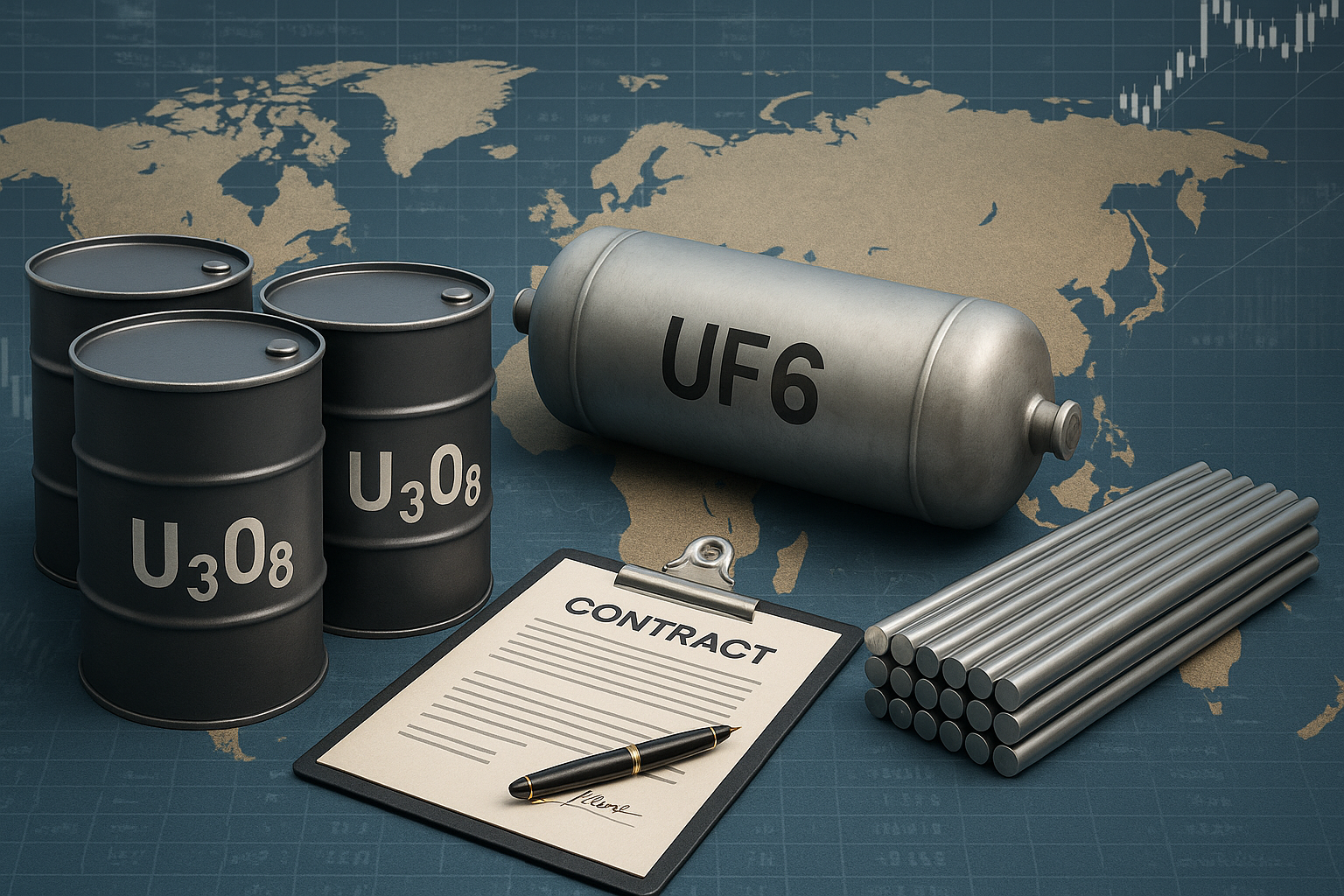
These prices refer primarily to natural uranium concentrate (U₃O₈)—the unprocessed yellowcake that anchors both spot and term contracts. Yet the supply tightness now extends beyond U₃O₈ into the entire nuclear fuel cycle. The Western market for low-enriched uranium (LEU) that is the material required for reactor fuel remains undersupplied following the withdrawal of Russian enrichment services. Conversion feedstock (UF₆) is likewise constrained, pushing utilities to lock comprehensive fuel contracts that cover mining, conversion, and enrichment.
Compounding this pressure, enrichment facilities that once provided secondary supply through underfeeding are now fully utilized, resulting in overfeeding—a reversal that increases natural uranium demand rather than relieving it. These dynamics confirm that uranium’s structural repricing reflects scarcity across every stage of the fuel cycle, not simply mine-level shortages.
Tightness reflects chronic underinvestment, delays in Kazakh and African production, and surging demand from SMRs, AI data centers, and fusion R&D. Risks persist including regulatory inertia, enrichment bottlenecks, and climate volatility, but uranium’s repricing is structural, driven by its dual function as clean-energy fuel and national-security commodity.
Historically, the uranium market relied on secondary feed from enrichment underfeeding and government stockpiles to smooth shortfalls. With enrichment capacity now fully utilized and secondary supply effectively exhausted, the market’s equilibrium depends entirely on new primary production, heightening both price volatility and long-term incentive levels.
 Utility Contracting: The Hidden Engine of Uranium Demand
Behind the price volatility and geopolitical headlines, utilities remain the principal force shaping uranium’s long-term trajectory. Unlike financial buyers, which can exit the market as sentiment shifts, nuclear utilities must secure physical fuel years in advance that is a necessity that anchors the entire U₃O₈ demand curve.
Since mid-2025, U.S., European, and East-Asian utilities have moved decisively from the spot market into multi-year term contracting. According to UxC, utilities have already purchased more uranium in 2025 than during the whole of 2024, reversing a decade-long pattern of inventory drawdowns. The term price, now near $82–$85 per pound, increasingly defines procurement decisions, while spot transactions serve mainly to bridge timing gaps rather than set benchmarks.
Utilities’ new contracts typically extend across the full fuel cycle, encompassing natural uranium, conversion to uranium hexafluoride (UF₆), and enrichment into LEU. This shift reflects a move away from price-only negotiations toward supply-assurance strategies, as utilities seek to control every step required to keep reactors fueled amid tightening capacity and longer lead times.
This re-engagement is reshaping market structure. New contracts often include inflation indexing, flexible delivery bands, and extended optionality into the 2030s, giving producers stronger price visibility and utilities greater security of supply. The contracting surge also narrows the spot-to-term differential, eroding carry-trade incentives and channeling liquidity toward physical delivery instead of speculation.
For investors, this matters more than the weekly spot fluctuations. Utilities’ willingness to commit to high-floor, long-dated agreements effectively institutionalizes a price floor near the marginal cost of Western production currently estimated at $70–$75 per pound. As inventories normalize and the uncovered demand wall beyond 2027 becomes more visible, this contracting cycle is likely to intensify, turning uranium from a trading story into a supply-assurance business.
Corporate Profiles
Uranium Energy Corp (NYSE: UEC)
Uranium Energy Stock Price Today | NYSE: UEC Live – Investing.com
Uranium Energy Corp remains the largest U.S.-based pure-play uranium company, with key ISR operations at Palangana (Texas), Hobson and Irigaray plants, and the advancing Roughrider Project in Canada. The company has secured new federal contracts under the DOE uranium reserve and is exploring HALEU supply chain participation alongside Centrus Energy. Backed by $331 million in cash and equity holdings and zero debt, UEC continues scaling ISR output across stable jurisdictions.
As of this publication, UEC closed at $15.32, up from $5.66 since TraderQue’s February 2025 coverage (170.8% gain). Its prior $8.75 target has been exceeded.

Energy Fuels Inc (NYSE: UUUU)
Energy Fuels Inc Stock Price Today | NYSE: UUUU Live – Investing.com
Energy Fuels remains the only U.S. company operating both uranium and rare earth element processing at commercial scale. Its White Mesa Mill in Utah is expanding to support HALEU feedstock and advanced REE separation, with a pending DOE grant expected to accelerate growth. Strategic monazite feedstock imports from Chemours support a vertically integrated model across nuclear fuel and REEs. With $117 million in working capital and no debt, the company’s dual-material strategy is aligned with national clean energy and defense priorities.
The stock closed at $23.77 as of this article’s publication, up from $4.63 since TraderQue’s February 2025 coverage (413.9% gain), surpassing the previously forecast $10.50 target.

Ur-Energy Inc (NYSE: URG)
Ur Energy Stock Price Today | NYSE: URG Live – Investing.com
Ur-Energy continues to expand low-cost ISR uranium production in Wyoming. Optimization at Lost Creek has improved throughput, while construction at Shirley Basin remains on track for a 2027 start. As a recipient of DOE reserve contracts and a participant in utility offtake discussions, Ur-Energy is enhancing wellfield capacity and positioning itself for scalable growth. It remains financially disciplined, with $70 million in cash and a minimal debt profile.
The stock closed at $2.03 as of this publication, doubling from $0.95 since TraderQue’s February 2025 coverage (113.7% gain), exceeding its former $1.85 price target.
A Structural Repricing, Not a Speculative Cycle
Uranium’s current rally is not a transient boom but rather a strategic revaluation born of supply scarcity, policy protection, and digital-era demand. With geopolitical divides hardening and federal procurement anchoring prices, uranium has transitioned from peripheral commodity to cornerstone of energy and data sovereignty.
For investors, the implications are profound. The sector’s upside is asymmetric: policy support and contracting cycles underpin floor prices, while supply disruptions and new demand sources drive persistent risk premiums. With spot and term prices converging near multi-year highs, valuation momentum increasingly favors North American producers, particularly Uranium Energy Corp, Energy Fuels, and Ur-Energy, whose operational leverage aligns with both market fundamentals and strategic procurement goals.
Archived Uranium Coverage @ TradersQue
The broader takeaway reflects what TradersQue called early in 2025: uranium’s resurgence is not about speculative enthusiasm but structural necessity. It is the cornerstone of a reindustrialized, digitally powered, and geopolitically self-reliant energy economy where scarcity, security, and sustainability are inseparable.
Additional Coverage
Additional coverage can be found on Todd Anderson’s X and LinkedIn pages.