



Clash Over LAC Port Ownership Escalates as China Intensifies Pursuit
The unprecedented maritime dispute over a majority of global south shipping ports has attracted greater Chinese command and escalated deeper Western angst.
Panama Ports Quietly Await Global Shift | TradersQue
China Merchants Group recently joined talks alongside COSCO, signaling a more coordinated push by multiple Chinese state firms to either in part or in full capture over 40 LAC-based ports and in turn wrest some or all operational control both from Western firms and Panamanian officials.
China Merchants Port Holdings Co Ltd | OTC: CMHHY | Investing.com
Such developments also show that the dispute has evolved into how ownership is decided other than ownership itself, establishing a new global precedent that will impact economies on a scale yet to be determined.
Ownership Rules Shift Under Political Pressure
The removal of CK Hutchison’s concession, now under an expanded international arbitration, shows that long-term contracts can be reversed when political conditions change during active negotiations. Legal remedies remain but now follow disruption rather than prevent it.
Most telling is how fluid conditions of $23 billion sale are proving to be. To move forward, parties are now considering splitting the 43-port portfolio into different ownership structures. Under this approach, Chinese firms could take larger stakes in regions more aligned with Beijing, while Western investors retain others.
This marks a clear break from past practice. Large infrastructure deals were once treated as unified transactions. Now they are being divided along political lines.
And the timing raises questions. The legal issues cited by Panama were not new, yet action came as negotiations intensified. Similar issues in other cases have not been enforced in the same way. This suggests that ownership identity and external politics continue playing an outsized role, notably when state sovereignty collides with maritime shipping, as recently evidenced.
 China Expands Influence as Western Capital Pauses
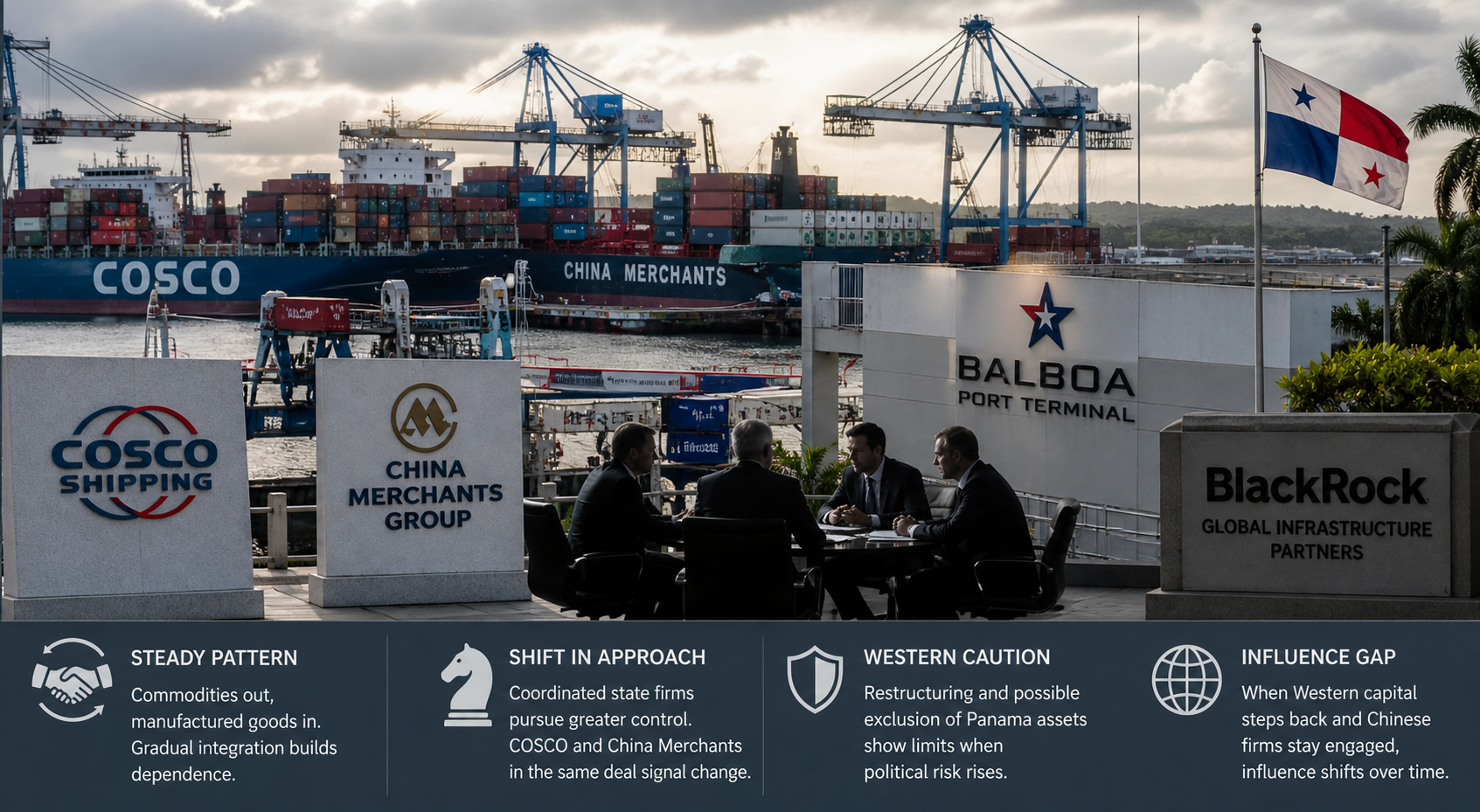
China’s approach to port infrastructure has long centered on trade and gradual integration. In Latin America, however, China’s reliance on gradual investment is now expanding via coordinated state firms to pursue larger control.
At the same time, Western participation appears more cautious. BlackRock and its partners remain involved, but the need to restructure the deal and possibly exclude Panama assets shows a limit.
This creates a gap. If Western firms step back from contested assets while Chinese state firms remain engaged, influence can still shift over time. Control does not need to be absolute to be effective.
Port Ownership Scenarios
Although no rulings have been made or projected, various ownership scenarios and subsequent impacts can be projected but while exercising due caution as the dynamics of this particular dispute prove fluid and significant.
Major powers now approach infrastructure as a national security imperative and thus risk fragmenting systems and operations that have functioned on economic expediency than political allegiance. Infrastructure assets will be divided, contested, and in some cases removed from open markets as a result.
 Scenario: U.S.-Led Deal with Panama Carved Out
In this scenario, the BlackRock-led group completes the broader port deal but excludes the Panama assets Balboa and Cristóbal. This allows the transaction to move forward while avoiding direct geopolitical conflict. The structure still requires approval across several countries and likely some level of acceptance from China. Panama would keep control of the ports or rely on interim operators, creating a separate system outside the deal. The result reflects a partial solution rather than a full resolution. It also shows that some strategic assets may no longer move freely in global markets.
Scenario: Hybrid Deal with Chinese State Participation
This likely base-case scenario sees Chinese state firms such as COSCO and China Merchants join the consortium. This leads to a hybrid structure where ownership is split across regions. Chinese firms gain influence in areas aligned with their interests, while Western investors retain others. The deal shifts from open competition to negotiated allocation based on political factors. Regulatory hurdles remain, but this structure provides a workable path forward. It also signals a broader move toward divided control of global infrastructure.
Final Thoughts
Ownership, control, and legal rights are no longer aligned in a simple way. Strategic assets may not move freely between buyers, even when deals are valid on paper. Political alignment and security concerns now shapes outcomes.
As such, this ongoing Panama port dispute signals an emerging landscape against which infrastructure assets will be owned and controlled in a more divided and divisive global market.
Additional Coverage
Additional social media coverage can be found on the author’s X platform.