



As the Strait of Hormuz Commands Headlines, a Panama Port Problem Persists
In June 2025, a CSIS assessment described China’s growing role in Latin American and Caribbean port infrastructure. Chinese firms continued expanding to this region via financing, construction, and partial ownership across dozens of port facilities and countless supply chains. At that time, U.S. concerns centered on China’s long-term global trade leverage built through commercial ties rather than through coercive means.
CK Hutchison Holdings LTD ADR Stock Price | OTC: CKHUY – Investing.com
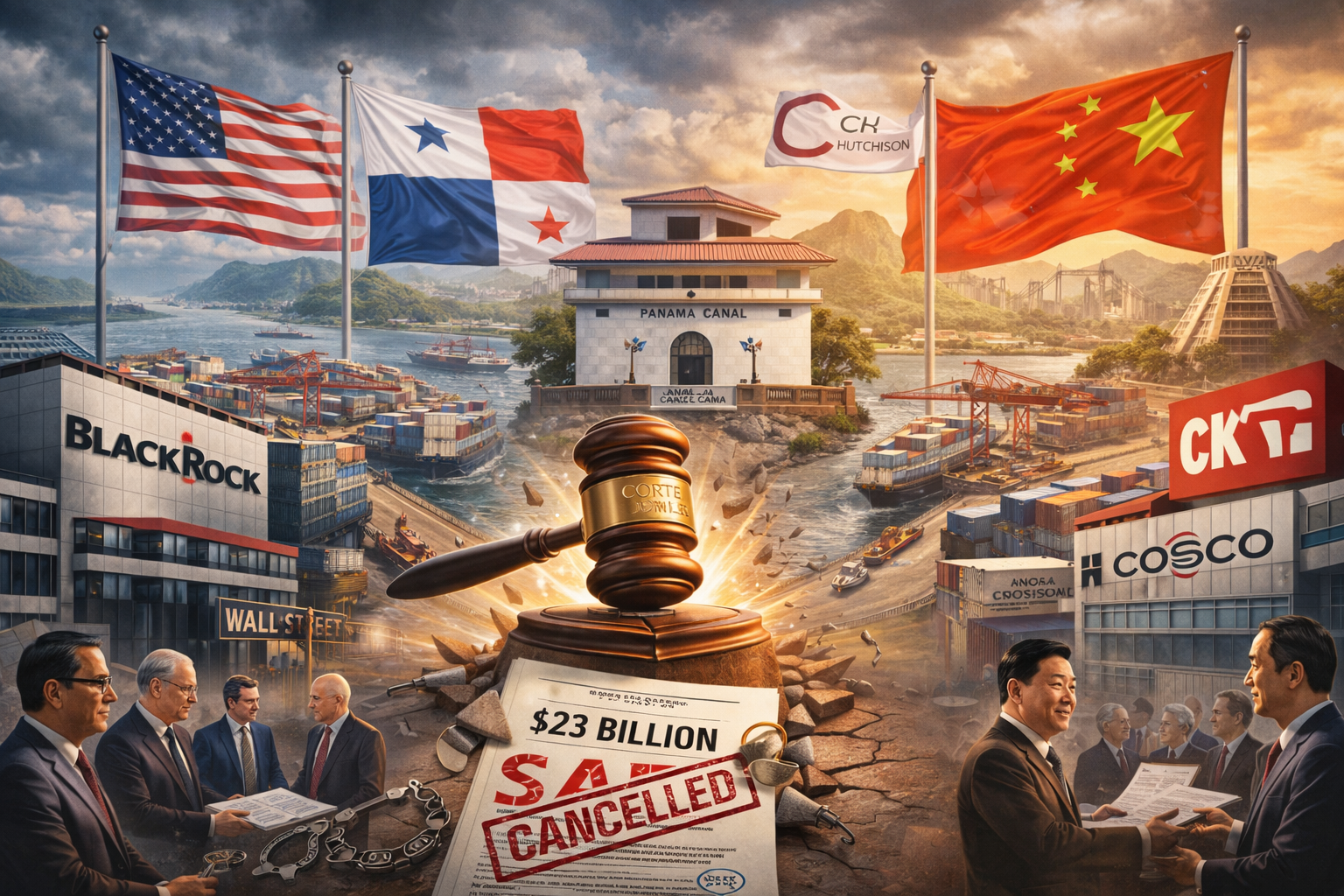
By early 2026, that concern turned more visibly. A proposed USD $23 billion sale of 43 Hong Kong-based CK Hutchison (OTC: CKHUY) ports to U.S.-led monolith Blackrock, initially framed as routine, abruptly became entangled in U.S.–China geopolitics. Panama’s high court annulled CK Hutchison’s operating rights and profits (in effect since 1997) on the basis of legitimate Constitutional concerns and took over two critical Panama Canal ports, Balboa and Cristóbal. China’s state-owned COSCO (OTC: CICOY) priorly intervened to seek majority control, causing BlackRock to pushback considerably to which, as of this writing, no resolution has yet occurred.
For context, the ports in question are not isolated facilities within the Panama Canal system. Balboa and Cristóbal together handle roughly 4 million containers annually and serve as major transshipment hubs at the canal’s Pacific and Atlantic entrances. While individual volumes are modest compared to the entire U.S. port system, they sit along a route that carries approximately 40% of U.S. container traffic. As such, their strategic importance lies less in throughput and more in positioning within a global chokepoint. Decisions about who controls or influences these ports will shape how goods move into and through U.S. supply chains, affecting everything from retail inventory to industrial production.
COSCO SHIPPING Holdings Co Ltd ADR Stock Price | OTC: CICOY – Investing.com
The swirl of events since the New Year, including the removal of CK Hutchison’s workforce and the allowance of competing shippers to pick up the slack, reveals a concerning shift in the U.S.-China rivalry that could become normalized: contractual ownership depends as much on political allegiance as on legal or commercial entitlement.
The key inconsistency lies in timing. The legal defects of CK Hutchison’s 26-year-old contractual concessions were not new, but Panama’s high court’s decision to act on them remains strikingly peculiar.
Allegiance Over Market
The indefinite seizure of CK Hutchison ports, which has since generated legal action, underscores the reality that long-term, international contracts can be reversed when political conditions evolve during legitimate negotiations. Put differently, contract rights and due recourse lose their primacy when attempting to legally acquire assets suddenly deemed strategically important and critical to national security by another entity.
But despite Panama’s high court decision being predicated on qualifying technical errors, similar issues in the same region were not enforced at all or evenly, further suggesting that ownership identity and external politics had shaped the outcome. (Despite CK Hutchison being based in Hong Kong, current U.S. politics deems such ownership as China-based.)
It is a shift that aligns with U.S. President Donald Trump’s historical approach to foreign trade relations, thus begging when the President will carve out sufficient time and tweets indicating the scope and scale of attention deserved to what he will imminently deem an emergent national security concern. And deservedly so.
But this in turn creates a clear dilemma: If Western investors, such as Blackrock, possibly withdraw from contested deals as has been recently reported, then Chinese firms will still expand their influence, especially in countries or regions with fewer or more malleable policy constraints. Without a coordinated U.S. response, China’s role in regional trade, logistics, and data systems will only deepen irrespective of direct operational control or passive corporate financing.
China’s current global port infrastructure presence reflects a breadth and magnitude that warrant attention.
China’s Same Old Strategy Has Evolved
China’s historical approach has been affirmed by a number of policy experts at last week’s U.S.-China Economic & Security Review Commission’s hearing on “China’s Expanding Interests in Latin America: Development, Leverage, Coercion, and Crime” affirm the country’s strategic approach and its gradual evolution into more direct actions involving ownership and control. Trade, infrastructure investment, and supply chains still form the core of China’s port strategy in the LAC region: Latin American economies export to China commodities such as copper, lithium, and agricultural goods while importing from China manufactured products and capital equipment. This pattern reinforces a dependency critical to Chinese expansion in this region.
The current CK Hutchison case, however, illustrates China’s evolving push for operational control beyond passive investment. Blackrock’s protest reveals Western firms’ (and Washington D.C.’s) growing recognition that this move for complete port ownership and control carries overtones of national security.
Now the U.S. government must follow suit with a coordinated response to curtail further Chinese entrenchment in supply chains that historically are near-impossible to displace once established.
And despite China facing greater scrutiny and political resistance by Western powers in its push to build influence through global infrastructure and trade, the United States must nevertheless effectively address this relatively quiet but critical affair of port ownership and control.
Final Thoughts
The current situation involving Chinese firms, U.S. finance, and Panamanian jurisprudence illustrates how political and legal measures weaken confidence in foreign infrastructure investment vital to both host and investors alike. Countries in the region may respond by diversifying partnerships or balancing between major powers, leading to a more fragmented environment. Proposals to divide infrastructure and supply chain assets along geopolitical lines only reinforces further deglobalization, and although such division would reduce direct conflict, doing so would also guarantee greater inefficiencies and higher costs irrespective of where along any supply chain.
Including on the seas.
Again, the significance of the deal is not the transfer of ports themselves, but the transformation of the rules governing who can own and control critical infrastructure in a geopolitically divided system. This present conflict is about what the negotiation itself reveals about the future of global infrastructure ownership structurally and legally.
Additional Coverage
Additional social media coverage can be found on the author’s X platform.