



 The EPA’s proactive stance in safeguarding public health from PFAS in drinking water remains evident. Ongoing advancements in scientific knowledge regarding the potential health impacts of various PFAS compounds, many of which are monitored within this program, remain a priority.
BioLargo Inc Stock Price Today | OTC BLGO Live Ticker – Investing.com
EPA’s PFAS Roadmap
U.S. Environmental Protection Agency Administrator Michael Regan recently announced the availability of $2 billion from President Joe Biden’s Bipartisan Infrastructure Law to address emerging contaminants like per- and polyfluoroalkyl substances (PFAS) in drinking water across the country. Biden-Harris Administration Announces $2 Billion in Bipartisan Infrastructure Law Funding to States and Territories to Address Emerging Contaminants like PFAS in Drinking Water | US EPA
This investment, which is allocated to states and territories, will be made available to communities as grants through EPA’s Emerging Contaminants in Small or Disadvantaged Communities (EC-SDC) Grant Program and will promote access to safe and clean water in small, rural and disadvantaged communities while supporting local economies. Regan announced the water infrastructure investments in Maysville, North Carolina, while holding a community roundtable with North Carolina Department of Environmental Quality Secretary Elizabeth S. Biser and other state and local leaders.
“Too many American communities, especially those that are small, rural or underserved, are suffering from exposure to PFAS and other harmful contaminants in their drinking water,” says Regan. “Thanks to President Biden’s leadership, we are investing in America and providing billions of dollars to strengthen our nation’s water infrastructure while safeguarding people’s health and boosting local economies. These grants build on EPA’s PFAS Strategic Roadmap and will help protect our smallest and most vulnerable communities from these persistent and dangerous chemicals.” News Briefs: Ohio Train Derailment Sparks… | Treatment Plant Operator (tpomag.com)
See the introductory article of our BioLargo, Inc. (OTCQB: BLGO) series for necessary context related to our initiation of BioLargo, Inc.
As nationwide PFAS testing at municipal water systems continues, the EPA intends to leverage the Toxic Substances Control Act (TSCA) to penalize industries whose PFAS production or disposal levels violate a maximum contaminant level goal (MCLG), also proposed by the EPA. The agency will release a notice of proposed rulemaking on March 3, with federal legislation introduced as early as September 2024, but more likely in 2025.

Initial PFAS Data
Through July 2023, a nationwide assessment has subjected 2,200 private and public water systems to PFAS testing. Of these assessed systems, approximately 20%—a total of 431 systems—revealed PFAS concentrations surpassing the EPA’s reporting thresholds, as per an analysis by USA TODAY. This marks a significant increase from a decade ago when only about 4% of nearly 5,000 systems tested were found to exceed limits set for just a handful of PFAS compounds. These data highlight similar findings by the U.S. Geological Survey that, also in July 2023, estimates over 45% of the nation’s tap water exhibits the presence of one or more types of PFAS. The study involved sampling residential tap water from 716 locations, encompassing private wells and public supply taps.
Combatting PFAS: EPA Initiatives
To augment the agency’s PFAS directives, the EPA is allocating an unprecedented $9 billion, as part of President Biden’s Bipartisan Infrastructure Law, to specifically assist communities grappling with PFAS and other emerging contaminants in their drinking water. This funding encompasses $4 billion through the Drinking Water State Revolving Fund (DWSRF) and an additional $5 billion via EPA’s “Emerging Contaminants in Small or Disadvantaged Communities” grant initiative. States, Tribes, and communities can further leverage nearly $12 billion in DWSRF funds and substantial annual SRF funds aimed at enhancing drinking water safety. This monetary support will empower communities to make critical investments in solutions for PFAS removal.
The information gathered via the UCMR 5 will serve as a cornerstone for the EPA to continue making evidence-based decisions, furnishing the agency with a deeper comprehension of nationwide exposure to 29 PFAS compounds and lithium. Moreover, this data holds the potential to unveil whether these substances disproportionately impact communities that are burdened by environmental equity concerns. The initial data release just days ago encompasses around 7% of the anticipated outcomes to be gathered over the next three years and will be periodically updated and made accessible to the public through the EPA’s National Contaminant Occurrence Database (NCOD) until the completion of data reporting in 2026.
Companies Acting Before Reacting
Unlike the politicization witnessed in other environmental domains, the drive to eliminate PFAS has gained considerable traction among numerous American manufacturers, let alone U.S. politicians from the local to federal levels. In June 2023, a landmark settlement was reached involving DuPont, Corteva, and the Chemours Company, who collectively agreed to contribute $1.1 billion to a cleanup fund targeting known disposal sites linked to these three corporations. Similarly, in the same month, 3M consented to financing $10.3 billion in projects aimed at PFAS removal and remediation across multiple dumpsites. Furthermore, 3M pledged to render all its global manufacturing sites PFAS-free by the conclusion of 2025.
These agreements underscore the inevitability of forthcoming PFAS regulation, shifting the focus from “whether” to “when.” The direct removal of PFAS from water systems, particularly in drinking water systems governed by the SDWA, entails that the EPA must periodically monitor priority contaminants that might be present in drinking water yet remain unregulated.
BioLargo’s PFAS-Removal Legacy
The pervasiveness of PFAS among a host of products renders these chemicals’ removal as essential over the next several years. Despite cheaper available methods by other companies, BioLargo’s (OTCQB: BLGO) proprietary aqueous electrostatic concentrator (AEC), reverse-osmosis approach proves the most effective, removing over 99% of all known PFAS while producing the least amount waste, utilizing the least amount of energy, and requiring less maintenance and upgrades compared to alternative methods. BioLargo’s recent partnership with the ICS Group confirms the technology’s success that only now requires commercial scalability to effectively bring to fruition the EPA’s strategic roadmap.
PFAS federal regulation will occur, albeit with thresholds set at reliable testing limits of 5 nanograms per liter, with goals reaching as close to zero as possible as testing technologies advance in efficacy and affordability. Municipal utility companies (and subsequently municipal government bodies) will look to enforce the most practical interventions to avoid imposing excessive rate hikes to cover installation and annual maintenance costs of PFAS removal methods, such as the following:
- Granular Activated Carbon (GAC) is the most cost-efficient and space-saving to install but expensive to maintain as it generates high, unrecyclable carbon waste requiring frequent incineration that produces greenhouse gas emissions (GHGs), which will only increase greater scrutiny, fines, and required remediation from the EPA. Essentially, one environmental problem is being traded for another. With eventual PFAS air-emissions testing on the horizon, GAC methods will become unpopular removal methods.
- Ion-exchange is cost-efficient and ideal for small systems. However, these systems cannot catch most short-chain PFAS, thus limiting their application as federally imposed thresholds lower in the future. Ion-exchanges systems are also more costly than GAC methods.
- Reverse-osmosis (RO) membrane systems are most preferred as installed membranes capture all PFAS chains—over 12,000 known types—plus removes other contaminants without needing addition testing equipment or materials, and without experiencing compounding disposal costs. However, ROs require a significant amount of energy and are traditionally the most expensive.
As more PFAS are categorized as hazardous, RO membrane systems such as BioLargo’s will become the preferred removal method to avoid upgrading costs from cheaper removal applications. As more states transition to and scale up their renewable energy sources, operating costs will plummet and make BioLargo’s method more cost-attractive than its $.30USD/1000 gallons already proves to be. This will lessen the need for municipalities to increase water rates—a political third-rail issue akin to tax increases.
As the EPA continues releasing datasets on nationwide water systems throughout the next two years, BioLargo’s value will increase significantly as it remains the exclusive developer of its high-demand, AEC PFAS removal technology as higher PFAS concentration levels are revealed in more U.S. locations, affecting an even greater percentage of citizens.
About PFAS:
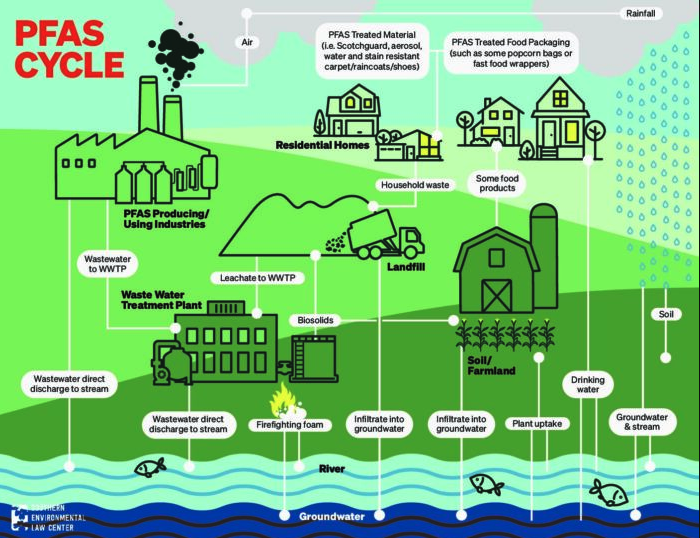
Per- and polyfluorinated alkyl substances, widely known as PFAS, constitute a family of chemicals that have seen extensive application in nonstick coatings, water-resistant fabrics, and various household and industrial products over the years. However, these chemicals are now recognized to elevate the risk of certain cancers and other detrimental health effects. Often referred to as ‘forever chemicals,’ PFAS possess exceptional durability and the capacity to accumulate within human bodies over time.