



U.S. Multinationals Still Face EU Climate Disclosure Rules Despite EPA Rollback
The EPA’s rollback of the GHGRP offers political symbolism but no change for American companies soon operating under EU disclosure mandates.
When a federal agency’s announcement makes headlines but leaves obligations unchanged, we are witnessing not governance, but spectacle. The Environmental Protection Agency’s proposed termination of the Greenhouse Gas Reporting Program (GHGRP) is one such moment: symbolic, domestic, and irrelevant to the compliance reality facing globally integrated American companies.
At issue is not whether greenhouse gas (GHG) disclosures are burdensome. Rather, it is that the companies affected by the rollback are already bound by disclosure mandates beyond U.S. jurisdiction. Chief among them is the European Union’s Corporate Sustainability Reporting Directive (CSRD), which extends deep into the global economy by requiring large U.S. multinationals with significant business in Europe (see matrix below) to publish audited sustainability reports. Lawmakers in Brussels are even considering revisions that could expand the scope of companies covered, though the final shape of those changes has not yet been decided.
Regardless, such revision of EPA policy does not alter that critical jurisdiction.
CSRD Reporting for U.S. Multinationals
| Effective Date | Key Thresholds* ($USD) | U.S. Companies Likely Impacted |
|---|---|---|
| January 1st, 2028 | – EU turnover >$178 million annually, AND
• EU branch with ≥$47 million turnover |
Apple Microsoft Alphabet Amazon ExxonMobil Pfizer Johnson & Johnson Procter & Gamble PepsiCo Intel Corp. |
*Contingent on meeting thresholds for two consecutive years and qualifying EU presence.
To illustrate the scale: Apple Inc. reported total revenue of approximately USD $391 billion in FY2024. Publicly available data discloses USD $101.3 billion (roughly 25–26%) was generated in Europe. While quarterly breakdowns vary and are not always disclosed in full, the pattern is clear: for Apple and peer firms, the European market is too financially vital to ignore or exit. It is most certainly a hill on which no U.S. corporate executive or board member will die for the sake of political posturing.
Even companies not meeting CSRD thresholds nonetheless face mounting expectations from institutional investors, ESG rating agencies, and international regulators aligned with frameworks such as the International Sustainability Standards Board (ISSB) and the Task Force on Climate-related Financial Disclosures (TCFD). In short, climate transparency is no longer a voluntary corporate virtue. It is a regulated condition of access to global capital and consumer trust.
Politics be damned.
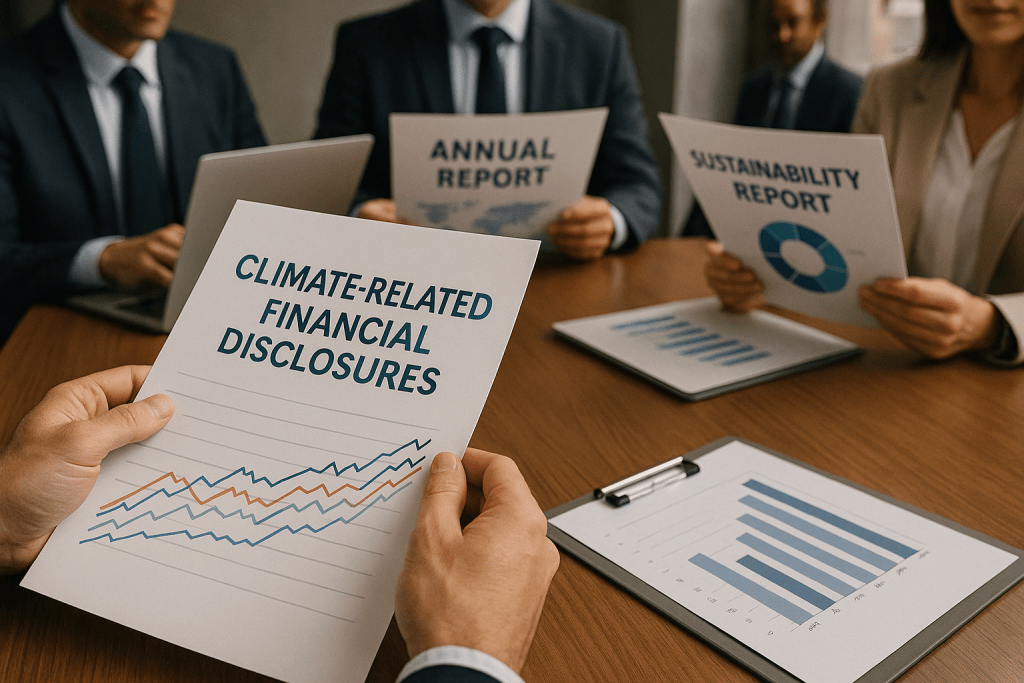 EPA’s Retreat Leaves U.S. Firms Exposed
The EPA’s decision to walk back domestic reporting may carry political resonance, but for U.S. multinationals, it changes nothing. The proposal does not repeal CSRD, rewrite EU law, or slow the momentum of emerging ASEAN disclosure mandates. What EPA’s decision does is dismantle a domestic infrastructure for generating GHG data at scale, just as international demand for audited, CSRD-grade climate disclosures continues to peak. Without GHGRP, U.S. firms may face higher compliance costs in reconstructing equivalent reporting pipelines not for Washington but for Brussels.
The predictable result of such deregulatory flourish with no jurisdictional power will be immense downstream costs, shifts in shareholder alliance, and global brand revaluation, all signaling a retreat not from red tape but rather from relevance.
Disclaimer
The views and opinions expressed in this article are solely those of the author and do not necessarily reflect the official policy, position, or opinions of TradersQue, LLC or its affiliates. All information is provided for informational purposes only and should not be construed as investment, legal, or other professional advice.
Additional Coverage
Additional social media coverage can be found on Todd Anderson’s X and LinkedIn.

🌿 From Compliance to Competitive Advantage:
Your Sustainability Story Starts Here
In global business, sustainability remains no longer a sidebar — it represents the storyline. At TradersQue, we guide organizations with disclosures ranging from CSR initiatives to basic ESG metrics to sustainability strategy and leadership, registering a narrative that resonates with investors, regulators, and stakeholders.
TradersQue delivers a viable framework for impact, investment, and integrity. Our reports are not simply documents; they are proof of foresight, accountability, and long-term value.
We align your assessed sustainability and ESG goals with the Global Reporting Initiative (GRI) Standards, the world’s most widely adopted sustainability reporting framework. We then identify what matters most through materiality analysis, and translate complex data into visual, stakeholder-ready reports for any business, from start-up enterprises to legacy conglomerates.
Through every stage, your organization gains:
- Visual, presentation-ready reports tailored for internal or public audiences
- Alignment with GRI Standards and UN SDGs for global recognition
- Sector-specific insights and optional third-party assurance to enhance stakeholder confidence
With TradersQue, ESG and sustainability reporting become your company’s collective growth narrative—one grounded in data, shaped by vision, and certified for tomorrow’s global standards.
Your corporate resilience deserves recognition. Let us author its legacy.