



Florida’s Property Sales Pressure Remain the Flagship for All U.S. Coastal Climate Risks
The 2026 Atlantic hurricane season is expected to be below normal due to the oncoming El Nino weather shift, but that does not remove coastal housing risk as previously addressed in December 2025 at TradersQue.
Catastrophe Bonds Funding U.S. Climate Strategy | TradersQue
NOAA’s outlook calls for a 55% chance of a below-normal season, 35% chance of a near-normal season, and 10% chance of an above-normal season. NOAA’s expected range is 8–14 named storms, 3–6 hurricanes, and 1–3 major hurricanes, compared with the 1991–2020 average of about 14 named storms, 7 hurricanes, and 3 major hurricanes.
Most notably, NOAA also cautions that landfall location and landfall intensity cannot be reliably predicted months in advance, including in Florida. Home-property seller-stress and price-cuts there and elsewhere remain elevated due to increasingly policy-restricted property changes that are dictating price-drops.
Florida provides the most prophetic example, but all U.S. coastal and otherwise impacted states within this analysis must be given due attention.
Florida as Proxy
Florida’s insurance market has stabilized since the 2021–2023 property crisis, but its housing market is still repricing the full cost of ownership, alongside hurricane-season costs across other Gulf and Atlantic coastal states.
Citizens Property Insurance Corporation expected its policy count to fall to about 385,000 by year-end 2025, down from roughly 1.42 million in October 2023, and recommended its first average personal-lines rate decrease since 2015. By March 2026, Citizens reported approved rate cuts averaging 8.8% for homeowners multiperil policies and 5.5% for wind-only policies.
Florida’s OIR also reported that 20 property and casualty insurers had entered the market since reforms, with more than 190 residential filings seeking decreases or 0% increases. The 30-day average homeowners-rate request was -1.2%, versus -0.3% a year earlier.

Florida’s Property Insurance Complex
| Insurer | Florida Status | Investor Takeaway | Reasons Cited |
|---|---|---|---|
| Farmers Insurance | No return | 2023: Farmers pulled back from Florida homeowners’ coverage and stopped writing new homeowners’ policies through certain Florida operations.
2024–2026: No clear broad return has emerged. |
Farmers described the move as part of managing risk exposure, especially catastrophe and hurricane exposure in Florida. |
| Bankers Insurance | No expansion of coverage | 2022: Bankers withdrew from parts of the Florida homeowners / dwelling-fire market.
2024–2026: No clear meaningful re-expansion into Florida homeowners’ coverage. |
Bankers cited unprecedented reinsurance costs, which are closely tied to hurricane and catastrophe risk in Florida. |
| AAA / Auto Club Group | Active with hints of stabilization | 2023: AAA selectively reduced renewals for some Florida homeowners’ policies.
2024–2026: AAA remains active and stabilizing. |
AAA cited the need to manage risk and catastrophe exposure, with broader pressure from inflation, litigation, and the 2022 hurricane season. |
| Progressive / ASI | Active but more selective in clientele | 2024: Progressive / ASI nonrenewed a large number of Florida policies to rebalance risk.
2025–2026: The company is active but highly selectively. |
Reducing hurricane exposure and rebalancing storm-prone concentrations cited. |
| American Strategic Insurance / ASI | Active via Progressive but highly selective | 2024: ASI, tied to Progressive, non-renewed a significant number of policies as part of exposure management.
2025–2026: Active through Progressive but highly electively. |
Same as Progressive: policy reductions were tied to reducing hurricane exposure. |
| State Farm | Active with continued commitment | 2023–2024: State Farm deemed cautious in high-risk areas.
2025–2026: It remains an important Florida property insurer. |
Tighter underwriting appears most closely related to catastrophe-risk management, especially in coastal or wind-exposed areas. |
| Travelers | Limited evidence of re-emergence | 2023–2024: Travelers reported as limited in higher-risk areas.
2025–2026: No clear re-expansion evident. |
No company-cited reason was confirmed, but reported restrictions appear most correlated with catastrophe exposure in higher-risk zones. |
Hurricane / catastrophe exposure, high reinsurance costs, litigation pressure, and financial solvency concerns were the most common cited reasons. Some companies made voluntary underwriting decisions to reduce risk, while others were not merely “scaling back” but were placed into liquidation.
Those insurance-market disruptions are no longer confined to carrier balance sheets; they are now filtering directly into housing affordability, ownership costs, and market liquidity.
Florida and Beyond
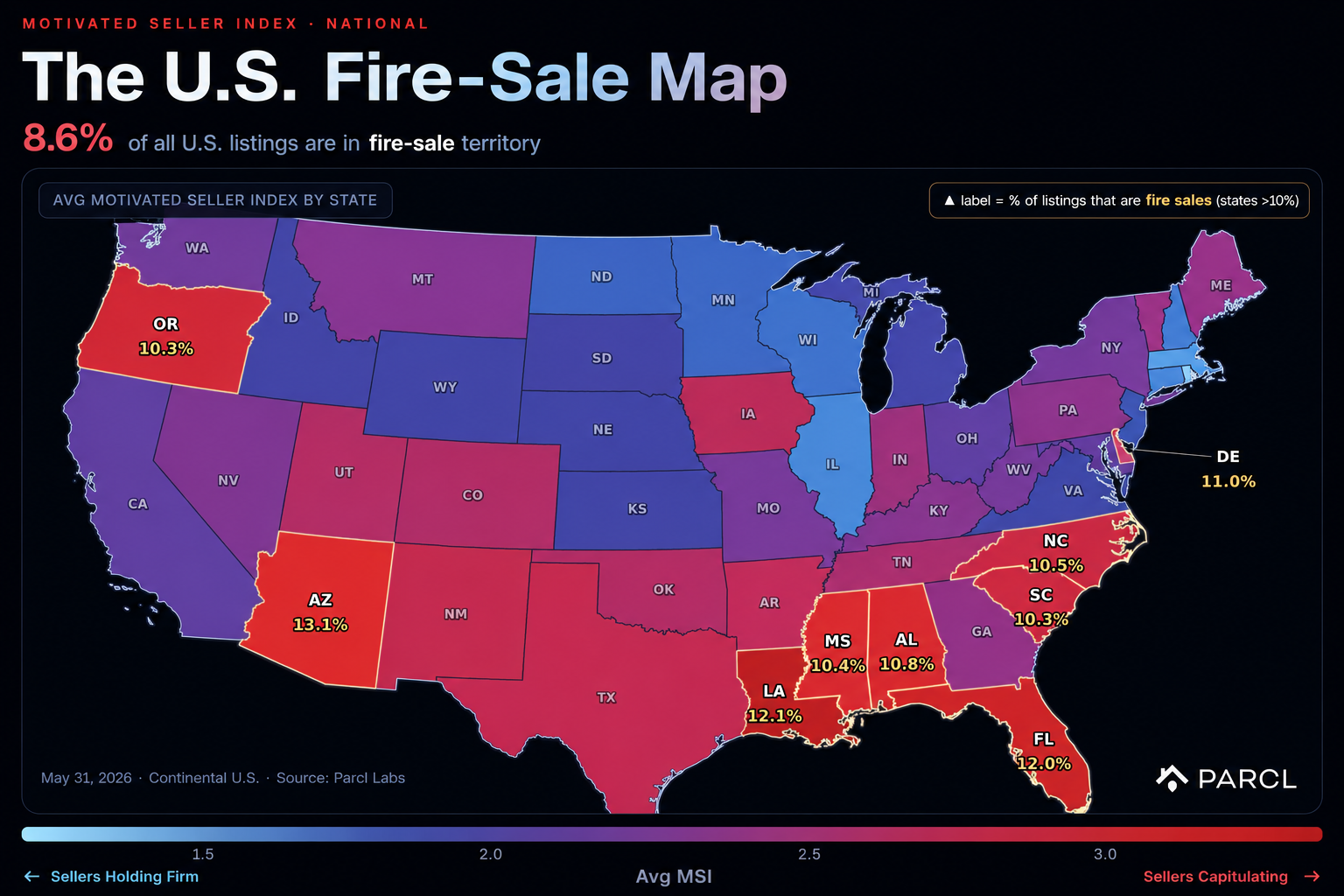
Housing markets remain under pressure in most coastal states. Florida’s 12.0% fire-sale share is materially above the U.S. 8.6% level, meaning insurance stabilization is helping but not enough to erase the affordability drag from an increasing list of fees and taxes awaiting new homeowners: insurance, flood exposure, and hurricane deductibles that then collectively influence taxes, HOA or condo fees, and mortgage rates.
| State | PARCL% | Hurricane Relevance |
|---|---|---|
| Florida | 12.0% | Highest combined insurance, wind, flood, storm-surge, and housing-cost stress among coasts |
| Louisiana | 12.1% | Gulf Coast hurricane and storm-surge exposure |
| Alabama | 10.8% | Gulf Coast exposure and meaningful wind/flood sensitivity despite shorter coastline |
| Mississippi | 10.4% | Increasing Gulf Coast storm-surge and wind exposure has elevated home-seller stress. |
| South Carolina | 10.3% | Atlantic hurricane exposure |
| North Carolina | 10.5% | Atlantic hurricane exposure |
PARCL’s Motivated Seller Index measures seller urgency using factors such as time on market, price-cut frequency, speed between price cuts, and size of reductions. So these maps do not directly measure insurance premiums, foreclosures, hurricane damage, or distressed debt. They measure how aggressively sellers are adjusting prices to get deals done.
Hurricane Season’s Relevancy Despite Forecasts
Cotality’s 2026 Hurricane Risk Report underscores the scale of coastal exposure. Nationally, it estimates more than 32.2 million homes across tracked states are at moderate or greater risk from hurricane wind, representing over $12.26 trillion in reconstruction cost value. It also estimates more than 6 million homes at risk from storm surge, representing about $2.1 trillion in reconstruction cost value.
Investing in Resilience Through Cat Bonds
As delivered in a TradersQue December 2025 analysis, by mobilizing global investor capital, catastrophe bonds and similar instruments provide insurers with an additional hedge, reducing the pressure to raise premiums or exit high-risk markets after major disasters or in disaster-stricken regions.
ILS Stock Price | Brookmont Catastrophic Bond ETF | Investing.com
But despite differences in structure, triggers, or terms, these instruments share a common purpose: they move extreme-event risk out of traditional insurance balance sheets, use objective triggers and funded collateral to reduce credit risk and speed payouts, spread rare but severe losses across a broader investor base, and strengthen insurance-market capacity as climate and catastrophe risks rise.
| Instrument | Description |
|---|---|
| Brookmont Catastrophic Bond ETF (NYSE: ILS) | U.S.-listed, actively managed ETF providing exchange-traded access to catastrophe bonds. It is positioned as the first catastrophe-bond ETF and offers daily ETF liquidity, though the underlying cat-bond market can be less liquid than traditional bonds. Designed for investors seeking high-yield, low-correlation exposure to insured natural-catastrophe risk. Investors can lose principal if covered catastrophe triggers occur. |
| Securis Catastrophe Bond Fund (UCITS) | European UCITS catastrophe-bond fund, now described by Securis as a sub-fund of Twelve Capital UCITS ICAV. The fund aims to generate returns and growth by investing in UCITS-compliant catastrophe bonds, using detailed market and risk analysis to balance expected return and catastrophe risk. Intended for eligible/professional investors depending on jurisdiction and share class. |
| Collateralized Reinsurance Notes / Collateralized Reinsurance | Private or semi-private reinsurance structures where investor capital is placed in collateral accounts to support potential claims. Economically similar to cat bonds in that they transfer catastrophe risk to third-party capital, but they are usually negotiated reinsurance contracts rather than publicly traded securities. They can reduce counterparty credit risk because obligations are funded upfront. |
| Industry Loss Warranty (ILW) Notes / Contracts | Reinsurance or derivative-style contracts that pay when total industry-wide insured losses from a defined event exceed a preset threshold, rather than solely when the buyer’s own losses exceed a threshold. Used by insurers, reinsurers, and ILS investors for macro catastrophe hedging, retrocession, and portfolio diversification. ILWs introduce basis risk because industry-loss estimates may not match the buyer’s actual loss experience. |
Home Valuations Despite the Clouds
The combined message from the insurance data, the PARCL maps, and hurricane-risk data is that coastal housing should be analyzed through a risk-adjusted carrying-cost model, not a simple comparable-sales model.
A traditional valuation model might focus on:
recent comps + square footage + location + mortgage rate
But a 2026 coastal-state model now includes far more caveats:
recent comps + mortgage rate + homeowners’ insurance + flood insurance + roof age + wind mitigation + hurricane deductible + storm-surge exposure + property-tax reset + HOA/condo fees + special-assessment risk + future insurability
This framework applies most strongly to Florida, but it also applies to Louisiana, the Carolinas, Alabama, Mississippi, and coastal Texas.
Final Thoughts
Florida’s fire-sale pressure is part of a broader coastal and Sun Belt seller-motivation cycle, but its 12.0% fire-sale reading matters because it combines the national affordability correction with the country’s largest hurricane-insurance exposure. The commonalities are buyer demand for discounts where insurance, storm surge, wind risk, flood exposure, and future carrying costs remain difficult to underwrite.
Investors are not to avoid coastal states outright, but to separate temporary seller motivation from fundamental risk.
 Additional Coverage
Additional coverage can be found on the author’s X page.